
Home Blog Page 155

Company hired to assist with STR bylaw

0

County council has found a contractor to oversee the short-term rental bylaw that looks to be near finalization at the upper-tier, before going to Algonquin Highlands, Dysart et al, Highlands East and Minden Hills for expected adoption.

While the company was not named at a Jan. 24 meeting, it is believed to be Granicus, the same company that handles the file for Niagara-on-the-Lake, Georgian Bay Township, Kawartha Lakes and Lake of Bays.

They were the sole bidder after council put out an RFP Nov. 9, and were chosen by a committee Dec. 19.

Director of planning, Steve Stone, said the company will register all active STRs and drive bylaw compliance. They would also collect the municipal accommodation tax, if adopted by councils.

Stone said they “can provide a full suite of surveillance software modules, including address identification, license compliance monitoring, permitting and registration, 24-hour hotline service and STR activity monitoring.”

When all the townships have signed off on the hire, Stone said they will let Granicus know they are the selected bidder.

The contract would be for three years, with the townships splitting the cost; Dysart just over $130,000, with Highlands East, Algonquin Highlands and Minden Hills just over $60,000 a year. It’s estimated Dysart has 515 STRs, with HE at 253, AH at 287 and MH at 297.

Stone noted implementation will take 22-24 weeks, which puts council’s wish of a spring start in jeopardy. They hope it can be ready to go for the May 24 weekend.

Warden Liz Danielsen said she was disappointed in the timeline “as I’m sure a number of those who have been concerned about short-term rentals are in the time that it takes to get this going live.” She asked if there was any way to move it along in time for the May 24 weekend.

Acknowledging it is about six months of lead time, director of economic development, Scott Ovell, said one benefit is it gives the townships time to communicate what they are doing.

CAO Gary Dyke said he is meeting with the other CAOs and relevant staff Feb. 12, and will provide a verbal report Feb. 14. Dyke said, “I think whatever we can do to accelerate the program, we will do that.”

Dyke added, “in fairness to the people that are being impacted by these bylaws, once the documentation has been passed and adopted by the municipalities, it’s also inherent upon us to develop an implementation program.”

He said there would be education on the application and inspection processes, for example. “Everything related to it would be part of a document or communication piece that would go to the users. So, it’s not like we’re going to pass it and cross our fingers, but work with the lower-tiers, work with the users of the bylaw…

Elizabeth Oakley, who spoke to Highlands East council in opposition to the passing of the bylaw, said they have a petition that is nearing 700 signatures.

She said they are “requesting a pause to the County’s STR legislation. Things are in flux with some councillors beginning to see how discriminatory, unfair and costly it will be for STR hosts. There have been numerous emails and phone calls made to members of all the municipalities as well as County Council,” she said.

Oakley added, “this issue will have a negative impact on tourism in our region, which goes against what the elected officials say they’re trying to attract.”

However, as recently as the Jan, 10 meeting, all councillors expressed interest in going forward.

Floodplain mapping presented to public

0

Fraser Rogers looks at a large computer monitor, giving a bird’s eye view of his Anson Street property in Minden. It is overlaid with lines that indicate what he already knew.

He is in a Gull River floodplain. However, thanks to a County-led floodplain mapping project, he can see that the floodplain is actually a little more extensive than when mapping was last done in the 1980s. It gives him more ammunition as he continues to ready his property for future potential flooding, after enduring a number of them in the past.

“First of all, it will rule out that we’re not going to do… which we had no plans to do… any more additions on our existing home,” he said at a Jan. 29 public information centre at the Minden Hills Community Centre.

Rogers said Minden is known for flooding. He says when he was born in 1951, he was brought to the family home, as a newborn, in a canoe. The waters rose again, in 2013, when he was working on an addition. However, he said the sump pumps and sandbags did their job. They have also purchased a generator. They also do not have a full basement, just a crawl space. He said as long as Mother Nature and Parks Canada do not send a gush down the river, he is as prepared as he can be for flooding.

Nonetheless, “it’s nice to see that this is fairly updated. They said they were 2018 aerial photos,” Fraser said.

Mayor Bob Carter, looking at the downtown Minden maps, said “as you can see, there’s huge differences compared to what exists today… it goes both ways. There’s some land that was flood land that really isn’t, but I think there’s more that’s going the other way.

“That means there’s a lot of potential building sites that are really now not available. People who had ideas, ‘why don’t we develop there?’ this is unfortunately going to be the answer.”

He said the overall project is good and was needed to help in updating plans at the County and in his township.

Cory Harris of Ganaraska Conservation Authority, which spearheaded the work that began prior to COVID, said there was a lot of interest in Monday’s open house. He said they were able to explain the context for the study, that it was not just for Minden but “it’s producing mapping for the first time for a pretty large area of Ontario.

Harris said flooding is going to occur whether or not it’s mapped but it’s better to have an understanding of what areas are going to flood, and to what extent.

“When these models are completed you can look at depths, you can look at velocities, you can assess risk levels and you’ve just got a lot of good information to make decisions about whether you buy certain property, or don’t, of if you have a legacy development in a floodplain you can also make informed decisions about how to manage risk in the current situation.”

HSAD housing now in limbo

0

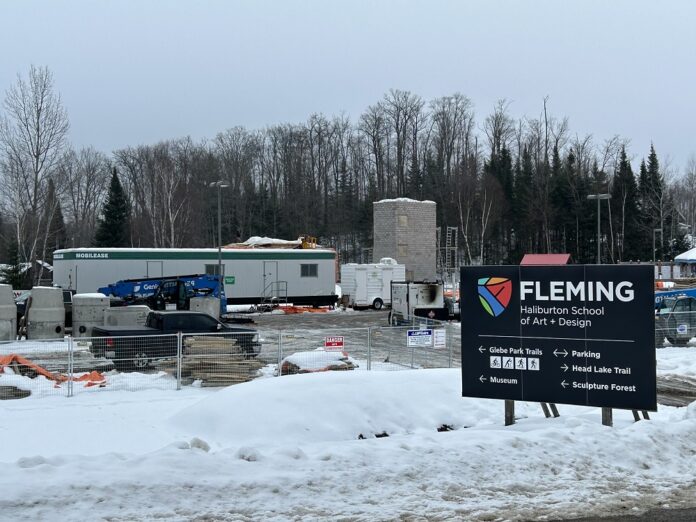
A planned 47-unit student residence for the Haliburton School of Art + Design (HSAD) could be in jeopardy, Fleming College president Maureen Adamson confirmed this week.

Post-secondary institutions nationwide have been left reeling after immigration minister Marc Miller announced Jan. 22 the federal government will cap the number of international student permits it issues over the next two years.

Miller said his department will approve approximately 360,000 new undergraduate permits in 2024 – a 35 per cent reduction from last year. He noted each province and territory will be allotted a set number of permits, with some provinces to see drops as high as 50 per cent. The number of permits issued in 2025 will be assessed at the end of this year.

Adamson said it would be a big hit for Fleming, with the institution having around 3,500 international students in classes for the 2023/24 school year. That accounts for half of the student body, Adamson said. She did not disclose the split of domestic to international students in Haliburton. The school also has campuses in Lindsay, Peterborough and Cobourg.

“This announcement has an immense and adverse human and economic impact for Fleming College… [it] poses a threat not only to the educational experiences of all students, but also to the vitality of our regional economy,”

Adamson said. “The economic impact… will be a staggering loss to our communities, including Haliburton.” Adamson would not confirm whether the $16 million residence would proceed. As of Jan. 31, there were still workers on-site.

She said Fleming is developing a mitigation strategy that will look at all the college’s operations and commitments, before deciding “the best steps [we] can take to build a viable and robust future.” The process will wrap up next month.

Federal cap on foreign students

“This new reality includes the elimination of Fleming’s existing key revenue streams that enable us to invest in developments like this residence,” she said. “It’s too early to say more – no final decisions have been made.”

Why the need for a cap?

Miller said changes target institutional “bad actors” such as small private colleges, which he claims have taken advantage of international students by operating under-resourced campuses and reneging on supports promised to students paying exorbitant tuitions – often three or four times that of a domestic student.

The minister also believes a reduction in foreign students may have a positive impact on Canada’s housing crisis.

Haliburton-Kawartha Lakes-Brock MP Jamie Schmale believes something needed to be done to “fix our broken immigration system.” He said it’s no secret Canadian colleges and universities have used international students to address budgetary shortfalls, particularly over the past few years.

Immigration, Refugees and Citizenship Canada data shows 621,565 study permits were issued in 2021, ballooning to more than 800,000 in 2022. Numbers for 2023 have not yet been disclosed.

The Ontario government has been criticized for its lack of investment in post-secondary education in recent years. Adamson said provincial funding for domestic enrollment was first frozen in 2017, then slashed by 10 per cent in 2019 with no increase since. Quoting a report published by Ontario’s blue-ribbon panel, Adamson said Ontario provides $6,891 for each domestic student, while the Canadian average is $15,615.

MPP Laurie Scott didn’t address those concerns when questioned by The Highlander. She said the province is implementing measures to address challenges.

“These include enhancing oversight to ensure program quality, aligning education with labour market needs, and mandating housing guarantees for international students,” Scott said. “We’ll also pause new public college-private partnerships, strengthen oversight of existing partnerships, and improve regulation of career colleges to ensure educational standards are maintained.”

Mishal Venu is an international student in the visual and creative arts diploma program (VCAD) at HSAD. He arrived in Canada from Bahrain in September 2023.

Asked how he would have responded had these new limits come down before he moved, Venu said, “it would be a pretty disheartening situation. I feel for any student impacted by this. You set your heart on going away to study, to maybe build a better life. Some people are looking to escape from countries where you’re not acknowledged, where you don’t get good pay. A lot of those people will be stuck now, not able to come here.”

Dysart mayor Murray Fearrey is remaining hopeful Fleming will build the residence. The township donated almost four acres for the build and invested six figures into developing a new clubhouse for the Haliburton Highlands Nordic Trails Association, whose previous facility sat on land Fleming wanted to build on.

However, Fearrey said there was no contract or signed agreement that stipulated Fleming had to follow through.

“I am worried in case this doesn’t happen. The township has been very cooperative with the college. I’d be really disappointed for the community if it doesn’t go ahead,” Fearrey said.

Storm dominate Huntsville

0

On Jan. 20, the U13 Cheryl Smith RE/MAX team played Huntsville North Country on home ice.

The Storm had a very strong first period, scoring five goals. Connor Isles scored the opening goal, assisted by Bently Bull. Nash Wilson followed with an unassisted goal. Oakley Craftchick then assisted a goal by Bull. Kelson Bagshaw added to the board, assisted again by Bull and Hunter Hamilton finished the period with a goal, assisted by Mackay Windover.

The second period started strong again for the Storm with Bull opening the scoring, assisted by Craftchick, followed shortly after by an unassisted goal by Bagshaw. Wilson added two more, with assists by Moss Davis and Bagshaw.

Huntsville never gave up and scored two quick ones on Carter Shaw. The Storm’s Travis Greer and Windover ended the second with two more goals.

The Storm again dominated the third period, scoring five more goals with contributions from Wilson, Windover, Bagshaw and Hamilton.

The final score was 16-2 for the hometown Storm.

Huskies cling to fourth place in East

0

The Haliburton County Huskies got back on track with a come-from-behind 4-2 road win over rival Cobourg Cougars Jan. 22 as the Ontario Junior Hockey League regular season enters the final stretch.

The hometown club is sitting comfortably in a playoff spot in the league’s East Conference with just 13 games to play, boasting 51 points and a 24-16-0-3 record.

Monday’s tilt in Cobourg was a big one, with the Huskies having the chance to leapfrog the Cougars in the standings.

It was a notorious slow start for the blue and white, who were pinned into their own zone for long stretches as Cobourg controlled the game. Trevor Hoskin gave the home side a deserved lead at 12:46 of the opening frame, scoring his 29th goal of the season on the powerplay, assisted by Kaiden Harmon and Andy Reist.

The Huskies were outshot 13-7 in the first period.

Head coach Ryan Ramsay got into his team during the break, and they were better for it to start the second. Centreman Charlie Fink potted his 12th of the season at 3:48, scoring on a five-on-three powerplay opportunity after Chris Brydges and Hoskin were both caught for high sticking within 15 seconds of one another around the two-minute mark.

The visitors grew in confidence, taking control of the game. They couldn’t find a way past the impressive Ryan Piros in the home goal, who made 15 saves in the middle frame. Michael De Sousa landed a sucker punch for Cobourg at 18:06, assisted by Hoskin and Jack Lowry.

The third period was one-way traffic as the Huskies took over. Lucas Stevenson tied the game 48 seconds in, assisted by Matt Milic. Ian Phillips got the go-ahead goal at 11:35, assisted by Stevenson, and Ty Petrou added a late empty netter at 19:17 to send the visitors home with two points.

A meager showing on home ice Jan. 20 resulted in the Huskies dropping a 4-1 decision to the West Conference’s Burlington Cougars.

The Huskies were flat for much of the opening period – outshot by the visitors 12-6. They went in behind at the break after Cougars captain, Jacob Bramwell, lit the lamp at 11:47, assisted by Justin Legault and Tommy Karmiris.

Owen Davies doubled Burlington’s lead 21 seconds into the second, beating Huskies netminder Brett Fullerton with a speculative shot from the boards, assisted by Eric Bertelsen and Alexander Stephen.

Lucas Digiantommaso made it a three-goal game at 2:16, taking full advantage after Fink broke his stick attempting to clear the puck – assisted by Mitchell Brooks and Gabe Runco.

Stevenson gave the home crowd something to cheer about at 14:50, scoring during fouron-four action. He had his captain to thank – Saini was relentless as he carried the puck along the boards on a breakaway before sending a pass to Stevenson, who made no mistake with the finish.

The Huskies created a few openings late in the period, but Phillips was caught trying to make a play on the blueline, sending the Cougars on a two-man breakaway, which Brooks dispatched at 19:05, assisted by Legault and Nikola Murgic.

The home side dominated the final frame, firing 16 shots to Burlington’s six, but couldn’t find a way past Kyle Metson, who finished the game with 32 saves.

Trenton 6-2 Huskies

The Huskies went face-to-face with the league-leading Trenton Golden Hawks Jan. 19, getting blown out in a 6-2 loss.

Blueliner Milic gave the Huskies a deserved lead 8:53 into the first, assisted by Noah Lodoen and Adam Smeeton. The visitors outshot their heavily favoured hosts 14-12 in the opening frame.

The Golden Hawks came to life in the second, firing four goals without reply.

Lucas Marshall gave the Huskies hope in the third, scoring his sixth goal of the season on the man advantage at 2:37, but that was as good as it got for the blue and white.

A busy period for the Huskies sees the team host the St. Michael’s Buzzers at S.G. Nesbitt Memorial Arena Jan. 27 (4 p.m. puck drop), before a road game against the Wellington Dukes Jan. 28. They’ll end the month on the road in Georgetown Jan. 31.

Hodgson signs try-out contract with Preds

0

The Milwaukee Admirals – the Nashville Predators’ AHL team – announced Jan. 17 they’d signed Haliburton’s Cody Hodgson to a professional try-out contract.

Hodgson is returning to the ice for the first time since the 2015-16 season, when he split time between the Admirals and Predators. Following that season, he retired after being diagnosed with malignant hyperthermia.

Sportsnet’s Elliotte Friedman reported during a Leafs telecast Jan. 13 that Hodgson, 33, was eyeing a comeback, since he had been given a clean bill of health and was back skating multiple times a week.

“He understands he’s not starting in the NHL, he knows nothing is guaranteed, but he’d like to resume his career and he’s looking for an opportunity,” Friedman said.

Hodgson has declined comment for now.

A first round pick of the Vancouver Canucks in 2010, Hodgson played in six NHL seasons, scoring 64 goals and adding 78 assists for 142 points in 324 contests between the Canucks, Buffalo Sabres, and the Predators.

Hodgson also earned a gold medal with Team Canada at the 2009 running of the World Junior Hockey Championship, scoring an incredible five goals and 16 points in just six games.

Nicholls wants to make mark at U18 nationals

0
Photo (c) 2024 Mike Martin www.MikeMartinPhotography.ca Photo (c) 2024 Mike Martin www.MikeMartinPhotography.ca

Haliburton’s Owen Nicholls will test himself against some of the best up-and-coming curling talent in Canada next month when he takes to the ice for the U18 national curling championships.

Taking place in Ottawa Feb. 5 to 10, the competition will feature 21 of the nation’s top performing teams – with representatives from all provinces and territories, apart from Nunavut.

It will be a second successive appearance at the competition for Nicholls. Last year, he was a member of the Ontario champion, Team Stratton, while this year he will fly the flag as skip on Team Nicholls.

“At the end of last season, Team Stratton all went our separate ways. I started a U20 team with a former teammate, but I knew in the back of my mind I still had another year of U18 eligibility,” Nicholls said.

Having relocated to Ottawa in the fall, Nicholls said he didn’t know many locals from the Rideau Curling Club, where he is now a member, interested in competing. He had almost given up hope of putting a team together when he remembered a young curler, Kole O’Connor, who had reached out to him last year asking how to break into the competitive circuit.

“Turns out he had another year of eligibility, so he became my lead. We connected mid-November and the qualifiers for provincials was in early December. So, it was a week of scrambling trying to find players,” Nicholls said.

They recruited the team’s third, Drew Zettler, after Nicholls connected with a friend from Nova Scotia he met at last year’s tournament who knew someone looking for a team in Ontario, while their second, Tye McCutcheon, is friends with O’Connor.

The team was able to practice together once before going 3-0 at the provincial qualifier in Ottawa Dec. 1 to 3. That qualified them for the Ontario championships, which were also in Ottawa Jan. 10 to 14.

Team Nicholls went 5-2 in round robin play and beat Team MacDougall 6-4 in the semi-finals. They lost the final 6-3 to Team MacTavish from Waterloo, though claimed silver, and a spot at nationals, by again defeating Team MacDougall in the ‘B Final’, this time 10-5.

“It’s a huge accomplishment, especially given our team’s circumstances and how late we came together. It’s really special for me, because I’m skipping the team this time,” Nicholls said. “Getting back to nationals again so soon is amazing. It’s very special for me to get back. If we put a few games together, we all make some shots, I think we have a decent chance of at least making the playoffs.”

Mountain bike racer juggles work and play

0

Haliburton County mountain bike racer Nick Emsley had a big 2023 – winning the Canadian Rockies 24 Hour race and starting his own business; Fix it Nick.

Emsley finished second in the 2022 version of the gruelling Alberta race, saying “it was a close race, a tough one.”

So, he was determined to return this past summer to the world-renowned Canmore Nordic Centre.

“The race was exceptionally good… truthfully, I couldn’t have asked for a much better race,” he said of the win.

He was naturally pleased as, “with 24-hour races, you never really know. You can go in as prepared as you want but you never know. I mean it’s 24 hours. How do you prepare?”

For example, he said riders can train for six to eight hour stretches but never actually train for 24 hours straight.

“So, it’s hard to prepare yourself for that 24-hour period, but overall, physically, mentally, you’re all ready to go,” Emsley said.

In the 24-hour solo open men under 40 category, the local completed 21 laps in 23:14:14.2, beating out Magnus Stenlund, who did 20 laps.

“He was a great competitor, we were really neck and neck,” Emsley said of Stenlund. “He kept me really going and we were playing a little cat and mouse for awhile there. But I took the lead in the start and kept a consistent pace at the front. And he kept trying to catch me. Couldn’t have asked for a better 24-hour race. Everything worked out great. My mental picture, physical picture, everything was good.”

He said it is challenging trying to get nutrients right in a 24-hour race. He estimates he burns 700 calories an hour in the first eight hours of an endurance race. Then, muscles deteriorate, requiring less. Near hour 20, he might be burning 500 an hour. But he did burn about 15,000 in 24 hours, “which is a lot.”

He said while riding, he tries to consume about half of what he burns. The challenge is riders cannot take on a lot of solid foods as it takes energy to digest. So, there are a lot of smoothies and “foods that won’t make you sick. Which is hard,” Emsley said.

And while riding, there were only three spots he could actually eat food. “You have to consume around 400-500 calories in three bites. It’s hard to get the right foods. It’s a big challenge but this year everything worked out well.”

It was Emsley’s fourth 24-hour race win in his career.

After that, he did an eight-hour at Harwood Ski and Bike near Orillia. But as it was just a month after the 24 Hour, and he said his deep tissue muscle was not healed from Alberta, he finished fourth.

As for this year, Emsley said he had already registered for the Canadian Rockies 24. It’s July 27-28. He is undecided about Albion Hills since it is only a month prior to the Alberta race. He is planning some eight-hour events.

Fix it Nick

As a person who “likes to do his own thing,” with a “design fabrication mind” and being into construction and maintenance, Emsley started Fix it Nick in April 2023.

“I know there’s a little lacking in the handyman industry right now. All of the contractors, or most of them, have been doing bigger work.”

He said in his first year, he was not expecting anything big but knew it would be hard. “In the spring, I hit my max of 87 hours a week,” he said, which was why he did not train and race as much last year.

It went from not expecting much to a lot of phone calls, Emsley said. It expanded faster than he thought it would. He said he’s tripled what he originally envisaged in one year. “I’m expanding even more this year. So, it’s really good.”

At just 24 years of age, Emsley still wants to race and said he can do so once his business is firmly established.

“It’s been something I’ve been doing for 13 years, having put all of this effort in.”

Highland Storm strike Silver-Stick

0

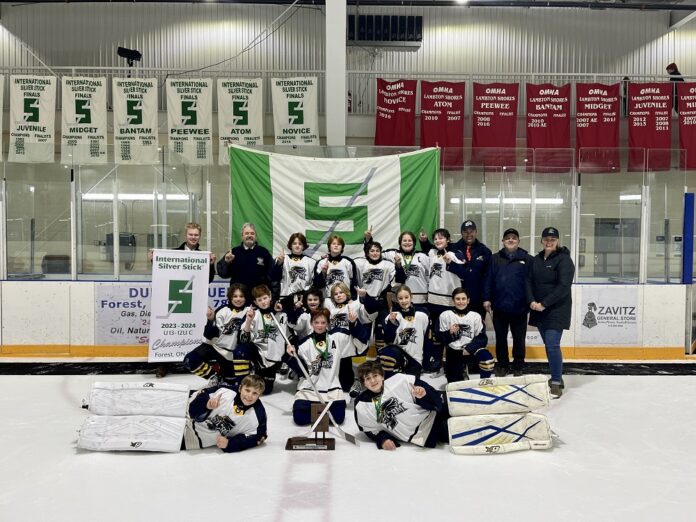
The Highland Storm U13 Rep team have returned victorious from the Jan. 21 International Silver Stick Championships in Forest, Ontario.

Team manager Cynthia Hutchinson said the team went 4-0 in the preliminary round against four other regional champions, from Columbus, Ohio, Dresden, West Niagara and Frontenac.

In the finals, the Storm were up against the scrappy Ice Dogs from Arran-Elderslie.

Hutchinson said the Storm made use of their speed and passing to create space and generate goals from Travis Rowe (2), Chase Kerr and Henry Neilson to secure a 4-0 win behind the shutout goaltending of Blake Hutchinson.

Strong defensive support from Levi Rowe, Hudson Meyer and Tyler Hughes kept Frontenac at bay. At the same time, forwards Lyla Degeer, Cruize Neave, Hawksley Dobbins, Linus Gervais, Jaxon Hurd, and Brycen Harrison were all over the ice with incredible forechecking and back-checking, generating chances. Marshall Heasman was again at the ready if needed in goal as the Storm brought home the title, Hutchinson said.

For head coach Scott Neilson, this finishes what he started last year after a narrow loss in the semi-finals. Supported by assistant coaches James Reilly, Shawn Walker, trainer Marcus Rowe, and team manager, Hutchinson, the U13 team was well prepared, organized and motivated.

“For the kids, the banners hanging in Minden and Haliburton will represent memories that will last a lifetime,” Hutchinson said.

‘Ray days’ priceless for canoe builders

0

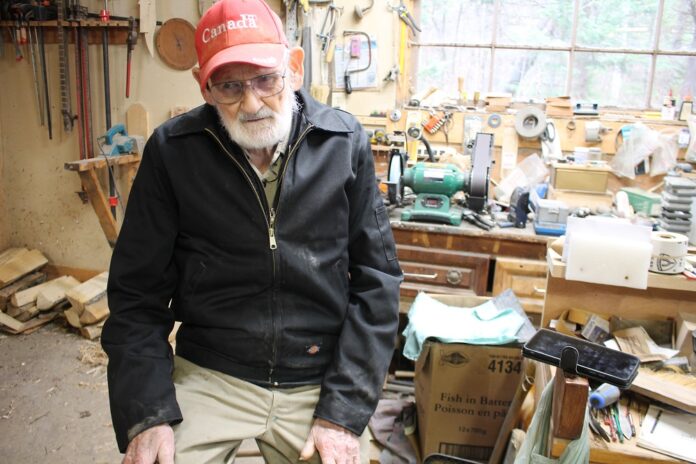
Kim Switzer and partner, Brad Archer, are enjoying what they are calling ‘Ray days’ – working with legendary canoe and paddle builder, Ray Kettlewell.

For the past year, the partners have been travelling to Kettlewell’s shop near Kinmount to learn how to build cedar canoes.

In a large shed, heated by a wood stove, and filled with tools, Switzer and Archer lean over a canoe-in-the making, steaming cedar ribs to curve them around a form, and then tacking them down with specialized nails.

Kettlewell looks on, occasionally offering a word of advice, but mostly letting the couple do the work themselves.

Kettlewell knows a thing or two about the trade. He’s been involved with canoeing and wood most of his life.

Prior to 1970, he worked in the hardwood lumber industry; logging and managing a sawmill and dry kiln in southwestern Ontario.

Much of his spare time was spent paddling, though, on his own and guiding groups of adults and children on canoe trips. Kettlewell earned a canoe instructor’s certificate in 1973 and 15 years of marathon canoe racing earned him a canoe full of trophies.

He began making paddles in 1970 to supply himself with the kind of paddles he wanted. He had access to the best hardwood and years of knowledge of wood. Since 1977, making paddles had been Kettlewell’s full-time occupation until retirement. After having purchased a 130-year-old Chestnut form canoe from New Brunswick, his focus shifted to canoe building and he points to the 20th canoe he’s built up on a rack. He reckons it takes 200 hours to build one by hand.

At 89, going on 90, it’s time to pass on his knowledge. So, when Switzer came calling last fall, and the two shared a connection over all things canoeing, it made sense for Kettlewell to take her under his wing.

Switzer tells the story of how she learned about, and wanted to buy, a famous Ray Kettlewell paddle but she couldn’t lay her hands on one. When she learned the inventor lived just down the road, she called and was invited to come to the shop.

Deep passion

“We talked for over two hours, about the passions that light us up, like the feeling of being one with your canoe. Only a select few share that real deep passion for paddling and being in a wooden canoe. And then I saw he was building these boats. I came looking for a paddle but then it was like, wait a minute, what’s this? I said I want to learn how to build these. I want to be involved in this. I want to know how to do this. And the next thing I knew, I’m down here building and this has been an amazing journey, so many skills, so many lessons to be learned. And I really hope to carry this on.”

Kettlewell is equally pleased since, “there’s nobody really passing this on that I know of. I know some other builders, but they’re not passing it on because probably they can’t find anybody to do it. It’s a dying industry because everybody thinks fibreglass does the job. With cedar, hand-built canoes, you’ve got to have many, many skills.”

Looking at Switzer and Archer planking the canoe, Kettlewell adds, “they’re interested. I don’t know whether they’re interested enough to make a career out of it, but at least there’s knowledge being spread.”

Switzer has a yellow canoe that she saved from the landfill, however, she said the canoe has in many ways saved her life, helping her to heal from a myriad of losses.

“So, this is also going to help me keep my yellow boat alive, which is a big part of who I am. Learning how to build boats and hopefully passing on these skills and knowledge to others. I want to keep doing this. I want to build a boat with my son, Memphis, because he’s got that passion. And he’s been able to come down here. Ray has welcomed him into the shop and he’s been weaving seats and tacking planks, too. If we don’t have people that want to teach and pass on these skills, it’s going to die.”

Switzer adds no one has ever wanted to teach her woodworking, but Kettlewell has been “amazing” and pushed her beyond her comfort zone. For example, using power tools and doing things she’s never done before. It’s given her confidence.

“I’m just in awe of this whole experience. It’s lit me up in so many ways.”

Archer had a shop and carpentry skills so the two make a good team. He says it has been an interesting experience, sharing how his family owned the Matabanick Cottage Resort on Boshkung Lake, with its large boathouse. “My grandfather used to build boats, and did a lot of work on canoes. I don’t know if they actually made any canoes or not, but I know they made cedar-strip row boats and dippy boats.”

Switzer can’t wait to get the canoe in the water, even if there is some ice. She finds solo paddling slow, calming and steady. It brings her peace and joy.

Switzer adds her ‘Ray days’ may be unpaid, but they are priceless.

“This isn’t something that we would put a value on. And I think that was one of the questions that Ray asked me. What would you value this at… the information, the knowledge, the skills, the craftsmanship, the time, the energy? All of that is priceless.”