
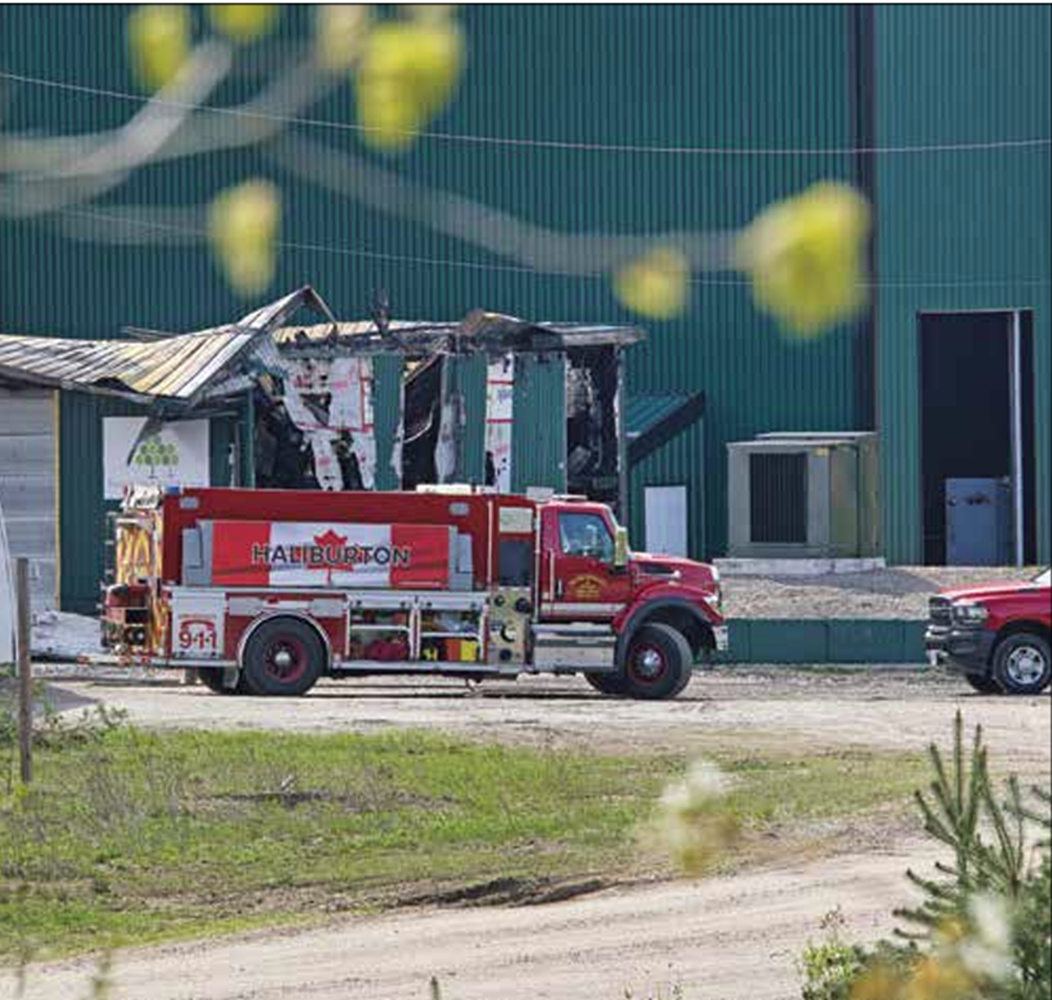
Haliburton Forest Biochar management is still assessing damages after an early morning fire at its Kennaway Road facility May 22 took out one of the business’ production buildings.
Malcolm Cockwell, managing director of Haliburton Forest and Wild Life Reserve – the parent company of Biochar, told The Highlander the blaze broke out around 1:30 a.m. No injuries were reported.
“Efforts to secure the site and investigate the incident are ongoing. The extent to which the incident will disrupt Haliburton Forest Biochar’s operations is yet to be determined,” Cockwell said.
Introduced in 2016, the division uses leftover wood chips, shavings and powder from the Forest’s sawmill operations to produce biochar – a highly-porous charcoallike substance primarily used to improve soil health and capture carbon. Acting like a sponge, biochar helps soils retain water and store nutrients.
It’s also used in manufacturing, replacing fossil fuel products like carbon black and coal coke during the production of bioplastics, green metals and other materials.
Stacey Parish, deputy fire chief with the Dysart department, said the fire call came into the station at 1:35 a.m., with first responders arriving at 1:55 a.m. She said 22 firefighters from three departments – Dysart, Algonquin Highlands and Highlands East – tackled the blaze, with officials on-scene for 11 hours.
While the fire was reported to the Ontario Fire Marshal, Parish said there’s no concern for public safety.
“Nothing to be concerned about as it is a natural product,” Parish said.
Jim Demetriou from the fire marshal’s office said an investigation is underway.
“At this time, the incident remains under active investigation and there is no information available to share. The Office of the Fire Marshal is unable to provide further comment while the investigation is ongoing,” Demetriou said.
Cockwell confirmed clean-up is underway. The fire is the first major incident at the site since Haliburton Forest invested $10 million to expand the division in 2022. The Ontario government pitched in an additional $4.6 million last year to support a transition into engineered biochar, opening the door for more growth in advanced manufacturing.