
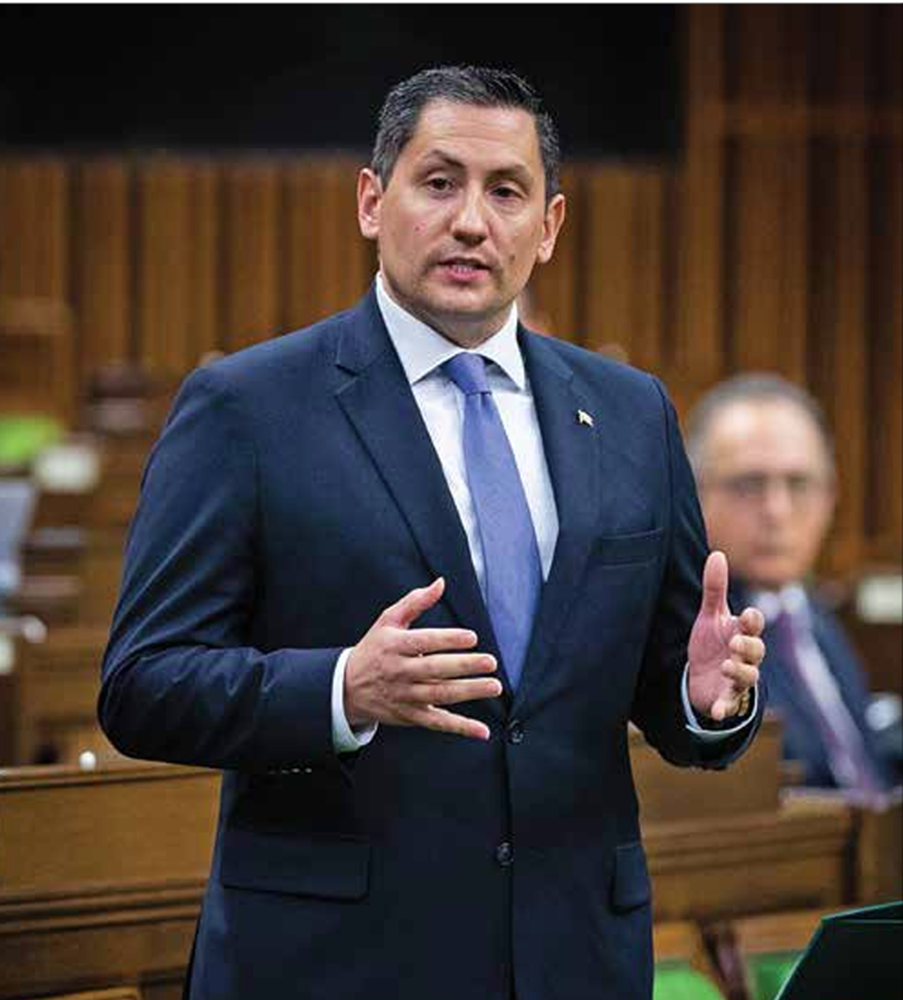
A Haliburton reverend said he wasn’t surprised by recent changes introduced by the Canadian Armed Forces (CAF) to limit religious references at some official military ceremonies, while the area’s MP, Jamie Schmale, believes the move is an unnecessary break from tradition.
Rolled out July 31, the new rules strip active CAF members, volunteers, students, casual workers and contractors from using religious-specific language – including references to God – at sanctioned military events such as graduation parades, change of command ceremonies, ship commissioning, dedications for infrastructure projects, honours and awards ceremonies, seasonal mess dinners and CAF-led Remembrance Day services.
Instead, those references are to be replaced by “spiritual reflections” that focus on lessons learned, beliefs, values and experiences to inspire gratitude, remembrance, hope and integrity, a directive on the Government of Canada website reads.
Schmale said the changes were being driven by the Liberal government and had been in the works since October 2023, after a directive was issued to military chaplains to “carefully choose words that are inclusive” when speaking to people, including atheists, at public events
“I don’t think you need to erase tradition. Military prayers and religious observances have provided comfort and meaning to generations of Canadians that have served,” Schmale said. “When I speak to veterans today, many say there are no atheists in a foxhole.”
The Haliburton-Kawartha Lakes member of parliament said he wasn’t a fan of handcuffing chaplains.
“When you have a chaplain of whatever denomination doing a service, defining appropriate language, to me, doesn’t mean inclusion. It means exclusion,” Schmale said. “I just don’t think this honours the traditions of those who came before.”
While the rules won’t impact local-level Remembrance Day observances, Schmale said it could be a noticeable change for those who tune into the nationally-broadcast services from Ottawa.
CAF acting chaplain general, Shaun Yaskiw, told the National Post last month that the goal of the new guidance is to ensure everyone attending military-led events feel their beliefs are being valued.
“As a chaplain, it is my professional responsibility to be able to see and respect the full expression of spiritual and religious beliefs of those who come to me,” Yaskiw said.
The change does not restrict chaplains from offering spiritual or religious care in private settings, including counselling, faithspecific gatherings, worship services and requested religious rites.
There’s also an allowance for Indigenous practices to be used in military settings for cultural, historical and educational purposes – though they must be relevant to the occasion or framed explicitly within an educational or cultural context.
Mixed opinion
Harry Morgan, minister for the Haliburton Pastoral Charge, said he hadn’t heard about the changes before The Highlander contacted him in mid-August. While he said he “gets it,” believing the government wants to be seen as neutral and secular without showing preference to any particular belief, he’s not sure what the amendment accomplishes.
“I don’t believe this benefits anyone. Instead of including the rich history of faith traditions in our beloved Canada, our ceremonies will feature bland, generic ‘spiritual reflections’,” Morgan said.
“A better and more inclusive solution would be to use expressions or prayers of different faith traditions in proportion to their numbers in the military – or in the nation,” he added.
After witnessing firsthand, the everdecreasing influence of religion on society, Morgan felt a move like this was inevitable.
“No longer is the Lord’s Prayer said in public schools. Some have advocated for the use of ‘Happy Holidays’ in place of ‘Merry Christmas’, and in our national anthem the words have been changed from ‘all Thy Son’s command’ to ‘in all of us command’. I’m surprised we still have ‘God keep our land’,” Morgan added.
Glenn Woods, the Royal Canadian Legion’s veterans’ service officer for the zone, said the change doesn’t impact him personally but that he has heard concerns from local members.
“I’ve talked to a few veterans about this – one of them went through boot camp and into battle, their sense is they would like things kept as they are. They want to stick with tradition,” Woods said.
A member of Princess Patricia’s Canadian Light Infantry seeing active service, Woods said there used to be a mandatory church services held in fields that all members had to attend.
“They’d make a big deal of it with the drums and then someone would deliver the sermon,” Woods said. “Things change though, religion doesn’t have as much of a grip on life today as it did 50-100 years ago, and I don’t think that’s a bad thing.”
Schmale is calling on the government to reconsider parts of the directive.
“Consult with chaplains, veterans, faith communities and try to come up with an approach that protects both inclusion and religious freedom. I think that’s probably the best path forward,” Schmale said.