
Home Blog Page 90

Dysart mayor, locals fume at gas costs

0

Dysart et al mayor Murray Fearrey is taking aim at Haliburton County’s gasoline re-sellers, questioning why prices remain so high at Highlands pumps compared to other nearby areas.

Expressing his frustrations at a Sept. 24 Dysart council meeting, Fearrey said the rapid increase in fuel costs in recent years is making life difficult for County residents, a tough pill for the mayor to swallow given most locals need a car to get to and from work and to live their lives.

“It’s not really a municipal issue, it’s not in our mandate to focus on or be worried about, but I am worried. This affects our citizens in a huge way,” Fearrey said.

On his recent travels, Fearrey noted the price point for gasoline to be much cheaper in communities such as Lindsay, Peterborough, and Orillia than the County. Early last week, gas could be bought at the Haliburton Mobil for $1.56 per litre – it was a couple cents cheaper at gas bars in Minden, but as much as 20 cents cheaper at pumps in Kawartha Lakes.

Fearrey has reached out to owners of local stations to find out why the disparity is so significant. He said he’s yet to hear a reasonable explanation.

“When you start talking about a price difference of 60 or 70 cents per gallon, that’s an awful lot. I want to see if there’s a way to improve on that. See what the rationale is for hiking up the price here,” Fearrey said.

Costs more to haul gas to rural areas

Expert answers

Prices have fallen over the past seven days, with gas available in Haliburton for $1.48 per litre on Oct. 1, $1.46 in Minden, and $1.50 in Wilberforce. To Patrick De Haan, head of petroleum analysis with the website GasBuddy, that’s a typical fluctuation in today’s market.

“Because we have a global market, the price of oil is constantly changing at a moment’s notice,” De Haan said.

He said the industry took a massive hit during the pandemic, with global demand slowing to a snail’s pace through much of 2020 and early 2021. This brought prices way down, to less than 80 cents per litre across much of Ontario.

Petroleum producers lost billions in a matter of months, De Haan said.

“When the price was so low, producers threw in the towel. They stopped producing until the market improved,” he noted.

That turn came in 2022, with prices eclipsing the $2 per litre mark in most areas by that summer. The quick rise was blamed on Russia’s invasion of Ukraine, with De Haan saying the market is quick to react to major world events.

“We went from one side of the extreme where there was no demand at all for gas, which drove prices down and caused supply to drop. When the economy reopened, demand increased very quickly and was exacerbated by one of the world’s largest oil producers invading another country – the risk of disruption of action to oil markets was increased… so prices went up,” De Haan said.

Cost breakdown

The Canadian Fuels Association (CFA) said there are four key components to pricing gas in Canada – the cost of crude oil, wholesale prices, retail mark-up, and taxes.

A 2023 CFA report found the average price at pumps in Toronto that year was $1.54 – of that, 64 cents went to crude costs (42 per cent), 50.3 cents to taxes (31 per cent), 31.6 cents to refiners’ operating margins (21 per cent), and 8.9 cents (six per cent) to the selling business.

De Haan said most retail stations have profit margins between five and 15 cents per litre. He feels the County’s rates are fair.

“Ultimately, it sounds like there might be a real aggressive competitor down the road [in Lindsay and Orillia] that is keeping prices down. Some stations are willing to take less of a profit margin if it’s new… the reality too is it costs more hauling gasoline to rural areas, so that might be why you’re seeing a bigger difference,” De Haan said.

Dysart Ward 4 coun. Carm Sawyer, who runs West Guilford Auto Centre, said when he was in the gasoline business several years ago, he was charged 10 cents per litre more for wholesale fuel than stations in Minden were charging customers.

The Highlander reached out to several stations to explain their methods for pricing gas but could not secure an interview. Thea Bourne, spokesperson for BG Fuels, which owns Haliburton Mobil, said in an email, “it is BG Fuels’ standard policy to not comment publicly regarding the management of its retail fuel prices.”

Local reaction

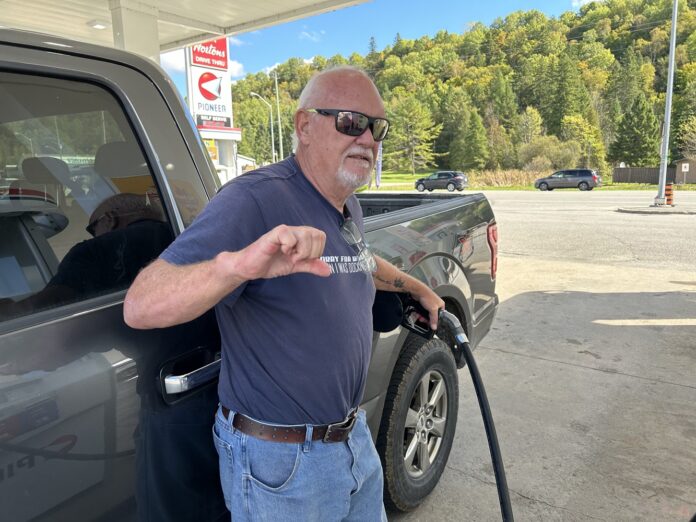
Alan Cook was filling his truck in Minden Sept. 27.

“It’s a bargain compared to what it was about two months ago, but it’s still outrageous. We seem to get robbed quite nicely up here – I have a cottage in Penetanguishene and gas is always cheaper in Orillia,” Cook said, estimating price increases since 2020 have added an extra $100 to his commute from Minden.

Ashley Willoughby said she and her husband work outside the County and are now paying hundreds of dollars a month more for fuel than they were before the pandemic. The Minden resident said she often feels trapped at home as there isn’t much money left over for big outings.

Living on a fixed income, retired Haliburton resident Scott Spong said he’s been forced into adjusting his driving habits.

“Everything is planned out now. No more driving back and forth to get a loaf of bread – instead of 10 little trips I have to make sure I know what I need and where I’m going, because it’ll be a few days before I’m in town again,” Spong said.

De Haan warned residents current rates are likely here to stay.

“I think this may be the new norm – Canada’s carbon tax is going up every year… there’s going to be a continued rise regardless of how low the price of oil goes,” he said, with a barrel of crude running approximately $94 as of Oct. 2.

“I hear a lot of people saying things like ‘the price of oil is a lot lower than in 2008, so why am I paying a whole lot more?’ That’s because taxes have gone up, the cost of doing business has gone up. There’s been a lot of core inflation on the price of gasoline,” De Haan added.

Townships weigh in on school busing

0

Minden Hills mayor Bob Carter said he and Dysart et al mayor Murray Fearrey are requesting a meeting with Trillium Lakelands District School Board (TLDSB) about a recent busing decision that is forcing some elementary and high school students to walk what they consider to be long distances to schools.

The board’s new policy means elementaryaged students living within 1.6 kilometres of school, and high school students within 3.2 kilometres, aren’t being bused any more. It is mainly affecting Minden Hills and Dysart et al, with only one family in Wilberforce, and none in Cardiff, impacted.

Carolynne Bull, TLDSB communications lead, said the review completed in Haliburton and Minden is similar to ones done in Bracebridge, Huntsville, Kirkfield, Kilworthy, and Fenelon Falls.

“These reviews look at whether exceptional conditions exist and whether changes are needed,” Bull said. “During the Haliburton/ Minden review, it was noted the conditions in the villages… are similar to those in other areas of review and similar to the conditions across TLDSB for schools without any exception areas,” she said. “Sidewalks are not a factor in the board’s decision-making. Posted speed does play a factor, though posted 40km/h [zones are] considered safe,” she added.

The decision is not sitting well with parents, such as Karin Kleer of Minden. In a letter tabled at council’s Sept. 26 meeting, she said, “the walk to school of 1.6 km is a safety issue in itself. It is too far for children to be expected to walk, some as young as three years old. How many adults walk 1.6 km back and forth to their place of work five days per week?

“In inclement weather, the safety risk is even more of a danger to the children. With buses already travelling past the driveways of our littles citizens, why is TLDSB not continuing to bus these students, thereby ensuring their safety? The safety of our community’s children should be paramount.”

Crossing guards

Coun. Shirley Johannessen said she shared Kleer’s concerns, especially around the busy intersection of Water Street and Bobcaygeon Road. She has already asked the township to beef up safety at the busy crossroads, investigating flashing lights for the pedestrian crosswalk.

At last Thursday’s meeting, she added she thinks it is time for the township to hire a school crossing guard and a spare.

“A trained, highly-visible person to manage traffic, and assist with crossing at busy intersections where the risk of vehicle-pedestrian collisions is high,” the ward 1 councillor said. She added the crossing guard and spare could come under township bylaw.

Coun. Tammy McKelvey said the busing decision is a major concern. “Not just Bobcaygeon Road and Water Street, there’s kids that are walking down Bobcaygeon Road from up past the cemetery in the winter with no sidewalks, or down Deep Bay Road with no sidewalks, and plows going by, and the stupidity of it is the buses they rode on last year are also going by them.”

She called for a meeting with TLDSB, as “I struggle to understand anybody making this decision. Did they actually drive these roads and see what kind of risk we are putting our children at?”

Carter said he and Fearrey have requested a meeting, although he noted the area has a school board trustee, Gary Brohman. “We intend to put all the pressure we can on the school board. The next approach is the provincial government directly.”

Brohman would not publicly comment on the change, only to say it will be reviewed in 2025. He said it was a staff procedural decision, which is out of trustees’ hands. Brohman said he is being contacted by parents and is directing them to superintendent of business service, Tim Ellis, and director of education, Wes Hahn.

CAO Cynthia Fletcher said staff would report back in October with regards to crossing guards, while any physical changes, such as flashing crosswalk signs, would be discussed as part of the 2025 budget.

Bull told The Highlander the director and/ or superintendent of business services had not received a request to meet by either mayor as of press time.

“The walking conditions in the villages of Minden and Haliburton are similar to those in other areas and the review that was conducted ensured the rules are being equitably applied across TLDSB,” she said. “Questions about sidewalks and sidewalk conditions can be directed to the municipality.”

Low-cost rabies clinic coming to Haliburton this weekend

0

This fall, the Haliburton, Kawartha, Pine Ridge District Health Unit (HKPR District Health Unit) is teaming up again with participating veterinarians throughout the City of Kawartha Lakes, County of Haliburton and Northumberland County to provide reduced-cost rabies vaccination clinics.

The clinics are intended to assist pet owners with financial challenges to ensure all animals have access to important immunizations.

Rabies is a deadly viral disease that affects the central nervous system of warm-blooded mammals, including humans. The most common transmitters of the disease in Ontario are bats, foxes, skunks, and raccoons; however infected pets and other domestic animals can also spread rabies. Rabies can be transmitted to humans when there is contact with the saliva of an infected mammal through a bite, scratch or licking of an open wound.

“The HKPR District Health Unit has investigated 520 animal bite or scratch exposures since the beginning of 2024,” said Richard Ovcharovich, manager of environmental health with the HKPR District Health Unit. “You can help protect the health of your four-legged friends by ensuring your dog or cat is up to date on vaccinations.”

Rabies vaccination of pets and some livestock is the only mandatory vaccination of animals in Ontario. Pet owners must ensure their cats, dogs, and ferrets are vaccinated against rabies at three months old, and ensure the animal is reimmunized against rabies by the date specified in the certificate of immunization.

“We want to thank the participating veterinary offices who are making these important clinics available to our communities,” Ovcharovich said. “By offering more clinics and dates this fall we can reach more people and more pets. If you are a pet owner who faces financial challenges, then the clinics are for you.”

In Haliburton, Dr. Israel Arteaga will visit Pet Valu, 231 Highland St., Haliburton from 10 a.m. to 4:30 p.m. Sunday, Oct. 6. Rabies vaccine is $30. Microchip will also be available for an additional $30. Cash only. No appointments are needed. Dogs must remain on a leash and cats must be in a secure carrier. Owners should bring proof of their pet’s most recent rabies vaccinations if available. For more information, visit hkpr.on.ca/rabies.

Leave deer alone: Haliburton businessman

0

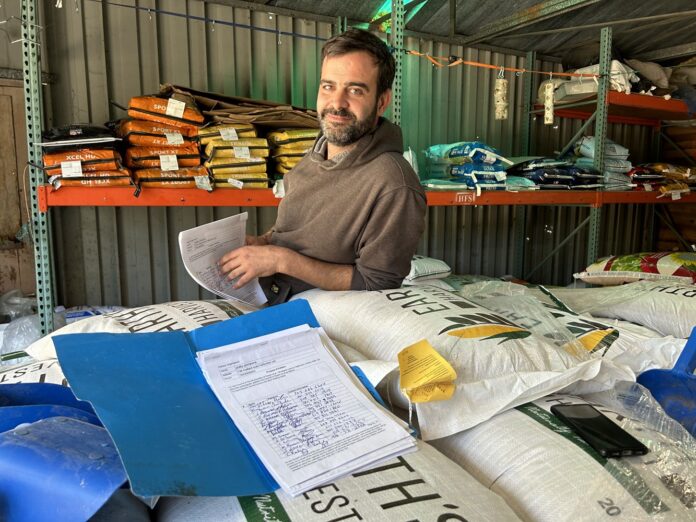
County resident Phil Primavera says he’ll likely never stop feeding deer at his Haliburton Feed and Seed location on Mallard Road, no matter how many tickets he receives from Dysart et al’s bylaw department.

It’s been about 15 months since the township introduced legislation outlawing deer feeding in Haliburton village and residential areas on the north shore of Lake Kashagawigamog. The original bylaw, passed in July 2023, prohibited feeding in Ward 1 between May 1 and Sept. 30, though an update last November made it a blanket ban – meaning no deer to be fed at any time.

Violators face a $150 fine each time they’re caught feeding. Primavera said he received two tickets earlier this summer.

“The first time I was charged was about three months ago, the ticket was filled out incorrectly. Then they came back a couple of days later and issued me with another ticket – I didn’t pay either of them,” Primavera said, noting the township opted not to follow through on the first offence, with the second thrown out in court.

The entrepreneur said he’s been feeding deer on Mallard Road for about four years. He gives them carrots and “supplementary treats” like corn and molasses. Seven fullgrown deer and a couple fawns could be seen wandering the Feed and Seed property Sept. 27.

Primavera said he gets a kick out of seeing the animals – he and his wife raise deer at their small family farm – and doesn’t see that changing any time soon. He told Dysart council last week he has no plans to stop feeding them.

“I just like them – I moved up from the city where it isn’t a normal thing to see a deer wandering around. I think it’s amazing you can walk out your front door and have these animals right there. I see them every day and never get bored of it,” Primavera said. “To me, feed them, don’t feed them – I don’t care what you do. This is more about property rights to me.”

He believes the township is wasting valuable time and resources on a bylaw he says is difficult to enforce – for a ticket to be issued, someone has to be caught, either in-person or on camera, feeding deer. With it largely being complaint-based, Primavera is also worried about pitting neighbours against one another.

Hailey Cole, a Dysart bylaw officer, told The Highlander as of Sept. 30 the township has issued four tickets for deer feeding.

Primavera said he’s not convinced the deer feeding bylaw is actually legal, referencing Ontario’s Fish and Wildlife Act from 1997. Section 13 of the act states the Minister of Natural Resources is responsible for prohibiting or regulating the feeding of wildlife, not municipalities.

Cole said the bylaw was sent to MNR for review before being adopted.

“The only commented we received was to ensure the bylaw does not interfere with baiting of deer for the purpose of hunting,” she said, noting an exception was included.

Many communities across Ontario have bylaws regulating feeding of wild animals, including Toronto, Thunder Bay, Midland, and Bracebridge.

Petition launched

Primavera understands the rationale behind wanting a ban, saying he’s not completely against one. But he feels there are better ways for the township to achieve its objectives.

While considering a bylaw, council heard how the increased presence of deer has led to more accidents on Haliburton’s roads, with residents Mike and Debra Landry estimating there to be around 100 collisions between animal and vehicle annually. Others complained about deer destroying their personal gardens.

“I’d focus more on education in town – why the deer are here. Deer like to be in open areas to feel safe, that’s why they’re coming into town, not just because people are feeding them,” Primavera said. “I’m probably one of the only guys raising deer in this town – the caloric nutrition one deer needs during the day to survive, a town the size of Haliburton would never be able to completely provide for the population.”

He’s offered to help train people on when and what to feed the deer, estimating there to be around 150 of the wild animals living in Ward 1.

Shelley Stiles, owner of Country Rose, supported the bylaw last year. She said deer regularly frequent her Hwy. 118 property.

She told The Highlander Oct. 2 the deer remain an issue, regularly eating her stock. A new eight-foot fence is currently being installed in an attempt to keep them away.

Primavera has launched a petition calling for the immediate repealing of the bylaw, signed by about 420 people. He plans to deliver it to Dysart council Oct. 22.

“I don’t think this bylaw is in the best interest of the deer, the town, or the people… we live in Haliburton. We’re not a metropolis or a concrete jungle, we’re literally in a forest. If people want to feed deer on their property, they should be allowed to do it,” he said.

Mayor Murray Fearrey said council has no plans to revisit the issue.

“We’re actually hearing from some of the rural areas that this is working, they’re not seeing as many deer,” Fearrey said. “There’s no appetite to kill the bylaw. We’ll look at it after a year, see what’s good, how reasonable things are, and what we can improve.”

O’Connor speaks reconcili-action at HSAD

0

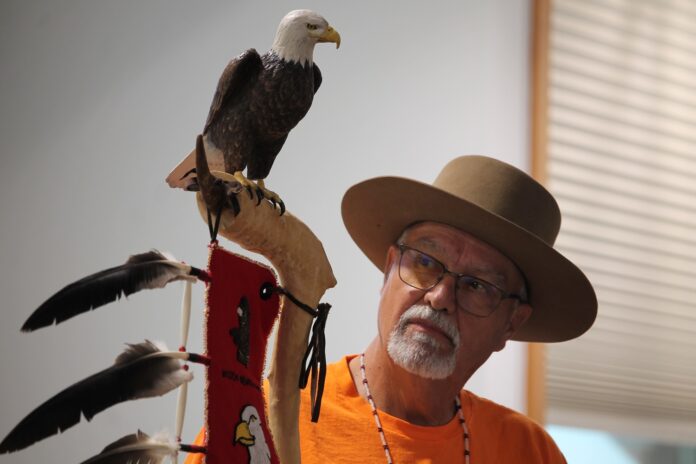
While wearing orange T-shirts recognizes children who never returned home from residential schools, or survived colonial institutions, what’s really needed is reconciliaction, Larry O’Connor told students and staff at Haliburton School of Art + Design during National Truth and Reconciliation Day Sept. 30.

O’Connor has been on a years-long journey to rediscover his culture after being raised in Oshawa. However, he was born Anishinaabe Odawa, his home community is Sheshegwaning on Manitoulin Island, and he is from the Bear Clan,

He brought his eagle teaching staff to the college this past Monday, spoke about National Truth and Reconciliation Day, and offered tobacco and smudging to participants.

“Truth and reconciliation is a journey. It’s a long journey,” O’Connor said.

He travelled to Sault Ste. Marie to go through the archives of a residential school there. He found his great grandmother and a great-aunt. He shared some of the comments written adjacent to his great-aunt’s name; “holy untaught, didn’t speak English.” O’Connor said it was because she spoke her own language.

“Our ancestors, our family members went there (to residential schools). Some came home, some didn’t,” O’Connor said.

He added the orange T-shirts recognize that so many lives were lost and must not be forgotten, as “there’s not an Indigenous person on Turtle Island that hasn’t been impacted by the residential schools.”

He said he had heard numbers as high as 69 per cent did not survive residential schools, with graduation rates of just seven to eight per cent, delivering those graduates jobs such as domestics or blacksmiths, where they learned to use their hands, but not their language. “If they spoke their language, they were punished.”

He talked about missing and murdered indigenous women, and the red hand symbol against this.

“Reconciliation requires a lot of good work… and ceremonies. Ceremonies are important. We still have some of our medicines, languages weren’t lost. Had governments been successful, they would have been lost. They’re not.”

He noted treaties allowed people at the college to be on Indigenous land, and his people were glad to share their land, but “there are truths that have to be taught. That’s what truth and reconciliation is all about.

“If it wasn’t for an uprising on an Indian reserve because of a golf course expansion (Oka crisis), we wouldn’t have had that Royal Commission struck… that they dragged out as long as they possibly could… we wouldn’t have those 94 calls to action.

“We recognize in that process so many of our women were gone missing. Another commission had to be held. Two-hundredand-thirty-one (231) calls for justice came out of that.

“Next time there’s an election going on, or someone wants to go to Ottawa, ask them about that. What are you going to do that’s different?

“We can do something. We can have a conversation. They’re good conversations. Sometimes they’re hard conversations… sometimes it’s tough. That’s a good reason why we smudge, too, because it takes some of that burden off of us.”

He ended his talk with, “it’s easy for us to remember Remembrance Day because it’s been around for a long time. This is a conversation that we’re only having now. But the truth is that this needed to happen even before the last Remembrance Day. This is something that is part of our history; a sad part of history of Canada before it was Canada.”

O’Connor hosts Tales from the Big Canoe on CanoeFM the last Wednesday of the month at 6 p.m., rerunning the Friday at 11 a.m. The Township of Minden Hills also raised a Truth and Reconciliation flag at its municipal office building Sept. 26.

Stirring positivity on Top Chef

0

Since leaving her hometown in Veracruz, Mexico 15 years ago, Miriam Echeverria said she has had three primary life goals – move to Canada, become a Canadian citizen, and score herself a spot on TV with Top Chef Canada.

The 11th season of the long-running Food Network Canada show premieres Oct. 14 with Echeverria, until recently the executive chef at Dimensions Algonquin Highlands, one of 10 confirmed contestants. She’ll compete for national excellence in a series of gruelling culinary challenges, with the winner declared the country’s best chef and earning $100,000.

Echeverria, who specializes in French and Italian cuisine, said it’s been a surreal year. After celebrating her second anniversary with Dimensions last winter, she received an invitation to apply for Top Chef Canada and jumped on it.

“I was working in Toronto when the first season aired [in 2011], one of my good friends, Rob Rossi, was on it. He finished in second place, and I remember following the whole process – him being away for filming, then watching the show with him and the rest of the team once he was back, it was very inspiring,” Echeverria said.

She went on to have her first taste of TV a few years later, appearing on Chopped Canada, and while that experience helped to prepare her for the stress and pressure of cooking in front of a live camera, it was small fry compared to Top Chef.

Echeverria said she used her big opportunity to try and set an example for change in an industry renowned for brash personalities and toxic workplace culture.

“I was most excited to just show up, meet the other competitors, create new bonds and friendships – to me, that’s the important thing,” she said. “This is personal for me, but I wanted to show that as a chef you can also be human. A lot of time we normalize bad environments and abuse in the industry – I think you can be a great chef without having to minimize people.

“That was my contribution to the show, as well as my cooking. Just being positive and showing you don’t need a big ego to be in one of the best competitions. You can just be yourself,” she added.

Honing her skills at Toronto restaurants such as Greta Solomon’s, Lunita, and Mercatto, Echeverria said her approach to cooking is “very humble, not pretentious at all” and that she likes to showcase different vegetables. She said her time at Dimensions, where she would often forage the forest for mushrooms and other edibles, helped her on the show.

She left her position with the resort, located on Maple Lake, in June – returning home to Mexico to care for her ailing mother.

Echeverria visited this past weekend to say goodbye to a community and friends she says she’ll cherish for the rest of her life.

“It has been a blessing to be part of this community… Dimensions was like my own healing retreat too,” she said, noting prior to moving north from Toronto she was considering leaving the industry. “I’m now looking forward to getting back at it with a different mentality, with different skills as a chef that I learned by being in a place as welcoming, as full of nature as Haliburton.

“Now I can say I’ll always carry a piece of this community with me,” Echeverria concluded.

Art and beer on tour

0

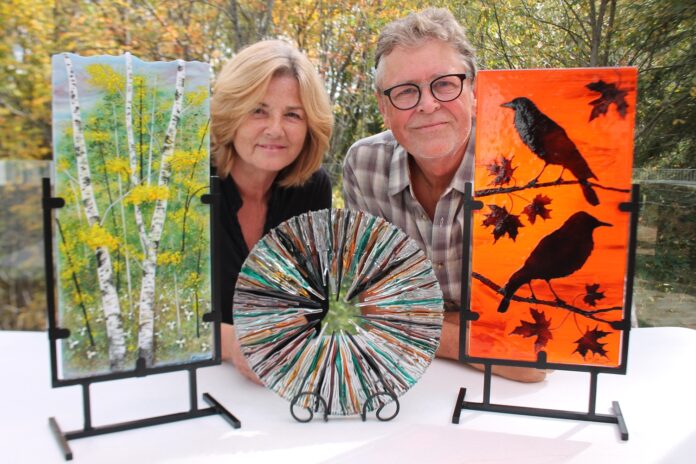
Peter Emmink and Joyce Pruysers-Emmink are busy tidying up their Dawson Road, Algonquin Highlands property in preparation for The Studio Tour Haliburton Highlands Oct. 5-6 and Oct. 12-13.

The falling maple leaves are their biggest challenge as the 37th iteration of the tour sets to launch this weekend.

In addition to hosting folks at their Ivy Cottage Fusion Arts studio, the fused glass creators are spokespeople for the fall classic.

“We’ve been working madly in the yard, trying to get things cleaned up for the tour,” Peter said.

Discussing this year’s tour, which launched in 1987, the Emminks said there are three new artists.

The first is Susan Hay. She paints uniquely-textured, colourful, acrylic landscapes. The second is Allison Barrow, who does water-colours, and is a guest at studio (V), home to Artech Studios.

The final addition is Deborah McInnes, who is Albert Cote’s wife. Cote teaches at Haliburton School of Art + Design. McInnes owned and operated a quilt shop for years, and has had pieces at the Houston Quilt Market. They are guests of the Emminks.

The three were chosen from eight applicants by a jury. Joyce said, “we have quite a large jurying team because we want to keep the quality. I think that is probably one of our key goals, to always keep it interesting, but the quality has to be (there).”

Sustainability

When the Emminks were first on the Studio Tour in the early 1990s, they said 1,000 people would come through their doors on a weekend. Now, they get about 500 over the four days of the two weekends. Some studios get 700-800, “but it’s not the numbers that we saw.” Joyce said.

“Back then, we were one of the first tours that started up. I think that was a key piece. We would get people from all over; Toronto, Ottawa and London. We get some of those people, but certainly… considering how we had to advertise in those days, we didn’t have social media, reaching out to those far regions was tough but we still got that volume.”

Joyce said they get cottagers these days who tell them they have been coming for 25 and 30 years, but many are downsizing and not buying as much art.

Peter added they are trying to get younger people out, and are ramping up social media, “because that’s how they get around.” They said millennials like digital, such as the Toureka app, so they are printing fewer brochures.

The Studio Tour remains stable, which Peter attributes to the quality of art, as well as the region. “It’s so inspiring. Our artists take great pride in creating in the Highlands and sharing it with people.”

Joyce added a chance to learn at the various studios keeps people’s interest. It’s a way to attract younger artists, too. A former teacher and special educator, Joyce said making art is so good for mental health.

Beer

This year also sees the release of The Studio Tour beer, in conjunction with Boshkung Brewing. Fernando Diaz de Leon Rendon created the logo. Folks can have a taste at the Emminks the first Saturday, and April Gates’ studio (Q) the second Saturday.

The Studio Tour is self-guided from Tory Hill in the east to Carnarvon in the west. There are 29 new and returning artists working in textile and fabric art, painting, leatherwork, glasswork, fine jewellery, photography, quilting, pottery, metal art, ceramics and more.

People can plan their route in advance by picking up a brochure, visiting thestudiotour.ca website, and checking out the Toureka! app.

United Way drives into Hali campaign

0

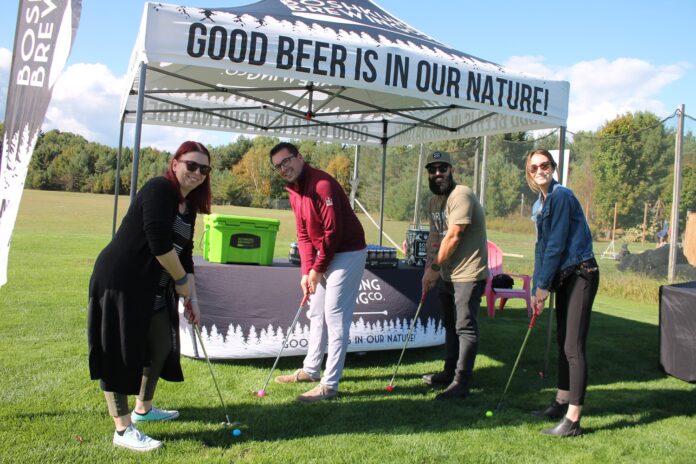
United Way City of Kawartha Lakes teed off its annual Haliburton region campaign launch at Carnarvon Family Golf Sept. 26.

Co-executive director, Shantal Ingram, said it’s important for them to have a presence in Kawartha Lakes and Haliburton County.

She said in the last year, or so, they had supported programs in the Highlands through their community capacity grant, as well as from their food security farm.

They have supported SIRCH and Point in Time, and noted an LCBO campaign is underway for donations at the till – until the first week of October. The four Haliburton County stores raise money for children and youth through Point in Time, Big Brothers Big Sisters, and EarlyON programs.

Co-executive director, Emily Beall, said some of the fresh produce from Edward Binney’s community farm and education centre in Lindsay is distributed through Haliburton Highlands Health Services, to the Minden Community Food Centre, some community housing sites, and Meals on Wheels programs. “The health services help us distribute it to as many clients as possible in the region,” she added.

Ingram said in 2022 and 2023, more than 3,000 pounds of food had been donated into Haliburton County.

The agency recently had a name change approved – to United Way HaliburtonKawartha Lakes. Beall said they are just waiting on the logo from United Way Canada, “then we’ll be a better representation of the region.”

The afternoon offered people a chance, for $15, to try out the mini putt and driving range, and sample Boshkung Brewing’s Paddle with Purpose beer, with the label specifically made for United Way CKL.

Royals relinquish crown to Huskies

0

Haliburton County Huskies centreman Nathan Poole said confidence is high inside the home locker room after the blue and white extended its Ontario Junior Hockey League (OJHL) winning streak to four games this past weekend.

The 20-year-old, an off-season acquisition from the Ontario Hockey League’s Kingston Frontenacs, was in tremendous form Saturday as he put up five points in a 6-3 demolition of the Markham Royals at S.G. Nesbitt Memorial Centre.

The win propelled the hometown team to second in the East Conference, tied with Stouffville Spirit on 12 points with identical 6-3-0 records.

Four-hundred-and-fifteen fans were treated to an offensive spectacle capped by Poole’s one goal, four assist performance and a hattrick from 20-year-old winger Deandres De Jesus.

The Huskies took a while to grow into the game, finding themselves on the backfoot early on, Ethan Wright handing the Royals a powerplay opportunity six minutes in after being called for hooking. Corbin Votary stood tall in the home goal, turning away a couple of decent scoring chances.

Finding their groove midway through the period, the Huskies drew first blood – Adam Smeeton notching his fourth of the season at 10:27, assisted by Alex Bradshaw and Camron Hankai. Teen sensation Sam Black doubled the scoring five minutes later, with the 17-year-old helping himself to his seventh goal in as many games, assisted by Poole and Ty Petrou.

De Jesus added a pair of powerplay markers early in the second, teed up on both by Poole and blueliner Carson Littlejohn.

Markham showed some fight as the middle frame drew on, getting on the board at 8:21 through Josh Caloiero. Julian Mandarino briefly gave the visitors hope of a third period comeback, adding a second road goal at 18:01, before De Jesus completed his individual rout with another powerplay goal at 19:58.

The third was a largely tepid affair, with the result a formality. Ashton Miwa threatened another Royals revival 9:51 in but the Huskies held on, with Poole firing a late empty-netter with 42 seconds remaining on the clock.

Head coach and general manager Ryan Ramsay said it’s been encouraging seeing his young side make such a strong start to the season.

“Hats off to everyone. The guys are buying in, everyone is getting on the same page, which is giving us some positive results.

We’re getting some solid goaltending by both goalies as well – things have been great the last couple weeks,” he said.

He praised Poole and De Jesus for their contributions – the centreman is in a five-way tie atop the league’s points chart with 16 from 8 games. De Jesus is one of only six players to hit eight goals in the season’s opening month.

“[Poole’s] numbers speak for themselves, but he’s also a good kid in the locker room. He talks and works a lot with the younger guys. He was a good player in the OHL, and we were lucky to get him. Poolie has done everything we’ve asked for and more so far,” Ramsay said.

“With Deandres, I watched a lot of game tape on him over the summer. I remembered him from our games [with the Caledon Admirals] last year. He can score and he’s the hot hand in the league right now,” he added.

The coach said he expects young forward Chase Del Colombo to return for this weekend’s games with the Niagara Falls Canucks and Milton Menace. They host Niagara in Minden Oct. 5, puck drop at 4 p.m., and travel to the GTA Oct. 6.

Tips for writers at book-reading event

0

Fay Martin, a close colleague of the late David Pate – who authored a book about national anthems – has partnered with the Arts Council – Haliburton Highlands to bring Pate’s book to the County during an Oct. 10 event.

Martin said another Major of Fine Arts colleague, Helga Rausch, who is a 38-year veteran in the Canadian Armed Forces, will also read from her to-be-published book Leaders All: Women in the Armed Forces since WWII.

Martin said a discussion with the audience, “will explore what writers need to support their work, both at the writing and the marketing phase.

“Writing a book is hard work, but getting it out into the world to be read is even more difficult,” she said.

Pate wrote a book about national anthems, “which you wouldn’t think is a very interesting topic. But you’d be wrong: Pate, a long-term CBC Radio host in Halifax, applied his slightly bent research skills and acerbic wit to make the subject sing,” Martin said.

“In The Worst Songs in the World: the Terrible Truth about National Anthems, Pate says they lean tremendously toward being violent, sexist and religious. They wouldn’t exist if there weren’t wars and professional sports – and the Olympics.

“Singing together is useful, perhaps even necessary, to make a disparate population feel unified and focused on a common goal. Pate wishes this power might be reflected in less gory and divisive lyrics, but he finds some heart-warming examples of bad words being put to good use.”

She said Pate died, young and unexpectedly, before his book was published. His colleagues in the Master of Fine Arts in Creative Non-Fiction program at University of King’s College, Halifax, have shouldered the burden of helping to market his book by hosting a series of launches across the country.

The event, co-sponsored by the Arts Council – Haliburton Highlands and the University of King’s College MFA program, will take place at the Dominion Hotel, 5 p.m.-8 p.m., Thursday, Oct. 10. Martin said it is “pay what you wish.” light snacks provided, food and drink available at cost. Pre-registration via haliburtonarts. on.ca/events1