
Home Blog Page 453

Resident pleads for Minden to protect heritage buildings

0
An excavator remains at the demolition site on Soyers Lake Road.

Elizabeth Turner dons a pair of wooden snowshoes and begins trekking on her property on Soyers Lake Road. As she heads for the lake, there is a demolished building to the right – the excavator that brought it to the ground still onsite.

Looking at the ruins at 1942 Soyers Lake Rd., she remembers the building’s past. It was built by her great-grandfather Joseph Dummitt in 1891. It was a lodge beginning in the 1920s until the 1970s. She lived in the farmhouse until going to university.

While she feels a personal loss, she thinks Minden residents need to know the building’s wider significance and why she is devastated council was unable to have it designated under the Ontario Heritage Act before its recent demolition.

“The development of the property reflects the development of the municipality from farming and logging to the beginning of the tourist industry,” she said.

She noted the gothic farmhouse was typical for pioneers of the day and the only example on Soyers Lake. Dummitt farmed dairy and beef cattle. The kitchen hosted square dances. For a half-century it was the Lakeview Lodge. The Soyers Lake Ratepayers Association held their early meetings there.

“So, the house has significance, not only to me and my family but to the whole lake community. I met a cottager yesterday who was shocked when he saw the demolition as he drove to his cottage from the city. He had always assumed that the house was a protected historic site and was shaken to think it is gone. A landmark on the lake is gone.”

When she got wind of a possible demolition by the property’s new owners, Turner had hoped to save the farmhouse from the wrecker’s ball via council designating it under the Ontario Heritage Act. However, as she told Minden Hills staff and councillors Feb. 27, she was too late and believes a lack of communication at the township on the file has dealt a “significant blow to local history.”

She noted that under the Act, council is allowed to make decisions regarding heritage properties, including to designate. She added they have to fulfill one criteria outlined in Ontario Regulation 9/06.

“1942 Soyers Lake Road clearly fulfills multiple criteria under Regulation 9/06 and is eligible for designation,” she said. She further noted that Ontario municipalities are required to protect their heritage resources and there are policies regarding cultural heritage preservation in the Minden Hills and County of Haliburton official plans.

She said she first raised the issue with a councillor in July 2019, and was referred to the planning department. She met with them last October and it was recommended she speak to council. She was originally to appear in January but was away and did not anticipate a winter demolition. While waiting for the February delegation, staff issued a demolition permit.

“By issuing the demolition permit prior to council receiving the delegation and making a decision, staff undermined council’s ability to fulfill their provincially-mandated responsibility to make decisions regarding historic properties within the municipality,” she told council.

She doesn’t think it was in any way malicious, just a “troubling lack of communication among those involved in this file and an insufficient understanding of provincial planning legislation and policy.”

She said she hopes the township learns from the experience, since there are many important historic properties not now recognized or protected.

“If Minden Hills is going to remain the special place that it is with a rich and interesting history that is enjoyed by residents and visitors alike, the protection of historically significant buildings is something the municipality must begin to undertake,” she said.

Mayor Brent Devolin said, “council is seeing this today for the very first time,” and has asked for a staff report. He said Turner had given them food for thought and expressed an interest in council taking a more proactive role in future.

After the meeting, Coun. Jennifer Hughey, who first spoke to Turner last July said via email, “It’s very unfortunate how circumstances transpired in this case, but a delegation is always the best way to present concerns to council as a whole. I commend Ms. Turner for bringing to light the way Minden Hills could work to conserve, protect and enhance the cultural heritage of the municipality through designation considerations in the future.”

Planner Ian Clendening, who spoke to Turner last October, added, “at this time staff will be preparing a report to council regarding heritage designations.”

The Highlander was unable to reach the owners of 1942 Soyers Lake Rd. for comment.

Folk camp ‘perfect antidote to a winter’s night’

0

Once again, there’ll be great live music in the Haliburton Highlands with the annual Winter Folk Camp concerts coming up Saturday, March 7 and Sunday, March 8.

The Haliburton County Folk Society, in a press release, said the concerts always surprise and delight audiences, with three performers sharing the stage each night at YMCA Camp Wanakita.

Saturday night’s show features the trio Boreal, and “the sweet harmonies” of Katherine Wheatley, Tannis Slimmon and Angie Nussey, Sue Shikaze said. She added Boreal’s songs conjure up vivid sights and sounds of winter that all Haliburtonians will recognize: pine branches bending low, squirrels’ footprints in the snow, the icy breath that accompanies shovelling, the sound of slap shots off the boards, and the angel truck drivers who lead us home in blizzards.

“These three artists create a warm, friendly, and genuine rapport with their audience. Their music is the perfect antidote to a winter’s night,” Shikaze said.

On stage Sunday night are a trio of guitar players: blues guitarist Emily Burgess, Drew Gonsalves playing calypso, and local jazz guitarist Nick Russell.

Burgess has toured across North America, performed at Massey Hall as the guitarist for the Women’s Blues Revue Band, and fronts her own band, the Emburys.

Gonsalves is the founder, frontman and songwriter for Kobo Town, a Juno award-winning band that blends calypso with musical influences ranging from reggae to hip hop.

Russell is no stranger to local audiences, sharing his music at Rhubarb and other venues throughout the county, with a style that combines classical and contemporary jazz and progressive rock.

“With this mix of genres and talent, there are sure to be musical moments that will only be heard on this night,” Shikaze said.

Tickets are $25 each and available online at haliburtonfolk.com or at the door. Shows start at 7:30 p.m. Cash bar is available.

Retiree burning a path to wellness with woodwork

0
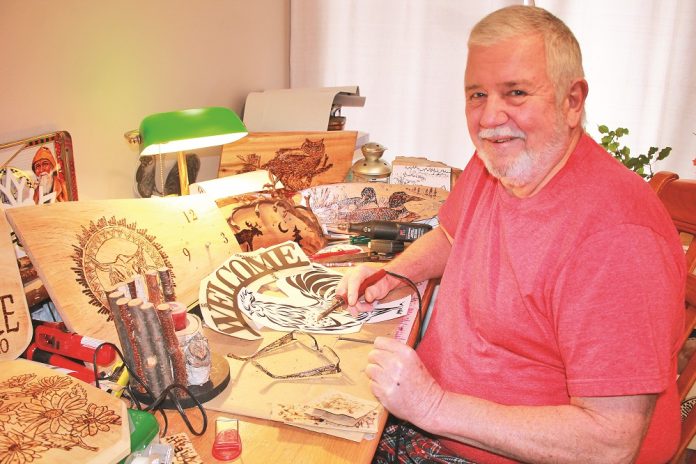
Allen Luke works with wood in his studio in Haliburton. Photo by Lisa Gervais.

It’s a weekday morning as Haliburton’s Allen Luke sits down to his workbench. He places tracings of the word ‘welcome’ and a picture of a rooster on a piece of wood, his trusty wood burner at his side.

He’s surrounded by already completed works, including coat racks and hangers, clocks, candle holders and candle displays, plaques, animals and walking sticks.

It’s “stimulating,” according to Luke, born in Montreal, moved to Toronto when he was six for 45 years, before discovering the Haliburton area in 1988.

He’s had a life, for sure, including health challenges the past 10 years that have included five heart procedures and being in the midst of a second bout of cancer.

“I haven’t had many good breaks in my life,” he adds, relating he was on his own at 15, saw his job as pencil and ruler draftsmen go the way of computers, and subsequent workplace downsizing and financial challenges.

However, “you know what? It’s life,” he says. “Attitude is a big thing. If you feel defeated by the word cancer, you might as well just die now.” So, he lives life a day at a time, with a philosophy that, “if I was to die tomorrow, I would have not regretted having been here.”

Since moving to a property just outside of Eagle Lake, he’s found the peace and serenity he craves. Although he is close to 70, he said he feels like he’s in his 50s so doesn’t attend a lot of programming aimed at seniors.

He loves to spend afternoon on the deck watching the birds, which inspires the wood burning.

He dabbled in the hobby about seven to eight years ago but has gotten more serious since they moved into their current house.

“Everything was coming around nicely. And, so I made quite a few last year and I gave a lot away to people and I went to several Minden markets and had a couple of garage sales.”

However, he doesn’t consider his work garage sale quality. “I love them. I don’t think there’s one that I don’t like. There’s some unique ones. Like, I love making a walking stick.”

He sources lumber locally, then cuts it into the size he needs. He uses tracings and then burns the wood. He uses a belt sander and circular saw.

“It’s not that tough really,” he confides.

Glancing at one piece, he shares, “I’ve got an artistic skill of zero. Give myself credit. One out of 10. Like with those ducks. If you asked me to draw them by hand, sorry, I’d have stick ducks. But I was a draftsman for 35 years, so I was a bit of an artist, but with a pencil and ruler.”

“Believe it or not, when I’m working with it, I actually talk to them, just like on NCIS where the coroner is always talking to his corpses during autopsies.”

Not familiar with todays’ catchphrase of ‘mindfulness,” Luke says when he is working on this wood, “you don’t worry about a lot.”

As he continues to show off his work, he says he’s discovering that Indigenous and wildlife themes are his favourites.

His advice for other people new to the area, recently retired, or forced from work, is pretty simple.

“Find something that grabs you, stimulates you, makes you feel proud of what you’ve done because you lose so much coming into senior-ship, because people in general have less and less use for older people. It’s a young person’s world.”

Meat maker doesn’t mince words about conviction

0

Norman Weber of Norm’s Smokehouse in Gelert doesn’t mince words in speaking about the unfairness he sees in his recent conviction for operating a meat plant without a licence.

The Ministry of Agriculture, Food and Rural Affairs (OMAFRA) put out a press release Feb. 27. They said investigators had also discovered that Weber had been supplying a local business with uninspected meat products. He’ll pay a total of $7,500 in fines after facing Minden Court Feb. 11.

“In September 2019, a Compliance and Advisory Officer and a local Health Inspector visited the store for a follow-up inspection and found that Mr. Weber had been producing several smoked and cured meat products without the required license to do so,” OMAFRA said.

They added it was his third conviction for offences under this regulation.

Weber told The Highlander in an interview he’d gotten out of the smoked meat business following his second conviction a couple of years ago. He said to make smoked meat, such as pepperettes, jerky, salami or sausages, plants require a category two meat license. He no longer had one.

However, he said he had not changed his website, which still advertised smoked meat, and customers had posted information on Facebook about his services.

At the end of last summer, before getting busy with wild game and fish, he said he took the opportunity to make some smoked meat for himself and his family.

He said he had a substantial amount in the shop when a compliance officer made a surprise visit Sept. 10.

“They find me with category two products in my cooler. Bam, Bob’s your uncle. How do I argue that?” He said he had no way of proving the smoked meats were for family so pleaded guilty for the sake of expediency.

He said his first conviction, which he calls the “salami caper,” in 2016, occurred after he was required to send his recipes to OMAFRA but did not hear back from them and went ahead and made five salamis.

Strike two came a couple of years after that. Weber takes full responsibility, saying, “stupid me, I was cheating a bit.” He said he had some pepperettes and jerky in his display cabinet when there was a surprise visit in 2018. He was fined $3,000 plus court costs.

Through it all, Weber maintains there has never been anything wrong with the actual meat, “always the issues were paperwork, bureaucracy, stuff like that.”

He said at one point, he had 12 different clipboards on the walls that had to be filled out on a daily basis. He added inspectors came every two weeks to check the “reams and reams of paperwork involved. Every step of every process you have to write down.” He said he got into trouble for things such as not having all the clipboards filled out, a little bit of light coming under the door or light bulbs not being strong enough in the cooler.

He estimates inspectors used to spend about $1,000 a day to come to Gelert to check up on him, and believes OMAFRA issued the press release about his conviction and fine to justify their existence.

Today, he still does wild game and fish but no longer sells meats. There’s a sign in his shop that says he’s been regulated out of existence.

However, OMAFRA said in the release thatOntario is a leader in food safety and meat inspection. They said the province’s Food Safety and Quality Act, 2001 and its regulations are part of Ontario’s food safety system and set high standards for the protection of consumers and the welfare of food animals.

Under penalties set out in the Act, an individual convicted of an offence is liable to a fine up to $25,000 for a first conviction, and $50,000 for subsequent convictions. Corporations may face fines up to $100,000 for first offences, and $200,000 for subsequent convictions.

Drug strategy partners carry on work

0
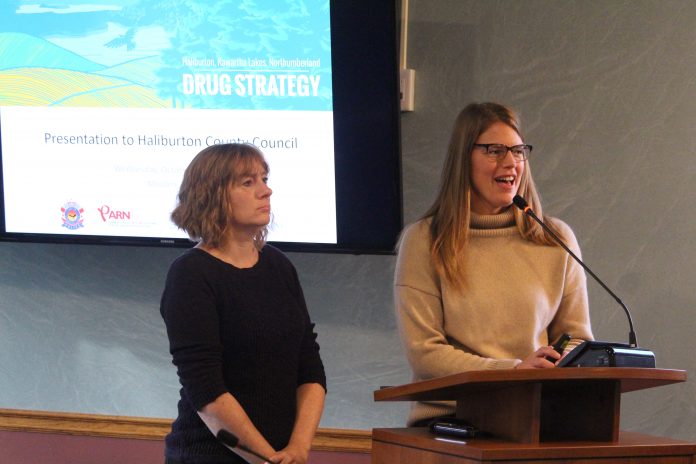
Cathy MacDonald and Megan Deman spoke about the approaching end of the Haliburton Kawartha Lakes Northumberland Drug Strategy Oct. 23. Photo by Joseph Quigley.

The Haliburton, Kawartha Lakes, Northumberland (HKLN) Drug Strategy is planning to maintain itself despite the end of its funding term.

The drug strategy has run for the past three years addressing drug abuse in the tri-county area by coordinating different services, with partners including the Haliburton, Kawartha Lakes, Pine Ridge District Health Unit (HKPR), OPP, the Four Counties Addictions Services Team and PARN – Your Aids Resource Network. The strategy operated using a funding grant from the Ontario Trillium Foundation but that expired at the end of 2019.

But coordinator Megan Deyman said despite her position ending, those partners are continuing to meet and further work on the strategy. She said it remains important and they hope to secure more funding through grant applications and municipal partnerships.

“The partners are committed to continuing and building on the work of the last three years,” strategy and PARN communications worker Dylan DeMarsh said.

But Deyman said having full-time staff working on it is critical given the limited time of other health organizations.

“The full capacity that organizations are at currently, substance use and core response sometimes get pushed off people’s desks,” Deyman said. “It should be a priority and they identify it needing to be a priority but they don’t always have the capacity to address it.”

She said the collaborative efforts of drug strategy members have helped with stigma reduction in local communities over the past several years.

“Haliburton, certainly, there is more of an openness and an increased awareness for substance use issues,” Deyman said. “You can see better, more understanding of the factors contributing to the rise of substances.”

Opioids have remained prevalent in the area. According to Public Health Ontario, there were 119 emergency department visits across the HKPR district related to opioids in the first half of 2019 – greater than the 67 in the first half of 2018. There were also 30 opioid-related deaths in 2018, compared to 10 in 2017.

“We are seeing an increase,” Deyman said. “Although this is a complex issue, it is also an immediate need to address.”

She said it is important that drug strategy work is tailored to the individual communities it serves.

“We need to be able to address it in a way that’s relevant and appropriate to the various uniqueness of counties and communities,” she said.

Bringing in a more diverse set of service options to help people treat and recover from substance abuse is a next step for the area, such as acupuncture, she said.

“We can look at maybe more nontraditional forms of support and recovery,” Deyman said. “There is an identified priority for beginning these kinds of supports and services in Haliburton. It just takes time to build. It’s on the horizon.”

Red Hawks fall just short against league best

0
Dylan Keefer attempts a shot on net. Photo by Joseph Quigley.

The Red Hawks boys hockey team held their own against the league-best St. Peter Saints but could not hold on in the dying minutes, losing 4-2 at home Feb. 19.

The Hawks kept even with the Saints, holding them to a 2-2 tie until late in the third period. But the Peterborough team went ahead by a goal with less than two minutes remaining and would score again shortly afterwards to ensure the Haliburton loss. The defeat in the Hawks final game of the regular season put them at a 6-6-1 record, good enough to qualify for playoffs.  

Coach Jason Morissette said it was not a negative game, adding he was encouraged the team played its systems well against a strong team.

“They’ve (St. Peter Saints) been beating most single-A schools by five goals, so I think we did great today,” he said. “We had gotten away from the game we were playing. Today, we were kind of back to playing the system that will help us have success.”

He added the team ran out of gas at the end but the game was a good learning experience.  

Defenceman Isaac Little said if they can maintain the level of play they had in the game, they should be able to advance.

“If we stick to our systems the coaches talked to us and preached all year, we’ll be able to get into the Kawartha tournament for sure and maybe have a shot at COSSA,” Little said.

Due to Campbellford being unable to field a team for a playoff game this week, Haliburton will get an automatic berth into the Kawartha Championship tournament March 3.

“Our players look forward to the opportunity to compete,” Morissette said.

Little said the team has come a long way since the start of the year, especially given the game cancellations due to labour unrest.

“We’ve come a long way and gotten a lot better and worked really hard all season,” Little said. “Hopefully, going to make a bit of a playoff push.”

HHHS, province must do better

0

Highland Wood could be a bellwether for catastrophe to come.

The long-term care facility’s emergency closure has gotten scarce attention outside of our county, but it deserves a lot more notoriety. After a tumultuous evacuation due to a sudden roof failure last year, family, staff and management held nothing back in severely criticizing how it was handled. A report was released Feb. 21.

For the Ministry of Health and LongTerm Care (MOHLTC), and Haliburton Highlands Health Services (HHHS), it is an embarrassment.

Highland Wood was a tragedy and exposes lapses in our health care system that need to be addressed. It is no surprise that people involved described long-term trauma. It cannot be understated how difficult it can be to move someone from a long-term care facility, many at the end of life. Though such moves do not necessarily lead to worse physical health, the mental and emotional toll on some families and residents was severe. Nobody should have to spend their precious final days dealing with this, but it happened, and at least two residents passed away after getting moved.

By all accounts, the powers were not fully equipped to handle the situation. Residents were moved quickly enough, but things got more difficult after that. Some families struggled with multiple moves. People complained about communications problems and a lack of support. There were issues with the repatriation process and staff struggled with the increased demands of the situation. The HHHS board was criticized for being absent, and deservedly so; it has been quiet on Highland Wood, when it is apparent it should have been very vocal.

This all raises questions about the state of long-term care infrastructure, both with Highland Wood and across the province. The roof nearly made it to its replacement date in the spring but failed unexpectedly ahead of time due to ice buildup, after a difficult freeze-thaw cycle in the winter. HHHS maintains the early failure could not be predicted, but it is apparent that families, management and staff do not buy that.

We cannot say whether HHHS should have been able to avoid this, though we will endeavour to answer those questions. But long-term care infrastructure is an issue the province must address. With long-term care projects assuredly on the rise, they must be built to withstand the elements and the more severe weather climate change will bring. Those facilities that already exist must get funding to guarantee proactive maintenance. Staff also must get proper support, lest a critical part of our health care sector suffer employment shortages due to burnout.

It is worth noting not every family found the experience onerous. Some felt the process went smoothly and their relatives received good care elsewhere after being moved. But the scope of negativity from staff, management and families shows that nothing can be brushed aside.

HHHS appears to be treating this seriously, but we will monitor closely to see their follow-through. We do recognize that HHHS showed courage in releasing this damaging feedback to the public. We also recognize that if the local health services didn’t have to worry so much about annual budgets, thanks to MOHLTC lack of funding, it wouldn’t have had to play “Russian roulette” [as one reported point of feedback called it] with the roof in the first place. It did gamble, but the MOHLTC was the one holding the gun.

We are at a turning point in our country. Our senior population is ballooning and our health care system is attempting to adapt to that. Haliburton is at the heart of it, with its large senior population. But If Highland Wood is any indication (and we have not even touched on waiting lists yet) our health care system is not ready to handle the influx.

Province-wide strike shuts local schools

0
Local education union members demonstrated outside Haliburton Highlands Secondary School Feb. 21. Photo by Joseph Quigley.

Local secondary and elementary faculty joined a historic provincewide strike Feb. 21 as unions and the provincial government remain at an impasse in collective negotiations.

All four provincial teachers’ unions joined in the protest, the first time this has happened since 1997. The event is the latest in a series of strikes as the province has been unable to come to collective agreements with those unions, who say they are pushing back against cuts.

The Ontario Secondary School Teachers Federation (OSSTF) has also spoken out against the province’s proposal to mandate some online high school credits. Haliburton Highlands Secondary School (HHSS) bargaining chair Jason Morissette said it is unfortunate the situation has escalated this far.

“We truly are out here today because the cuts they are proposing for schools, particularly, I believe, rural high schools, will be disastrous,” Morissette said. “We believe the government is definitely on the wrong track.”

The OSSTF has announced local schools will be part of another one-day strike March 5.

Minister of Education Stephen Lecce continues to criticize union action and said they are seeking wage increases. Unions have said they want a cost of living adjustment, pegged at inflation, which would be above the one per cent raise cap for public sector workers legislated by the province last year.

“While union leaders are continuing to organize further disruption, our government remains focused on getting deals that ensure students are learning each and every day,” Lecce said in a press release.

But Morissette said teachers would not be giving up days of pay by going on strike if they were solely interested in money. “This is about working conditions and it is about students, so we are standing up for that,” he said.

The Elementary Teachers Federation of Ontario (ETFO) members also demonstrated. The union announced its next phase of job action over the next two weeks, beginning Feb. 26. It will not include strikes but will see ETFO members not fill in for absences or use personal funds to pay for school supplies.

“Using their own money to ensure their students have what they need to learn is just another example of the lengths our members will go to support Ontario’s public education system,” ETFO president Sam Hammond said in a press release.

Meanwhile, high schools are still managing the Trillium Lakelands District School Board’s mandate for secondary school teachers to not leave for extracurriculars during the day. This is due to board concerns about being able to staff classes, as the OSSTF has decided its members will no longer cover for absent colleagues.

Although sports teams have managed to play games due to fortuitous scheduling and help from non-teaching staff coaches, they have been unable to attend all.

HHSS principal Chris Boulay reported at the school council meeting Feb. 11 the status of spring sports is uncertain due to the ongoing labour issues.

Citizens flood council chambers over shoreline bylaw

0
More than 40 people attended the latest County council meeting to see discussion about the draft shoreline preservation bylaw.

County council is planning to take its time to “get it right” on a draft shoreline preservation bylaw after concerned associations overflowed its chambers Feb. 25.

The Coalition of Haliburton Property Owners’ Associations (CHA) and the Haliburton County Home Builders Association (HCHBA) came out in force for their respective delegations to council on the draft bylaw, which would restrict development and activity within 30 metres of shorelines. Council voted to undertake another line-by-line review of the bylaw, engage citizens online and in public meetings, as well as consider a working committee or group to guide the process.  

With more than 40 people in the room, Danielsen said it was the fullest she could recall council chambers ever being in the past decade. She said although it was initially hoped the bylaw could be finished before the summer, it is clear consultations would have to last longer than that based on input.

“We acknowledge that there’s urgency there, but we also have to get it right,” she said.

The bylaw disallows any removal, destruction or injury to natural vegetation within the 30-metre buffer zone, unless the activity is under an exemption or a permit is granted.

CHA board chair Paul MacInnes detailed the science of how the natural vegetation is vital to lake health by helping prevent contaminants from getting into the water. Failing to protect lake health leads to algae blooms, which can plummet property values, he said.

“There will be costs to this bylaw, absolutely,” MacInnes said. “But it’s our belief that the costs of this bylaw will pale, absolutely pale, in comparison to the costs if we don’t protect our lakes.”

HCHBA vice president Glenn Evans said his association is not adversarial to the CHA’s position. He said the bylaw needs to be more moderate in its limitations on shoreline development than it is currently. He added properties that harm shoreline vegetation with development before the bylaw is in place need to take some responsibility too.

“We believe that we can work together to protect our lakes. We believe there is room for mechanisms, policies to be put in place,” he said. “But we feel the bylaw is a little bit far-reaching.”

Council discussed options for public consultation and the need to start meetings before the busy summer season. The County previously conducted an online survey on the bylaw which attracted hundreds of responses, though Coun. Carol Moffatt said many did not know of it.

Danielsen said the bylaw should not have been too surprising to people, given it was a topic in 26 different municipal meetings throughout the County and lower tiers and had multiple newspaper articles about it.

“For anyone to suggest that we’ve been working under cloak of darkness and we haven’t been trying to get the message out is not fair,” she said.

Danielsen said council also needs to sort out the costs of making the bylaw possible. The County has set aside $50,000 in this year’s budget as start-up funding for the bylaw.  

“There is going to be a rather extraordinary cost, because I’m not interested in us developing a bylaw we can’t enforce or manage,” she said.

Dysart changes septic program

0
File photo.

Dysart et al is moving ahead with plans to eliminate mandatory pump outs in its septic re-inspection program and hire a third-party firm to handle inspections.

Council voted 6-1 on Feb. 25 to support staff’s proposed changes to the program and have a new bylaw brought forward. Only Coun. John Smith opposed.

Chief building official Karl Korpela said the mandatory pump outs are unnecessary and have been the most controversial aspect of Dysart’s program. He said removing them should help increase compliance and inspection speed. He proposed pump outs only occur under maintenance requirements of the building code.

“It was determined that mandatory pump outs don’t contribute towards protecting our lakes based on the results that we’re finding,” Korpela said. “Eliminating mandatory pump outs also allows us to concentrate on other issues we’re seeing.”

Coun. Larry Clarke spoke in support of the effort and only pumping out when it is felt to be necessary. Under the staff proposal, an inspector would do a sludge test to decide.

“What’s important in this area, to me, he’s come back to us with a workable and sustainable program,” Clarke said.

Smith was against, noting the Coalition of Haliburton Property Owners Associations (CHA) and several lake associations feel it’s needed.

“Every one of them says that pump out, it’s a really important part. They’ve pointed out several examples where flaws would not have been found if it were not for the pump out,” Smith said.

Korpela said he has also heard from those sources opposed to the policy change.

“I want to emphasize a lot of that is based on misinformation about how beneficial a mandatory pump out actually is,” Korpela said. “There’s no benefit to a mandatory pump out. We’re not degrading our program whatsoever.”

Other septic inspection programs, including in Algonquin Highlands and the one about to proceed in Minden Hills, do not include mandatory pumpouts. Other changes proposed in a slate of revisions includes owners being notified of inspection dates and having them change it if necessary, rather than having them book the inspections themselves.

The changes come after compliance issues experienced in the first area surveyed in the program, which included Kennisis Lake and Little Kennisis Lake. A total of 112 out of 964 properties failed to comply, or 12 per cent.

Korpela said dealing with even a quarter of the infractions is not possible under current staffing levels and has proposed non-compliant properties be included as the first batch in the revised program.

The hiring of a firm, as done in Algonquin Highlands, is expected to improve consistency over the Dysart’s current method of having owners select from a list of 12 qualified inspectors, Korpela said.

The new bylaw is slated to return to Dysart’s Environment and Climate Change Committee before getting approval at the March council meeting.