
Home Blog Page 350

Storm’s ‘most challenging’ season ends early

0
File photo.

The Highland Storm announced March 18 its season would be ending prematurely with the A.J. LaRue arena due to become a COVID-19 vaccination centre.

The Storm announced that with the arena becoming a clinic at the start of April and bookings closing, the second part of the season would close more than a month early. This came after the organization had already put hockey on a two-week pause March 15 due to rising COVID-19 cases in the area.

Storm president Jason Morissette said it was bittersweet.

“You have to look at the positives. You can’t be entirely negative about it,” he said, adding local hockey players got to be on the ice far more than any others in their region. “We really were kind of looking out for each other and making sure we tried to do the best job we could to keep kids on the ice as much as we could.”

The Storm faced plenty of hurdles operating amidst COVID-19. Only inter-league play was possible, with the pandemic disallowing travel. The pandemic forced reductions in the number of players on the ice. A December-February lockdown shortened the season. Finally, the second session ended well short of its April 17 end date.

But Morissette said it was worth it to give youth something to do in a difficult year.

“Just the mental health side of our youth, our community. It’s been a real, real struggle. We heard time and time again from parents, a lot of thanks for providing something for the kids to go to each week, a distraction that was good for their physical and mental wellbeing,” he said.

Storm player Darian Maddock said it was a choppy year with the stoppages due to lockdown, but added it meant a lot to get to play.

“I would have just been sitting at home, doing nothing really,” Maddock said. “It was nice to have something to look forward to after school.”

Morissette said there is planning to come. Besides the pandemic, the league faces challenges such as a shortage of referees.

But he said after weathering the past year, the executive will have the experience to draw from for whatever restrictions could remain.

“It has been the most challenging of seasons in the history of Highland Storm, without a doubt. But we have strong numbers, we have strong volunteer numbers, we have strong parents that are supportive and our executive is very united.

“We did it because the truth is, we really, really are passionate about the Highland Storm,” he added. “But we’re also really caring about the health and wellness of our kids.”
Firefighters get training in frozen lake rescue

0
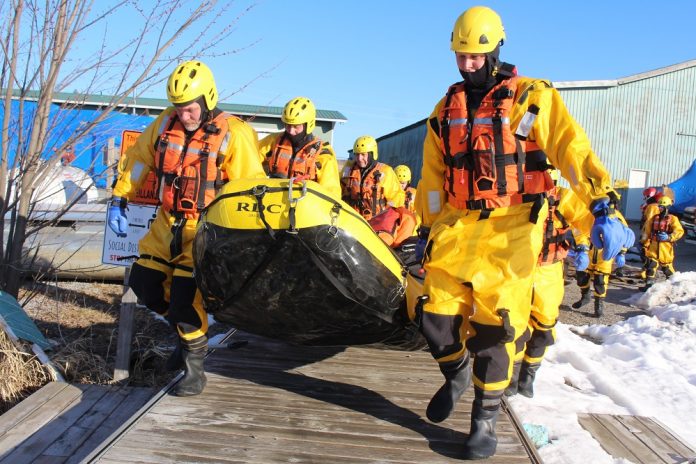
Firefighters carry a raft onto Grass Lake for an ice rescue training course March 20. Photo by Joseph Quigley.

After years of delay, Highlands East and Dysart et al fire departments received ice and water rescue training at Grass Lake March 20.

The Algonquin Highlands Fire Department taught the course. A handful of firefighters – four from Highlands East and six from Dysart et al – were instructed on how to conduct rescues on frozen lakes.

The course is required for the departments to perform such rescues should someone get in trouble on the ice. Instructor and Algonquin Highlands firefighter George Sharp said it is an important skill for County departments given the number of lakes in the area.

“We’ve got people, ratepayers and visitors spending time out on the ice,” Sharp said. “Need to be able to support the visitors and the locals when they get into trouble.”

The training comes after the Office of the Fire Marshall announced Jan. 13 it was closing the physical Ontario Fire College building to push a locally-based online model. The college had also stalled for years putting out an approved ice-and-water rescue course over a 2017 inquest into two Ontario firefighters who died in that type of training.

Departments such as Highlands East waited for an approved course before proceeding to train. That college course was set to go in spring 2020 – the first since 2014 – but was sidelined by the pandemic. But the course became deliverable this year and firefighters organized an in-house course, using instructors from Algonquin Highlands who had maintained training, Highlands East fire chief Christ Baughman said.

Highlands East is covering ice rescue costs using a community GoFundMe from 2017, which raised more than $20,000 after the death of cottager Bob Bell, who fell through the ice on Dark Lake. Baughman said they plan to train four more personnel in the fall so that each station would have one or two capable of starting a rescue before more backup arrives. After that, he plans to have the municipality modify its bylaws to include ice and water rescue by next winter.

“It’s a great success for us to be able to add this service, not only for the safety of our firefighters but the community,” Baughman said. “Something we weren’t able to do in the past. Now with the proper training, a firefighter won’t have to make a difficult decision or do something uninformed and ill-equipped.”

Dysart et al fire chief Mike Iles said his department has maintained ice rescue in its service, but it had been many years since it had been able to get new training while it waited an approved course.

“It was great to be working with several departments. The training itself was very informative and very worthwhile,” Iles said.

Sharp said the course included classroom time for theory, as well as practical time on the ice. Participants wore wetsuits and entered the icy waters of Grass Lake, performing different techniques.

Algonquin Highlands has maintained the rescue training for years, Sharp said. But he added it is more cost-effective to study with other departments, which is happening more often.

“The municipalities in the last two or three years are working more cooperatively than they have in the last decade. Things are going in the right direction,” Sharp said.

Community outcry alters arena vaccine plan

0
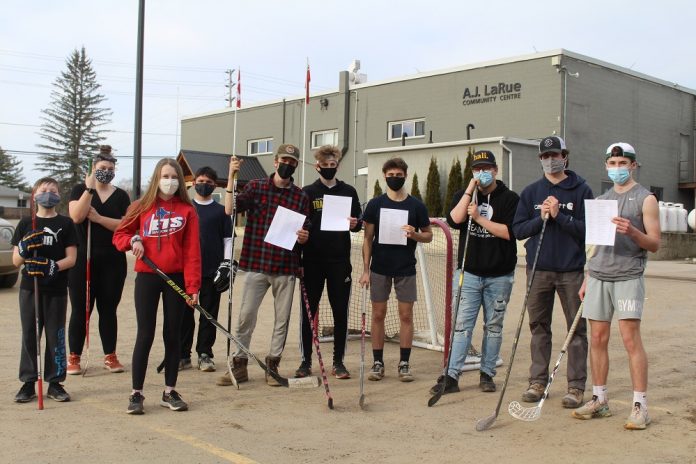
Local youth gathered outside the A.J. LaRue Arena for a demonstration March 22. Left to right: Chase Winder, Lexie Tait, Autumn Winder, Tyler McGovern, Darian Maddock, Nick Phippen, Colin Glecoff, Tyler Martin, Braedyn Robinson, Benjamin Robinson. Photo by Joseph Quigley.

Dysart et al is shortening the amount of time its A.J. LaRue Arena will be used as a COVID-19 vaccination centre in response to public outcry.

The municipality announced the clinic March 18 and said it would close all bookings from March 20 to the end of September. The next day, the municipality changed course and said it would only run from April 5 to June 12 before a new location is found.

The initial announcement prompted community outrage, with people concerned about summer ice and the start of the next minor hockey season. Mayor Andrea Roberts said the initial proposal was accepted at the request of the Haliburton, Kawartha, Pine Ridge District Health Unit (HKPR).

“We are all trying to do the right thing and get everyone vaccinated, so Dysart’s EOC (emergency operation centre) group said yes. Thankfully, the decision was re-evaluated,” Roberts said.

The health unit is preparing the A.J. LaRue Arena and the S.G. Nesbitt Arena in Minden as the County vaccination centres, with both expected to be ready in early April. The health unit is also working on pop-up clinics, including one for first responders at the Pinestone Resort March 18, which Roberts said could be part of a viable alternative.

“Everyone is working so hard to ensure we have places so we can all get our vaccine. With more temperature-stable vaccines, the possibility of pharmacies administering, and the S.G. Nesbitt centre booked, there are other options this summer,” Roberts said.

Local youth held a demonstration outside the Haliburton arena March 22, initially intended as a protest but shifted to a celebration after the municipality’s decision. Organizer and camp owner Greg Sadlier said people mobilized quickly to respond, with a petition garnering 75 signatures. He added the municipality needs to consider and consult youth more in the future.

“The youth came to me, and they said, ‘what can we do about this? How can we change this’?” Sadlier said. “For the youth to see something work so effectively, to see a way that they could make their voices heard in a substantial way, is really amazing to see.”

Highland Storm president, Jason Morissette, said the next season would be delayed under the previous timeline, which might have meant the Storm would not play against other teams in the region if that becomes allowed.

“Our community, it’s not like we have tons and tons of organized activities that are here for youth,” Morissette said. “We wanted an arena available for everybody, not just for hockey … We really appreciate their (Dysart’s) understanding.”

The initial proposal would have also meant the end of summer ice, utilized in summer camp programming by Hockey Haven. Owner Troy Binnie welcomed the municipality changing course.

“It would have been a tough situation to try to run a hockey camp without hockey,” Binnie said. “We are thankful for all the community support and town council support to have the decision reversed.”

Vaccine rollout creates controversy

0
Vaccinations are underway in the County. Photo via Flickr.

Little Redstone Lake resident David Baker is trying hard to get a COVID-19 vaccination for his wife Linda Guest, a chronic home care patient.

Guest is 76 years old, though cannot attend a clinic in person. Several health units have prioritized home care patients for the first wave of vaccines, but Baker said the Haliburton, Kawartha, Pine Ridge District Heath Unit (HKPR) has not and he has been unable to arrange an appointment.

Baker has pushed to get his wife a vaccine sooner, to no avail. With HKPR holding a clinic for emergency responders at the Pinestone Resort and Conference Centre March 17-18, he is questioning how vaccines are being distributed locally.

“I see no reason why patients like her aren’t included in a prioritized vaccination rollout,” Baker said. “Let’s face it, there’s been a lot of confusion in how this vaccine has been rolled out province-wide.”

The province has opened vaccinations to the public for people aged 75 and older, though health units manage the process. The provincial rollout is in three stages, with phase one underway and phase two due to start in April. According to the provincial website, phase one is supposed to include long-term care homes, health care workers identified as high-priority, adults age 80 and over, Indigenous adults and chronic home care patients.

The second phase, due to start in April, includes other seniors and frontline workers ranging from school staff to social agencies to grocery stores.

Haliburton Highlands Health Services (HHHS) president and CEO Carolyn Plummer said clinics for health care workers were held March 6 at the Haliburton Family Medical Centre and March 17-18 at Pinestone. She said after a concerted effort to reach high-priority workers like first responders, some vaccines were offered to the next groups on the list. That included workers at places like grocery stores and banks.

But Plummer said HHHS was asked to hold off on this approach, as not all communities in the health unit district had completed phase one vaccinations.

“All parties are learning and improving processes as we proceed in order to ensure that all priority populations have access, in priority sequence, as directed by the Ministry of Health,” Plummer said.

The health unit said the vaccine priority list is decided by the province, with medical first responders on a high priority within phase one. Chronic homecare patients are the last group on the phase one list and the health unit said it is working to reach them.

“As the HKPRDHU covers a large geographic region, there may need to be a variety of options provided to meet the needs of residents,” the health unit said in an email.

Acting medical officer of health, Dr. Ian Gemmill, said the Pinestone clinic giving doses to people further down the list was a minor error. But he added no one will be left behind in getting a vaccine.

“People are kind of overly sensitive about what might be called queue-jumping, but I can honestly tell you that I am not aware of any situation in which this would have been done intentionally,” Gemmill said. “I am completely willing to forgive people and to say let’s just get on with more immunization rather than fuss or worry about it … Everybody is headed to get vaccine if they want it and it will only be a matter of a few weeks.”

With respect to homecare patients, Gemmill said they will be able to contact the health unit for a link to book with the provincial system. A step-by-step guide is being added to the health unit’s website.

But Baker said his wife should not have to wait.

“She should be getting it now,” Baker said. “She should be prioritized.”

Vaccination appointments are currently available for people born in 1946 or earlier using the provincial booking system. The system is available at Ontario.ca/bookvaccine or call 1-888-999-6488.

Trusting the science

0

by Dr. Nell Thomas

I’m looking around the world and see vaccination rates vary from country to country. More than 448 million vaccine doses have been administered worldwide, equal to 5.8 doses for every 100 people, globally.

But there is a large discrepancy among countries. Israel continues to be vaccinating faster than any other country, with 109 vaccines delivered per 100 citizens as of March 22 (58 per cent have received one shot and 50 per cent have had both shots and are fully vaccinated). Canada has given 11.74 shots per 100 people (9.9 per cent have received first dose, and 1.9 per cent have received second dose). While some countries have not yet given even a single dose.

Most countries seem to be prioritizing fully vaccinating people. For example, the US has given 38 shots per 100 people, with 25 per cent having one shot and 13 per cent having had two shots. Britain has had a different approach, focused on broadly vaccinating the population with one shot. They have completed 41 doses per 100 people, with 38 per cent having had one shot and only 2.6 per cent of the population fully vaccinated. By maximizing the number of people with one vaccine, and delaying the second shot by three months, they have broader mass protection.

What our science tells us so far is the second vaccine will increase your immunity by only about 10 per cent in the first few months. The purpose of the second shot is to provide longer immunity. How long, we don’t know. But we do know that a single shot provides strong protection now, and for at least a few months. Experts are in agreement that delaying the second shot will diminish the ultimate effectiveness by only a negligible amount.

Is Britain’s approach working? Since early January, the daily number of new cases in Britain has fallen by more than 90 per cent. This is a larger drop than in almost all countries. Especially impressive given that the B.1.1.7 variant is their dominant strain and is more contagious than the original strain. Deaths continue to plummet in Britain. And they are using the Astra Zeneca vaccine, with no increase in diagnosed blood clots, and despite its slightly less effectiveness than Moderna and Pfizer, the British population is clearly reaping the benefit.

In contrast, worldwide, the number of confirmed COVID cases has increased 21 per cent in the past month.

People who study disease transmission use a term called the “R nought” (R0) to describe how contagious a disease is. It refers to the reproduction number of a disease. The number placed behind the R indicates how many people are likely to be infected by one individual with the disease.

For measles, the R0 is 12-18, meaning it is very contagious, as one individual can infect 18 others. If the R0 is greater than one, then each person is infecting more than one other individual and the disease will continue to increase in the population.

In Britain now, the R0 for COVID-19 is less than one, meaning the infection is no longer spreading. (Annual influenza has an R0 of 0.9-2.1).

In Ontario, as of March 18, the reproduction number (R0) for the new COVID variants of concern (the more contagious strains with the N501Y mutation) is 1.25, and the R0 for other variants without this concerning mutation is 1.07. Anything above one indicates exponential increase in growth, and the higher the number, the faster the infection will transmit. We are in a race to get as many people vaccinated as possible before these more contagious variants are widely circulating.

Stay tuned to all the fact-based resources for how to get swabbed (tested) and how to get vaccinated.

Don’t confuse Facebook with fact

0

When it comes to vaccinating Haliburton County residents against COVID-19, public health must not only follow all provinciallymandated guidelines but must also be transparent so there is no opportunity for members of the public to cast aspersions on the rollout.

There have been grumblings among the masses about a perceived clandestine clinic operating out of the Pinestone Resort and Conference Centre. We received one letter from a reader complaining it was done under the radar with no public announcements.

He was not wrong as we have only had official word this week about so-called popup clinics, including at places such as the Pinestone.

This led the letter writer and others to speculate. While surely for frontline workers, they heard of non-frontline workers being vaccinated, including two retirees and two in their 40s who weren’t even residents.

Others grumbled upon hearing bank workers were getting the jab and employees of some social service agencies.

Unfortunately, it is the type of speculation that will occur when health officials are not completely transparent about what is going on locally. There are accusations of queue jumping, and questioning local officials.

Other stories of some local seniors being offered appointments in Peterborough, Lindsay and Bracebridge are concerning.

It’s a tough one. Local health officials are in a flux position. They are making plans that are literally changing all of the time. Informed about a batch of expiring vaccines, they have made quick calls to volunteer firefighters for example. Some get a call about availability and are vaccinated within a few hours. Publicly advertising what they are doing isn’t always front and centre in their minds.

In a similar vein, likely no one predicted the backlash that would occur over the announcement that the A.J. LaRue Arena in Haliburton would be used as a vaccination clinic from March to September. However, youth proponents quickly said this was not a good idea. With ice out it meant a delayed start to the Highland Storm Minor Hockey Association season and threated Hockey Haven’s summer camp. Why not use the Haliburton Legion they asked. In the end, Dysart et al listened to the concerns, spoke with the health unit, and scaled back the clinic dates so as not to be so disruptive of the summer ice season. They will find an alternate location.

While we implore public health to do its best to anticipate public reaction and factor that into its decision-making, we also appeal to the public to be patient.

Public health officials are making decisions dayby-day based on circumstances largely out of their control. They are doing their best to get needles in arms in hopes of having all of us vaccinated by the end of summer. They are not sitting about scheming how they can get their friends and family vaccinated before everyone else.

Under the leadership of acting medical officer of health, Dr. Ian Gemmill, the health unit has done a very good job of getting its message across. Gemmill has hosted public forms and holds a media briefing once a week. It’s the best press access we have had in my time with The Highlander.

We encourage the public to go to him and other trusted sources to get their information, including mainstream media locally, rather than riding the rumour train and confusing fact with Facebook.

It’s been a very long year for all of us and once again we have to pull together for the betterment of the community.

Fridays for Future makes a stop in Minden

0

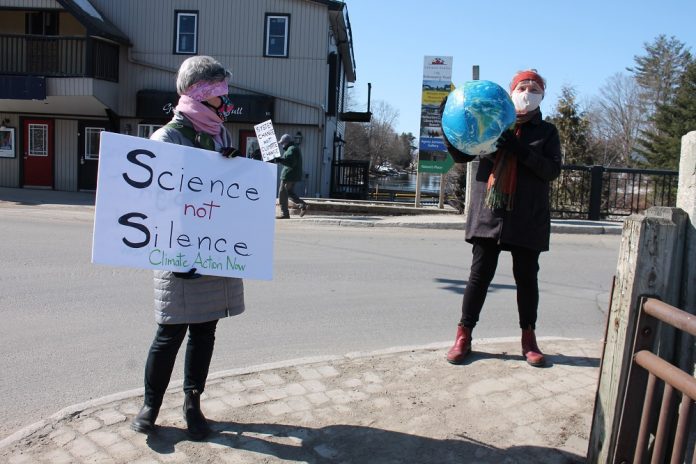
Members of Concerned Citizens of Haliburton County (CCHC) gathered in Minden March 19 for a Fridays for Future (FFF) global day of climate action.

Brandishing signs, they stood on the town’s main bridge over the Gull River and also walked into town.

Spokeswoman Bonnie Roe said it was part of worldwide activities with the theme of ‘no more empty promises’ from governments.

“All we hear is what will be done in 10, 15 and 25 years from now but that is too late. To quote the founding young activist of FFF Greta Thunberg, ‘listen to the science, act on the science’.”

Roe said they chose Minden to bring awareness to a different community in the County. They usually stage their events in Haliburton near the high school.

“The support was amazing with horns honking, street traffic thanking us and stopping to chat and some staff at Pharmasave coming out on the street to applaud us,” Roe said.

She said that this year, due to COVID19, many individuals and groups are also demonstrating virtually online.

She said people can place a sign on Facebook, in front of their home or at the end of their driveway.

“CCHC decided to be more visible but also follow current protocols for our yellow zone, which meant having only 25 participants, wearing masks and standing six-feet apart.

“We notified the municipality of Minden Hills and detachment commander of the OPP, Liane Spong-Hooyenga.

“We had 12 participants, Douglas the dog, and 15 regrets so the interest is there. Previously we have had 25-40 attend so COVID-19 has definitely affected our turn out.”

If anyone is interested in further demonstrations or CCHC they can email info@concernedcitizenshc.ca.

Health Unit multi-tasking during pandemic

0

By Kirk Winter

Despite priority being given to battling the COVID-19 pandemic, the Haliburton Kawartha Pine Ridge District Health Unit is meeting its other mandates of providing essential Ontario public health programming.

Acting medical officer of health, Dr. Ian Gemmill, told the March 18 board meeting that, “Although approximately 80 per cent of the staff at the HKPRDHU are fully engaged in pandemic response, there are essential services that local public health agencies provide that must continue regardless. Many programs continue to operate.”

These programs include:

• Providing support to the harm reduction response, including naloxone distribution, needle exchange and opioid surveillance.

• Working on mental health promotion as well as supports related to infection protection and control needs and assessments within schools, in addition to COVID-19 related case and contact management.

• Providing support to parents and guardians through the Healthy Babies program.

• Monitoring for influenza activity.

• Conducting routine inspection of food premises and personal services settings.

• Preparing for flood season, for an increase in the establishment of outdoor patios, and the opening of seasonal facilities including trailer parks, marinas, golf courses and beaches.

• Planning for tick surveillance activities.

• Conducting case and contact management for sexually transmitted infections.

• Providing emergency services to sexual health clinics.

• Following up on adverse events following immunizations.

Dr. Gemmill also shared that the initial phase of the launch of a new collaborative health record (CHR) system, Click and Connect, for the HKPRDHU went live March 8.

“The new system focuses on improving the exchange of information between local residents and COVID-19 Call Centre staff during this pandemic. People can visit the HKPRDHU website to submit their COVID-19 questions to staff. Anyone with a commonly-asked question will be provided information and links to additional resources, while those submitting other questions will receive responses directly from other health unit staff. Click and Connect is a safe, secure way for people to reach the health unit … and helps streamline inquires so staff can respond quickly,” Gemmill said.

He added that after the pandemic, the system will be expanded to improve access to other programs and services.

Health board hears immunization plan

COVID-19 immunization rates at Haliburton County facilities are universally high with 100 per cent of residents at Extendicare Haliburton, 96.6 per cent at Highland Wood and 91.1 per cent at Hyland Crest having received at least their first dose of vaccine, health unit manager of health promotion, Lorna McCleary, told the board.

McCleary and Marianne Rock, manager of health protection, said in phase one the priority has been vaccinating the most vulnerable. Those groups included residents, staff and essential caregivers at long-term care homes and retirement homes, health care workers including paramedics, Indigenous adults living on-reserve and individuals receiving home care.

The next phase, adults 80 and older, staff, residents and caregivers in other congregate settings for seniors such as assisted living, is underway.

To ensure the vaccination program is as widespread as possible, HKPRDHU is partnering with area hospitals, primary care medical doctors, pharmacists and municipalities to host mass immunization clinics.

In Haliburton County, they’ll use the S.G. Nesbitt Memorial Arena in Minden and the A.J. LaRue Arena in Haliburton.

“Supply of vaccine will remain limited over the next few weeks,” McCleary and Rock said, “We are looking at about 5,000 doses a week being available. We will follow the provincial direction for eligibility over time. The provincial goal is to have all adults immunized with the first dose by the end of June with the second dose coming in the summer of 2021.”

In phase two, running from April to July, priority will be given to older adults 65-79, people who live and work in high-risk congregate settings, essential frontline workers who cannot work from home, individuals with high-risk chronic conditions, and communities at risk.

Sunshine list sees bumps in health and education

0

The province said hospitals, boards of health and school boards contributed to almost three-quarters of the growth in 2020 public sector salaries.

In releasing the so-called sunshine list March 19 – of employees making $100,000 or more – the Ontario government said registered nurses contributed to approximately 60 per cent of the jump in the hospital and public health sectors while teachers accounted for 97 per cent of the increase in the school board sector.

“We know that Ontarians are relying on their government now, more than ever, during this pandemic to keep them safe and deliver the critical services they rely on, like health care and education,” said Peter Bethlenfalvy, president of the Treasury Board and Minister of Finance.

Hospitals and public health are up 59 per cent from 2019 and school boards 55 per cent. The average reported salary decreased slightly to $125,871 in 2020 from $127,396 in 2019.

Locally, it isn’t always easy to break out Haliburton County figures from regional organizations, such as the Trillium Lakelands District School Board (TLDSB). It had 181 employees on the list.

The Highlander asked TLDSB spokesperson, Catherine Shedden, to provide information on Haliburton County schools but she declined, saying “we do not provide a breakdown of schools and area.”

However, the majority of school principals in Haliburton County made the list, including the high school’s Chris Boulay, J. Douglas Hodgson Elementary School’s David Waito, Archie Stouffer’s Jane Austin and Wilberforce and Cardiff’s Elaine Fournier.

Fleming College president Maureen Adamson was marked as having made $292,367.34

As for the Haliburton-based health unit office, spokesperson Chandra Tremblay confirmed there is no one working in that office included on the list. The biggest salary regionally was former HKPR medical officer of health, Dr. Lynn Noseworthy, at $406,153.75.

Haliburton Highlands Health Services has 25 people on the list. President and CEO Carolyn Plummer topped it with a salary of $207,191.57. There are also 15 registered nurses.

Plummer said there are six new individuals on the list this year, all related to COVID-19.

The Haliburton Highlands Family Health Team also had a nurse practitioner named. In the municipal sector, there were 20 employees paid more than $100,000.

The County of Haliburton accounted for 11 with Mike Rutter the top earner at $169,972.73. Other directors on the list are: Andrea Bull, Craig Douglas, Mike March, Elaine Taylor, Tim Waite, Amanda Virtanen and Charlsey White. There are also three paramedics.

Dysart et al has three: CAO Tamara Wilbee, treasurer Barbara Swannell and director of public works, Rob Camelon. Algonquin Highlands has three: CAO Angie Bird, treasurer Jean Hughes and director of parks, recreation and trails, Chris Card. Minden Hills has two: director of finance, Lorrie Blanchard and director of public works, Travis Wilson. Highlands East has just CAO Shannon Hunter.

The Haliburton Highlands detachment of the Ontario Provincial Police, meanwhile, had 19 uniform members on the list.

The Highlander may have missed others on the list.

The Public Sector Salary Disclosure Act 1996 requires organizations that receive public funding from the province to make public the names, positions, salaries and taxable benefits of employees paid $100,000 or more in the previous calendar year by March 31 of the following year.

Banner memories arrive for curling squad

0
The Haliburton Highlands Secondary School boys curling team received its banner March 11 for earning the Ontario School Curling Provincial Championship. Left to right: Erin Nicholls, Owen Nicholls, Darrel Dobson, Liam Little, Corin Gervais, Jacob Dobson, Carlos Gregorio. Photo by Joseph Quigley.

After more than a year of waiting, the Haliburton Highlands Secondary School 2019-20 boys curling team has received its championship banner.

It arrived March 11, honouring the team for earning a provincial gold one year ago in the Ontario School Curling Championship.

The award would have normally been provided last spring, but the pandemic delayed the hand-off. The banner will be hung at the Haliburton Curling Club. Skip Jacob Dobson said it was a long year waiting.

“It’s great to see it come back to town,” Dobson said. “Just being able to see it come back and having everything we’ve done together as a team.”

The team of Dobson, Liam Little, Corin Gervais and Owen Nicholls went on a run last season, winning zone and regional competitions to play in the provincial contest.

They also earned a spot at the provincial OFSAA competition, but officials cancelled the event due to the pandemic. Ontario School Curling Provincial Championships president Carlos Gregorio presented the award.

He said the pandemic delayed the banner production. It was ready by December, but another lockdown delayed the presentation even further. The team also lost out the chance to play this season, with cross-school competition cancelled. Coach Darrel Dobson said they may have been able to go on another run this year if they had the chance.

“We definitely all hoped to play going into this year,” the younger Dobson added. “We were all disappointed when we heard we couldn’t for sure … It’s been difficult.”

The skip said the group has gotten out for some practices and one event but has not been able to play together nearly as much.

This was the last chance for graduating Dobson and Little, though Dobson said he would look to compete at the post-secondary level.

“We’re definitely looking forward to things getting better and being able to get back to playing the game we love,” he said.