Home Blog Page 334

Restrictions to ease on Friday

0

Haliburton County residents will see some COVID-19 restrictions easing as of June 11 as the province goes into step one of its roadmap to reopen plan.

Effective 12:01 a.m. on Friday, it means:

  • * Outdoor social gatherings and organized public events with up to 10 people;
  • * Non-essential retail permitted at 15 per cent capacity, with no restrictions on the goods that can be sold;
  • * Essential and other select retail permitted at 25 per cent capacity, with no restrictions on the goods that can be sold;
  • * Outdoor dining with up to four people per table, with exceptions for larger households;
  • * Outdoor fitness classes, outdoor groups in personal training and outdoor individual/team sport training to be permitted with up to 10 people, among other restrictions;
  • * Day camps for children permitted to operate in a manner consistent with the safety guidelines for COVID-19 produced by the Office of the Chief Medical Officer of Health;
  • * Overnight camping at campgrounds and campsites, including Ontario Parks, and short-term rentals;
  • * Concert venues, theatres and cinemas may open outdoors for the purpose of rehearsing or performing a recorded or broadcasted concert, artistic event, theatrical performance or other performance with no more than 10 performers, among other restrictions;
  • * Outdoor attractions such as zoos, landmarks, historic sites, botanical gardens with capacity and other restrictions.

The province said June 7 it is entering step one based on the provincewide vaccination rate and continuing improvements in key public health and health system indicators.

Riding for a D-Day hero

0

By Sam Gillett

On June 6, 1944, 14,000 Canadians stormed Juno Beach, helping the allied forces beat back Nazi troops.  

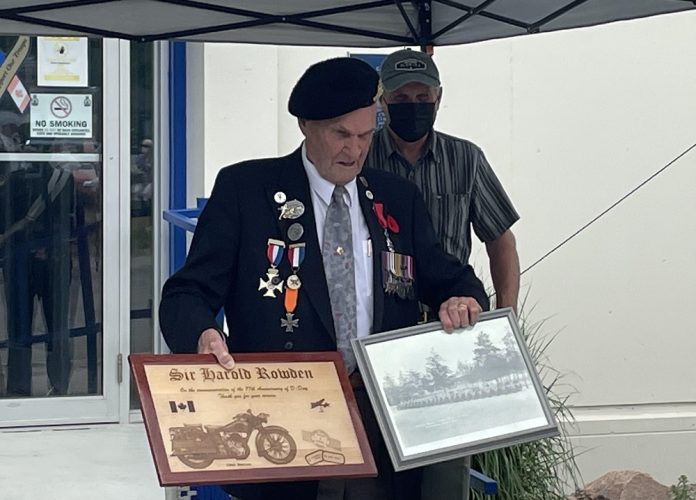
On June 6, 2021, Sir Harold Rowden, who was part of the D-Day advancement, was honoured with a special celebration.

A parade of motorcycle riders and an honour guard of Legion members greeted Rowden – often called “Rowdy” – outside Royal Canadian Legion Branch 129 in Haliburton.

The veteran, whose 97th birthday coincided with the anniversary, was a member of the 13th Field Artillery Regiment.

Flanked by Legion members, he waved and saluted as 64 motorcyclists paraded past – in homage to his service as a motorcycle courier; a job which saw him exposed to Axis forces while delivering messages to different military units.

“My officer would give me a message to take to the front,” Rowden said.

Upon delivery, “the boys would run up to me and shake my hand.”

After his service in Normandy, Rowden was named a Knight of the French National Order of the Legion of Honour. 

Rowden recently moved from Orillia into the Gardens of Haliburton retirement home in Haliburton Village.

“I’m very thankful to have him in the community,” said Haliburton Legion President, Don Pitman. “And to have the show of love from all the riders that came out today and the people that took the time to organize it and show respect.”

Mark Duggan played a key role in organizing the ride.

“We wanted to pay tribute to Harold, and thank him,” said Duggan, who became friends with Rowden over the past few years in Orillia.

Duggan presented Sir Rowden and the Legion with plaques, memorializing his service and his connection to motorcycling history.

Across the street, motorcyclists and onlookers applauded.

Before the motorcycle riders arrived, trumpeter Andy Salvatore played The Last Post, in solemn remembrance of the lives lost 77 years ago.

“Today, [Rowden] said the bigger remembrance is the people that were left behind,” Pitman said. “That really hit the nail on the head.”

An estimated 4,400 Allied soldiers died during the Normandy beach invasion – more than 1,000 were Canadians. The attack is viewed as a turning point in The Second World War, driving German troops to retreat. 

Linda Battams, a regional commander with the Legion, said she hopes younger Canadians learn about people such as Rowden and their service to the military.

“I want them to remember the veterans,” Battams said, “what they’ve done for us, the sacrifices they’ve made for us, and honour them.”

Hall of Fame inductees revealed

0

By Sam Gillett

The Haliburton Highlands Sports Hall of Fame has announced its first inductees.

Eleven athletes, three builders and three teams will be celebrated in an exhibit on the upper level of the A.J. LaRue Arena.

A wide range of athletes were recognized: football stars Michael Bradley, and Taly Williams; track and field Olympian Lesley Tashlin and university track star, Anna Tomlinson; hockey players Cody Hodgson, Ron Stackhouse, Bernie Nicholls, Donald Beverley “Joe” Iles, Glen Dart and Marla MacNaull, and curler Jake Walker.

Those honoured in the “builders” category – supporting sporting culture in the area – include Linda J. Brandon, Albert John (Ab) LaRue and Lenny Salvatori.

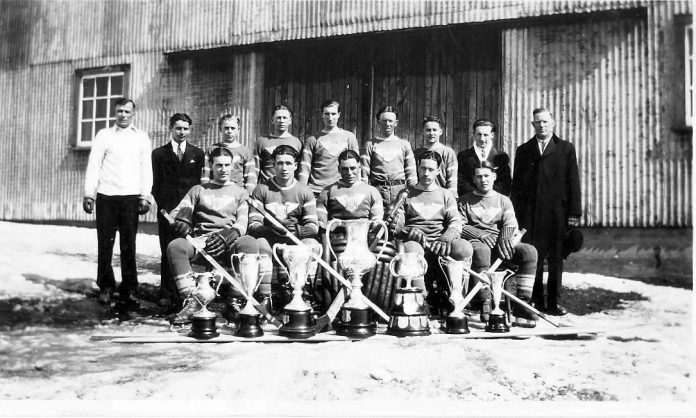
Famed Hockey teams throughout history also get a nod: the 1934 Haliburton Huskies, 1956-58 Minden Monarchs and the 1971 Haliburton Junior D Huskies will be recognized for their accomplishments on the ice.

“This is a group of people and teams that truly reflect the depth and the breadth of athletics in the Highlands,” said Scotty LaRue, chair of the Hall of Fame board. “We have 11 athletes, three builders and three teams whose excellence and commitment deserves to be celebrated and that is exactly what we are doing today.”

LaRue and the rest of the Hall of Fame board will host an induction ceremony on October 23.

“These individuals have contributed so much to their sports and to their communities and we want to ensure these contributions are never forgotten,” said LaRue in a press release.

The Haliburton Highlands Sports Hall of Fame will occupy a temporary space in A.J LaRue Arena’s community hall.

The Hall of Fame is part of the Haliburton County Community Co-operative, and raised funds for the exhibitions display cabinets, website, and promotional materials with help from community donations.

The Highlander will be profiling each athlete, builder and team in upcoming issues.

Schmale on Kamloops: status quo not working

0

By Lisa Gervais

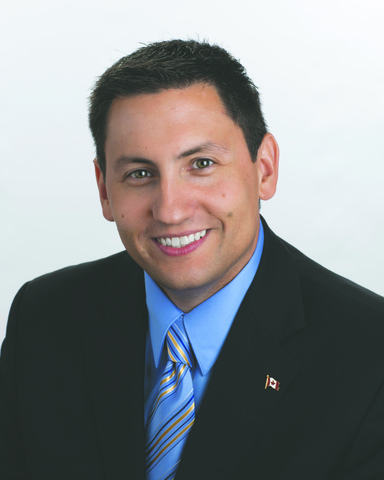
When Haliburton-Kawartha Lakes-Brock MP Jamie Schmale first heard that the remains of 215 children, some as young as three, had been found buried outside a residential school in Kamloops, BC, he reacted as a father.

“It makes you sick,” he said in a June 4 interview.

As the Shadow Minister for Crown-Indigenous Relations, Schmale added, “It’s something that has profoundly lasting and damaging impact on Indigenous culture, heritage and language. The legacy of residential schools is a shame.”

In a wide-sweeping interview, Schmale said the fact the last residential school was closed in 1996 means it is not something that happened in a faraway time. “The effects are still having ramifications on the survivors today, on the people that are very much around today.”

Schmale said he has been the lead on the file for the Official Opposition Conservatives. He has been working closely with leader Erin O’Toole and his office, committees, and speaking with Indigenous People, “reaching out and talking with them and trying to develop a fast forward.”

It began with work June 1 and is continuing.

He stressed that the Conservatives “felt this wasn’t an opportunity to politicize something,” but rather making “helpful suggestions. Not placing blame or anything like that because we know the failures are on governments of all stripes going right back,” Schmale said.

His party has asked for the government to develop a plan for Truth and Reconciliation (TRC) calls for actions 71-76, dealing with missing children and burial information by July 1. They also want funding for investigations at all former residential schools in Canada where unmarked graves may exist. Thirdly, ensuring the proper resources are allocated to communities to commemorate and honour the individuals discovered through the investigations and an education plan for Canadians of all ages to understand what happened.

He said any plan going forward must be Indigenous-led, with Ottawa providing assistance.

“Some believe they are gravesites, some crime scenes. Both are true. Some are saying leave it, some are saying let’s get closure … it has to be Indigenous-led, not Ottawa-led.”

The local MP said he is having emotional talks with Indigenous Peoples following the gruesome discovery.

He said a lot were not surprised by the finding but were by the number. He said many tell stories of classmates having gone missing and never coming back.

“Most of it is listening, trying to understand the pain they were and have been feeling.”

He thinks this is just the beginning.

Schmale said his party plans to vote in favour of NDP Charlie Angus’ motion on the issue, with a vote expected the week of June 7.

As of June 3, they are calling on the Liberals to: end their legal battle against the First Nation children and accept the findings of the Human Rights Tribunal; end their legal battle against the St. Anne’s survivors; push for the adoption of the TRC calls to action, particularly 71-76; provide survivors and their families the support for dealing with the trauma; and table within 10 days the steps they have taken to end their legal battles.

Schmale said, “We need to deal with this. We need to take action. We know what needs to be done. We need to listen to what the people on the ground are telling us and how we should proceed and then do it.”

The local MP said it’s clear governments have failed for centuries and this is “an opportunity to perhaps think differently on the situation. The status quo is not working so how do we proceed with reconciliation in a more meaningful way? And that includes financial and economic reconciliation too.”

For example, he said there remains equality issues. Some Indigenous police services do not have the same powers and resources as other police forces in the same province. He said the officers know the communities, people, families, and how to deal with situations differently, but don’t have the same powers to deal with those situations and that must change. 

He said many First Nations people don’t have the ability to acquire property, sell land, have self-governance and the resources to do that.

Referencing years-long boil water advisories, Schmale said in “today’s day and age, how the heck is this still happening?” In some cases, he said it is because a local has not been trained to service a water treatment plant.

“No matter where you were in Canada, when news of what happened in Kamloops came out, I think it affected everyone, Indigenous, non-Indigenous, it didn’t matter. When you hear about a mass gravesite of 215 children, some as young as three, I think a whole country mourns.”


Haliburton Highlands OPP investigating sudden death

0

On June 3, at approximately 2 p.m., members of the Haliburton Highlands Detachment of the Ontario Provincial Police (OPP), along with EMS, responded to a call for service regarding a body located in the water of Dark Lake in Wilberforce.

The deceased has been identified as Steven HONDERICH, 60-years-old, of Highlands East Township. A post-mortem examination is scheduled at the Centre of Forensic Sciences in Toronto.

Foul play is not suspected at this time and there is no threat to public safety.

The investigation is being led by the Haliburton Highlands OPP Crime Unit. Anyone with information is asked to call Haliburton Highlands OPP at 1-888-310-1122 or Crime Stoppers to remain anonymous at 1-800-222-TIPS(8477).

Minden artisan’s market to make return this month

0

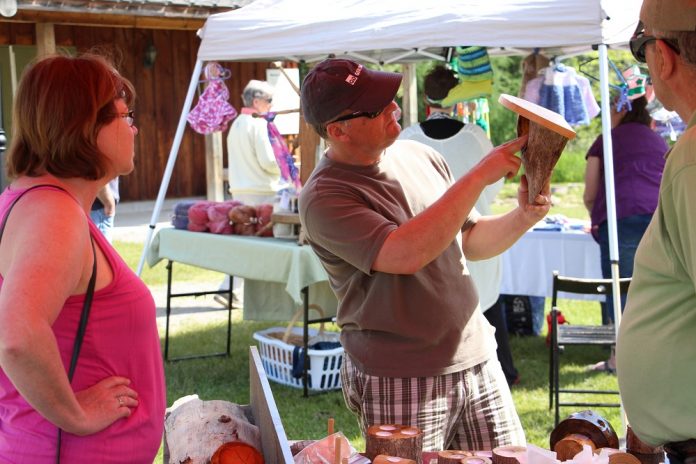
The Minden artisan’s market will be resuming this year after a pandemic hiatus in 2020.

Township of Minden Hills community development coordinator, Elisha Weiss, said the first market will be held June 19, running to Thanksgiving weekend.

She said it will be at the fairgrounds beside the farmers’ market.

“We will have a limited number of vendors each week (maximum of 10) and there will be COVID protocols in place like a defined entrance and exit, one way travel through the market, social distancing etc.,” she said.

Sara Michelle of Nyx Art Studio is one of the vendors who was unhappy when the markets were not allowed to open last summer. She plans to be there for this summer and into the fall.

She told The Highlander she’s excited about returning.

“It will be so amazing to get back to work and what we as vendors love doing. We need this market back in the community and I’ve been getting such amazing feedback from all of my followers that are so excited to have the market back as well.”

She said it will be good for the community’s mental health and well-being to be able to interact in a safe environment.

“We all need to get back to some kind of normalcy and these outdoor markets may be the first step. It’s been a long 15 months for us all and it’s time to bring some joy and social interaction back to people’s lives.”

Highland Yard running virtually for 2021

0

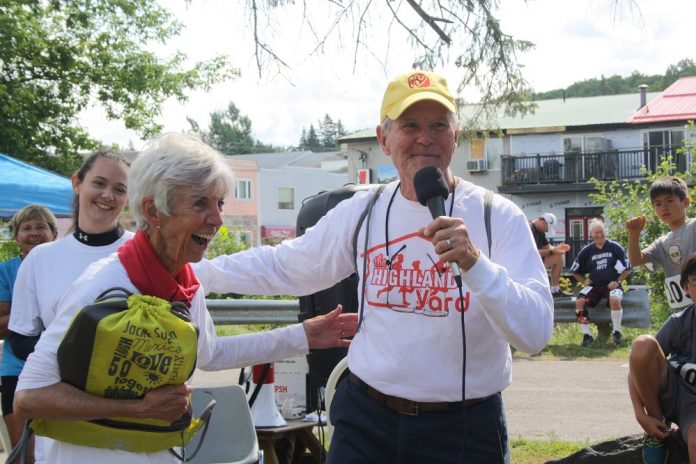
Registration for the annual Highland Yard charity run is now open.

While participants won’t be gathering in person, they’ll still be able to complete a race and raise money for affordable housing in Haliburton County.

Participants have the option of a 2k, 5k and 10k run or walk. A “freestyle” option is open to anyone who wants to participate however they like: whether it’s laps around a living-room or backyard sprints.

There’s also a chance to dive into local history with the original Heineken Yard race distance run from 1971. It’s 7.3 km from Camp Onondaga to the Rockcliffe in Minden.

Last year, the virtual event raised $25,000 which was donated to Places for People, a not-for-profit focused on Haliburton County’s affordable housing shortage. That’s the highest amount raised to date.

“I think people may have felt more willing to donate, maybe they had more money to donate since they weren’t travelling,” said Jack Russel, the race director and past board member of Places for People.

“It’s also more convenient,” said Russel. “People could define their own activity – I think people enjoyed that.”

No matter what kind of race you run, each registrant gets a pair of Highland Yard socks, and a chance to win a locally-made mug for every $50 raised.

Since 2012, Highland Yard participants have raised more than $140,000 for Places for People. Those funds help the organization to buy, renovate and secure housing for people who need it.

“It’s also given Places for People a chance to move in a different direction now, where we’re looking for multi-unit builds – not just homes,” said Russel. “Now we’re just going to go big; put in more units, provide more housing.”

Registration for the Highland Yard opened June 1 and participants must complete their chosen distance or race style by Aug. 1.

In a year where Canadians have been told to stay home, Russel said the Highland Yard’s mission is even more urgent.

“Some people don’t have a home to stay in,” he said.

You can register for the run at highlandyard.ca

Folk Society to host Canada-wide online concert

0

Live music might still be hard to come by in 2021, but one local group is bringing a country-wide concert to the laptops of Haliburton County music lovers.

The Haliburton County Folk Society is hosting Songs from Coast to Coast, a concert featuring three musicians from across Canada.

Coco Love Alcorn, Ian Sherwood and JUNO award-winner Helen Austin will all tune in via Zoom to share songs and stories on June 5 at 7 p.m.

Concert organizer Don Gage said, “This show is one that we would not likely see live and in person in Haliburton due to costs, scheduling and logistics of bringing three musicians from across Canada together.”

All three are accomplished musicians: Austin is a JUNO-award winner, Sherwood received the Canadian Folk Music Award for Contemporary Singer, and Love Alcorn has gained a large fanbase opening for the likes of Chantal Kreviazuk, Ani DiFranco and Burton Cummings.

The concert will provide each musician a chance to share original songs, chat about song-writing and interact with the other performers – all via their Zoom broadcasts.

Folk Society president Walt Tose said in a press release, “We are very pleased to be able to bring music to this community in these difficult times thanks to a group of dedicated volunteers, community partners, and a faithful and growing audience.”

The Folk Society has hosted six virtual open stages, two live concerts and seven live-streamed concerts with 11 different local artists during the COVID-19 pandemic, with volunteers experimenting with new event styles along the way.

The upcoming cross-Canada Zoom performance is the “big leagues,” said Haliburton County Folk Society marketing manager Barrie Martin. While internet speeds and technology posed challenges for volunteers coordinating the shows, the society has gradually gained expertise in handling online productions.

“We did a bit of a field test, and that prepared us to bring in these folks from across Canada. We’re looking forward to making something similar happen on June 5.”

While COVID-19 has meant major shifts in how the Folk Society shares live music around the County, Martin said, “We’re hopeful that we’ll be continuing to offer live performances one way or the other – hopefully in person.”

The June 5 concert is only available on Zoom with members of the Haliburton Folk Society receiving free access. Single-event tickets to the online show are available at the society’s website at haliburtonfolk.com

Zen and the art of natural plastering

0

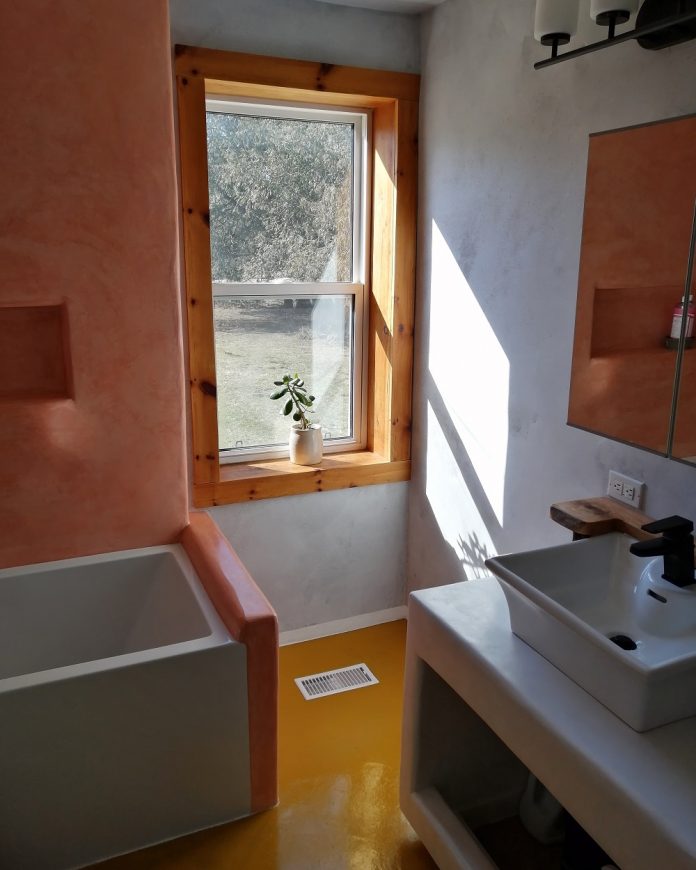
If you’ve chosen to build or renovate using natural plasters, get ready to enjoy the extended health benefits for you and the environment.

“Natural plasters can provide extraordinary comfort,” said Sebastian Renel, owner of Beyond Plasters in Minden Hills and a master craftsman in the art.

“They can create a close connection to the natural world with calming and healing effects. They can help regulate temperature and humidity in homes. They create harmonious spaces and eliminate toxins from our indoor spaces.”

After studying science and fine arts in university, Renel trained as a master craftsman in Japan and holds his certification in Sustainable Building Design and Construction from Fleming College. He is currently partnering with U-Links Centre for Community-Based Research in Minden to further study the benefits of clays and limes in natural plasters.

Renel said the earthen materials used in natural plasters have been among the most popular choices for shelters for “virtually all of human history.”

“Even today, approximately half of the world’s people inhabit shelters fashioned from clay-rich dirt harvested from the Earth’s crust.”

Natural plaster applications are increasing in popularity due to the benefits listed and several more, according to Renel.

For example, clay plasters can screen electromagnetic radiation from computers, televisions and other home appliances. Clay releases negative ions, increasing the freshness of the air in the home. Earthen floors literally help owners feel more grounded, and adding radiant heat provides the ultimate in comfort.

Natural plasters have a very low carbon footprint. Lime will also reabsorb the carbon dioxide it has released during its manufacturing process, which technically makes it a carbon-neutral material. Sourcing materials in Ontario is “very feasible” and sometimes on-site clays can be used.

Applications for natural plasters also include exterior surfaces, ovens, new fireplaces, fireplace remodelling and feature walls, including frescos.

“Mixing and applying natural plasters is a bit like cooking – there are an infinite number of recipes possible,” said Renel.

The most popular – a skim coat over existing drywall – can be smooth and highly polished and “provide a very Zen feel.” Bulkier coats can go on up to one inch thick and provide more texture for a rustic look. Tadelakt plaster is highly water-resistant and can be used for showers, cabinets and backsplashes.

“All these finishes can be customized with natural pigments or finished with natural oils that improve durability,” said Renel. “Fibres such as straw or cattails … help with tensile strength and sometimes create a desirable effect on the surface. If you can imagine it, it can be done.”

In addition to drywall, natural plasters can be applied over wood lath, straw bales, masonry walls and more. The process can vary depending on the scope of the project, thickness of plaster and desired finish or texture. Overall prices range from $6 to $40 per sq. ft.

Renel noted the process can take more time than traditional surfacing, especially for floors, since drying time is required between layers. However, he added, “the qualities of the finished surfaces are far superior compared to some of the conventional paints and other synthetic materials.

“In other words, the finished product is well worth the investment.”

Renovate for universal use

0

Are you living in your forever home, or planning to make your seasonal home the last stop? Will that dwelling remain fully accessible as you age in place? If not, it may be time to consider a universal design renovation.

Universal design enables maximum access to all areas and functionality of the dwelling throughout the human lifecycle, including birth, potential accident or illness, and aging in place. It ensures that your renovation dollars are being spent in the most practical and beneficial way possible for your life in this dwelling and the lives of those who follow.

This approach to both building and renovation is especially important in regions such as Haliburton County, where so many baby boomers have been retiring and so many empty nesters are thinking of retiring. According to Statistics Canada’s 2016 Census, approximately 33 per cent of the County’s permanent population was age 65 and older. Back that up to age 50 and older, and it jumped to 63 per cent.

Universal design has been losing the stigma of function overwhelming form. As the years pass, accessibility options have become more refined. According to the non-profit SAFERhome Society in British Columbia, these homes look better, work better and are worth more on the market.

Think wider doorways, hallways and stairways that contribute to that all-important sense of open concept living. Consider that, as SAFERhome notes, universal design meets the needs of the largest buyer group while offering a stylish, more livable environment for people at any age or in any walk of life. Such a home can be easily adapted to the changing needs of anyone who lives there.

Universal design renovations also increase the number of potential buyers and renters for the dwelling.

The SAFERhome Society’s SAFERhome Standards website features a 15-point checklist with directions for basic structural, design, electrical, telecom and plumbing practices when building or renovating.

These include making all exterior thresholds flush, making all hallways a minimum of 40 inches wide (ideally 42 inches), reinforcing washroom walls for future grab bars, and leaving an allowance for an elevator in stacked closets or building all staircases with a minimum width of 42 inches to allow for stair climber machines.

Electrical and telecom installation practices include positioning all electrical switches at 42 inches to the centre of the electrical box from the finished floor and returning all coaxial cable and telephone runs to one central area for smart control. Plumbing installation practices include particular positioning of all shower and tub controls.

Other options abound, such as installing an oven with doors that swing out rather than pull out, an adjustable-height sink controlled electronically, a high cabinet kick plate that elevates the dishwasher, and lever handles in place of round doorknobs.

If you are considering aging in place, check out the federal government’s planning checklist at canada.ca/en/ employment-social-development/ corporate/seniors/forum/agingchecklist.html.

For the SAFERhomes Standards 15-point “how to” checklist, visit saferhomestandards.com.