

I left last week’s Teeny Tiny Summit in Minden feeling pretty inspired.
Keynote speaker, Peter Kenyon, was a breath of fresh air as he spent an hour dissecting what it takes to build strong, thriving communities. Only, rather than regurgitating a series of verbose ‘how-to’ bullet points telling people how to improve life in Haliburton County, he said they need only do one thing – listen.
Kenyon believes the answers to all a community’s problems lies with its people.
As a society, I feel there’s been a shift recently in that whenever there’s a problem, we look to others to fix it – usually government. The issue with that? Governments have become so bloated, so fixated on process that it can take years to bring even the simplest solutions forward.
Or they’re so oblivious they only see an issue when it’s too late.
Just look at housing. Anyone paying attention could have told you, given the demand for homes from young Canadians, the refusal or inability of successive federal and provincial governments to invest in new builds, and the growing number of immigrants coming to Ontario, that we were on the cusp of a housing crisis.
The same can be said, locally, when it comes to childcare.
Usually, when these big-ticket issues arise, they land on some politician’s desk, or a council’s table, that maybe strike up a volunteer committee, which gets frustrated by a lack of action and disbands. Or worse, pawns it off to a consultant who, for big dollars, puts together a verbose ‘how-to’ list of bullet points telling people what they could be doing.
There’s been a lot of that in Haliburton County in recent years.
Kenyon suggested the first call should be going directly to the public. Host a town hall asking for people to come and suggest ideas. Make it a time that is accessible to everyone. Buy some pizzas and offer a free meal.
This is what the town of Kulin, about 300 kilometres east of Perth, Australia did when it realized it was losing its young people. The community decided the best way to retain talent is to make itself as attractive a place as possible to the younger generations. Volunteers launched the Kulin Bush Races in 1994, which now attracts 5,000 visitors annually and pours about $2.6 million into the local economy.
When they found the benefits of the races weren’t particularly long-lasting, the community came together to raise $25,000 to buy a waterslide and establish a waterpark. When they learned the slide was located 3,000 kilometres away, people volunteered to drive on their own dime to dismantle and transport it back to Kulin.
It’s worked – Kulin now has one of the youngest demographics in Australia. More babies were born there than in any other small town across the country.
These young people have revitalized the local economy. Stores are fully staffed, services you wouldn’t usually find in a small town are available. And they all invest locally too – Kulin was one of the first communities in Australia to open its own community bank. Its people rallied to raise $1 million to save its pub from going under, re-establishing it as a community hub.
The County does well from a tourism perspective but given the difficulty many full-time residents have making ends meet here, it’s incumbent on us to do better. That’s the only way we’ll get our young people to stay.
We need to involve them in local decision-making and help them bring their plans to fruition. Crazy ideas can work – Broome, Australia became world famous for its camel rides on public beaches. It’s now a multi-million-dollar business and one of the community’s top employers. That came from a teenager who wanted to do something different.
Engage our youth. Maybe then Haliburton County could become the Canadian-equivalent of Kulin – a true example of what can be achieved when a community comes together.
Community comes together

Last chance project a win

Some sources say more than 10 million tons of furniture waste (F-waste) ends up in landfills annually in Canada and the United States.
This F-waste can contain plastics, glass, textiles and other material. Because it is often bulky and non-biodegradable, it can take up substantial space in landfills. It can also create long-term environmental problems.
And let’s now forget that greenhouse gas emissions are a byproduct of logging wood for furniture manufacturing, releasing carbon dioxide into the atmosphere. Furniture that decomposes in landfills could also produce methane, another greenhouse gas.
Recent studies have also found that people purchased a lot of cheap furniture during COVID, and that is now beginning to clog our landfills.
What can you do?
You might start by purchasing better quality furniture that is made more sustainably.
And, of course, when that furniture ends its life with you, why not donate it to community organizations?
One of them is SIRCH.
The SIRCH warehouse in Haliburton accepts furniture. It used to be that the staff at the receiving door would determine whether the item was in good enough shape to be put up for auction, or onto the floor for resale.
Sometimes pieces were rejected, leaving the owner with no choice but to bring the item to the landfill. That could be expensive for the person dropping the item off, costly in terms of taking up space in the landfill, and environmentally-onerous as the materials broke down at the dump.
So, it is exciting to learn about SIRCH’s ‘last chance project’. As written about in today’s Highlander, SIRCH has employed Kevin Dunlop at the warehouse as part of the new project.
Now, when someone brings in a piece of furniture, the receiving team can get Kevin to determine whether the piece is salvageable. If it is, he works on the item from a trailer in front of the warehouse. From this mobile work station, he is saving furniture from going to the dump, and allowing it to be put up for resale, in turn benefitting SIRCH and its many programs.
He may not be able to save every piece, but he has a pretty good track record to date.
In addition to fixing the furniture, Kevin is happy to discuss the projects he is working on with the public.
He is eager to share tips of the trade.
He is hoping to inspire others to have a look at the furniture at their homes, and see if it can be fixed, before being donated to charity, or indeed, whether it can be repaired and stay at home.
This program is a lovely complement to SIRCH’s ongoing repair café. At the cafes, volunteer fixers repair all manner of items, not just furniture.
The next one is June 2. Incidentally, they are always on the look-out for volunteer repairers.
The Thrift Warehouse has diverted more than 75,000-cubic-feet of materials from going to landfills already in 2024. In 2023, it diverted 111,000 cubic feet.
Thanks to the ‘last chance project’ those numbers will only continue to climb.
It’s a win-win.
The power of journalism

Hello Haliburton County. I’m your Highlander reporter for the summer.
I’m very excited to be here in the Highlands. I am very happy to introduce myself in this column. I am passionate about storytelling and journalism – breaking the news – and communications.
I believe in the power of journalism to tell great stories, keep power to account, and feature unique things one’s never heard of. I am going into my final year of the journalism program at Toronto Metropolitan University in the fall; I’m going to be doing an internship in the winter semester of 2025 and will be taking courses like video production and reporting on race.
I came up to Haliburton County for the summer because I’m interested in community reporting, and building relationships with people in the community. I like that Haliburton County has a small-town feel to it, and that people know one another and talk to each other. It’s a world of difference away from Oakville and the Greater Toronto Area, but it’s a positive change and a change I’m welcoming. I’m interested in arts stories, and was ecstatic to hear that Haliburton has a vibrant arts scene.
I’m really looking forward to my time here in the Highlands. I’ve been to Algonquin Provincial Park for camping in August and again last year, when I came to see the fall colours in the park and stayed in Huntsville. I’ve been living in Oakville for the past 16 years and consider myself to have grown up there.
I used to play piano growing up. I did the Royal Conservatory of Music program and completed Grade 9, along with the accompanying Grade 3 Harmony and History component, with honours. I wrote briefly for the engineering school newspaper, in the form of a monthly column. I covered tips and tricks for university, and what to do during reading week, among other topics. I also like to cover human interest stories and write feature stories as well. Before coming to The Highlander, I read up on the newspaper and liked the profiles of people living in the community. I plan to write more about these and arts and community reporting during my summer here.
Although I’m dipping my toes into community reporting and wading in the waters of it this summer, my long-term goal is to work for a big daily newspaper, like The Toronto Star. This may change, as I continue working at The Highlander; I may find I like community reporting so much and want to stick with it. I’m a big believer in living alone as a way of gaining new skills and experiences and am looking forward to trying out some new restaurants with my family in the area and cooking for myself.
If you would like to reach me this summer, my email address is reporter@thehighlander.ca. If you have any tips, questions, or would like to e-introduce yourself, email me. I may just feature your idea or story tip.
Poverty rates ‘shocking, not surprising’
HIGHLANDER INVESTIGATES
The Haliburton, Kawartha, Pine Ridge district health unit (HKPR) has pegged the living wage for the region at $20.60 per hour in a recent report addressing local food insecurity and poverty – though Joli Scheidler-Benns of the City of Kawartha Lakes Haliburton Poverty Reduction Roundtable believes that number is “way, way off.”
Each year, the health unit updates its statistics on incomes and the cost of food and rent in Kawartha Lakes, Haliburton County, and Northumberland County – providing a snapshot of how, and where, people are struggling.
A key component of the study is monitoring food affordability and accessibility using the provincial nutritious food basket (NFB) tool. The health unit says the cost of the NFB across HKPR helps show the link between healthy eating and family income in the area.
It also looks at average monthly rents using rental listings from online marketplaces and newspapers. In its report, HKPR says anyone spending more than 30 per cent of their income on accommodation is likely living in poverty.
Government, community leaders must do more
It considered various scenarios – at the top end, a family of four with a median monthly income of $9,290 were found to spend 26 per cent of their income on rent ($2,391 for a three-bedroom) and 13 per cent on NFB foods ($1,184), leaving $5,715 for other basic needs. This demographic was the only one in the report to be above the poverty line.
A family of four with minimum wage earners brings in $4,166 monthly – spending 57 per cent on rent and 28 per cent on NFB, leaving $591. A senior living on old age security rakes in $1,996 monthly and spends 73 per cent on rent ($1,451 for a one-bedroom) and 15 per cent on NFB ($307 for a single person), giving them $238 for other essentials.
At the lowest end of the scale, a single person living on Ontario Works receives a maximum monthly income of $868. With average one-bedroom rentals at $1,451, or 167 per cent of an OW recipient’s income, and NFB costs taking another 49 per cent, they’re already $1,008 in the hole before accounting for any other cost.
“People are really struggling,” ScheidlerBenns said. “When you factor in the cost of rentals alone, if you can even find one, our lowest earners and people enrolled in programs like OW and ODSP just don’t have a chance.”
In its report, the health unit stated 12.9 per cent of County households are considered low-income. The poverty roundtable, in a 2021 release, estimated that number at closer to 17.9 per cent.
Scheidler-Benns believes the situation today is even more challenging.
“My guess is the numbers have increased. Part of the challenge with statistics is the numbers are usually around 15 months out of date by the time they’re released. Prices have gone up drastically since then, for pretty much everything – food, housing, fuel, heating… those on fixed incomes are trapped.”
There hasn’t been an increase to OW rates since 2018. Those on ODSP saw marginal increases – five per cent in September 2022 and 6.5 per cent in July 2023, but the maximum people receive through that program is $1,308 per month – which doesn’t even cover the cost of a rental today.
Lived experience
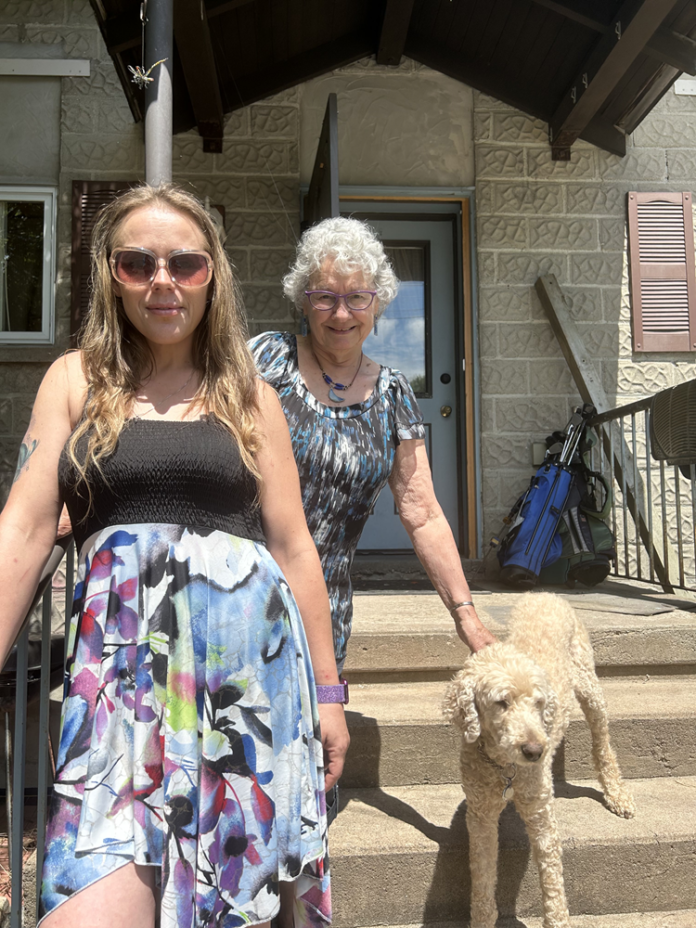
Forty-year-old Haliburton resident Angie Wilson has been living on ODSP for much of her adult life. Born in British Columbia, but raised in the Highlands, Wilson moved back to the County in 2013, after a few years in Barrie. She needed somewhere more affordable to raise her three children.
She was comfortable for a few years, but around 2017 – when cost of living started to increase – the struggle set in. With the walls closing in, Wilson found salvation through Places for People – a County-based nonprofit committed to providing affordable housing to those in need.
Wilson was given a three-bedroom apartment in Haliburton village at a reduced rate of $906 per month.
“I would have been screwed without Places for People. They have saved my life more than once. I would have lost my kids multiple times over if they didn’t step in when they did,” Wilson said.
Two of her children have since come of age and moved out – drastically changing Wilson’s income. She receives money from ODSP and child support for her 15-year-old daughter, but with costs rapidly rising over the past 18 months, and Wilson’s monthly intake dropping by around $1,000, she said she’s struggling to keep her, and her daughter’s head above water.
She recently took a roommate, her uncle, and while that’s provided some respite – helping to cover the cost of basic necessities – Wilson said she feels trapped. “The depressing, hopeless thing for me is I know there’s no future. I don’t have anything to look forward to. Once my youngest daughter gets older I don’t know what I’m going to do,” Wilson said – noting her only income will be her monthly ODSP cheque.
“I still have those costs, because you’re always going to help your kids as much as you can. But I’ll be spending more than half my income on rent. And I’m one of the lucky ones, already living in subsidized housing.”
Services stretched
Janine Mitchell, manager, human services with the City of Kawartha Lakes – which delivers social services to County residents – said, as of Sept. 2023, her department is assisting 255 people from the County on OW.
They also support low-income working households. The minimum wage in Ontario is currently $16.55 per hour. In a recent report to CKL council, Mitchell said single workers, or single worker families, working full-time on minimum wage bring in $30,121 annually. Using the health unit’s $20.60 living wage, full-time workers would bring in $37,492.
“The idea when minimum wage was first introduced was that one parent heading off to work could comfortably cover a household’s costs – that’s just not possible anymore,” Mitchell said.
The demand for social housing is greater than it’s ever been. The Kawartha Lakes Haliburton Housing Corporation is responsible for managing the local program. Aaron Mulcaster, program supervisor, said there are 429 households on the waitlist for community housing in the County.
He said 101 households have been on the waitlist less than a year. “A few” have been waiting 10 years or more.
Mulcaster said KLH has found housing for 27 County families since Jan. 1, 2023.
With costs rising across the board, more people than ever before are turning to food banks for support. Jean Munroe, executive director of the Minden Community Food Centre, said demand for service increased 27 per cent in 2022 and 35 per cent in 2023. It’s been a similar story through the first half of 2024, she said.
Barbara, who asked that her last name not be published, said she’s been relying on the Minden food bank for years. Also living on ODSP, Barbara said around half of her monthly income goes towards rent. After heat, hydro and other necessities she said that leaves her with next to nothing for groceries.
“Nobody wants to go to the food bank, we go there because we have to. I’d starve if it wasn’t for them,” Barbara said. “It’s not a nice way to live – I don’t have much, don’t get to do much. It’s just survival at this point.”
The Central Food Network, which operates food banks in Cardiff and Wilberforce, reported a 37 per cent increase in demand across the two sites in 2023. Tina Jackson, CFN executive director, fears people are struggling more than ever before – estimating a similar, if not greater, demand through the first half of 2024.
Judy MacDuff, manager of the 4Cs food bank in Haliburton, said demand increased about 28 per cent in 2022 and 31 per cent in 2023. With a similar increase likely for 2024, the Haliburton facility will be serving double the number of clients it did in 2021.
The children
The health unit estimates 25 per cent of children in the Highlands are living in poverty. Marg Cox, executive director of Point in Time, said that number is shocking but not surprising.
“I would say we deal with it every day – whether it’s a young child, youth, or older teenager. We’re trying to help them as much as we can,” Cox said.
Point in Time has partnered with Haliburton Foodland to collect food donations it can pass on to families in need. It also receives frozen meals from SIRCH Community Services. Occasionally, Cox said they’ll use cash or gift cards to buy food for people in a real crunch.
She estimates they’re assisting between 150 and 200 people per month.
Cox believes most service providers are already doing everything they can to help people. Real change, she says, needs to come from the different levels of government.
“The gap between the haves and have nots continues to widen… this is Canada we’re living in. It’s not supposed to be a place where people go hungry. And we know that people are,” Cox said. “I remember there being a campaign years ago, groups talking about ending poverty by the year 2000. I think we’re further away from that than ever before.
“It takes governments and community leaders making it a priority to come together and really figure out, together, how to deal with this issue. That hasn’t really happened yet,” Cox added.
Firefighters prevent vehicle blaze from spreading

Red Umbrella Inn owner Ziad Halasah was working in the office July 8 when he noticed one of his staff fly past in a vehicle. He was a bit surprised by the speed so went out to see what was going on.
The sight of a truck used for plowing engulfed in flames was naturally “unexpected” as was the plume of black smoke pouring into the air.
The fire, in the parking lot across from the inn, was also a worry as they store a lot of items in the area for people, including ice racing cars, and sailboats. Guests also use the lot to park their cars. There was a fence and home just to the north of the blaze on a hot day with wind.
A call was placed to 9-1-1 while inn staff tried their best to extinguish the truck and move items, including a large house trailer, out of the line of fire.
The first fire crew arrived from Algonquin Highlands, quickly followed by crews from Dysart and Minden Hills.
Minden Hills fire chief Don Kruger said the original call went to Algonquin Highlands and Dysart, with Minden getting its page around 2:30 p.m. Minden was out on another call for a vehicle in the ditch at the time.
“All three fire departments were on scene at one point,” he said.
“I guess the owner of the Red Umbrella Inn had somebody moving a plow truck out of the field.” Kruger said the person saw smoke in the cab, “and the vehicle went up in flames.”
He said flames were spreading through the grass; a snowmobile in the bush went up; and they were moving towards the house and trailer, along with other items.
“Fortunately, the fire crews were able to get there quick enough and prevent it from spreading beyond the vehicle and the little bit of grass there,” he said. “There was the potential for it to be much more than it was, fortunately, it was just a run-of-the-mill vehicle fire.” He confirmed there were no injuries. He estimated about 20 volunteer firefighters attended.
But it was far from ordinary for Halasah, who expressed relief no one was hurt and thanked volunteer firefighters for getting the situation under control quickly.
“I’m grateful to these people for what they do,” he said.
LCBO workers striking, stores closed

Rather than be ticked off they couldn’t pick up their favourite bottle of liquor from the Haliburton LCBO, several would-be customers hammered their car horn and bellowed messages of support for staff walking the picket line along Highland Street July 5.
Last Friday was the first day on strike for Ontario liquor store employees, with more than 9,000 workers walking off the job following a breakdown in negotiations between the LCBO and Ontario Public Service Employees Union (OPSEU).
Guy Alaimo, manager of the Haliburton LCBO, said it’s the first time liquor store employees have been on strike in Ontario. “The issue is a lot more than just wages – yes, money is a part of it, but the biggest issue for me and most of my employees is job security,” Alaimo told The Highlander.
He estimates around 70 per cent of the LCBO workforce are casual employees, who aren’t guaranteed hours and rarely receive benefits. He noted these workers only qualify for benefits after working at least 6,000 hours, which Alaimo estimated would take five or six years.
The latest offer, rejected by employees July 4, leading to the strike action, was for employees to receive a 2.5 per cent wage increase and LCBO to make an additional five per cent of workers full-time.
“Right now, 30 per cent of the workforce is full-time. They’re offering to bump that up to 35 per cent, but we want more than that,” Alaimo said. “The wage increase we’re asking for isn’t huge – we just want them to meet us on inflation, meet us somewhere fair.”
While Alaimo didn’t share how much workers were hoping to get, he pegged inflation and increase in cost of living at around seven per cent.
The Haliburton store typically has between eight and 10 active employees – four of them full-time, including Alaimo. He’s worked there for 10 years and considers himself one of the lucky ones.
“I started as a fixed-term employee, then went casual and became full-time very fast. In most areas in and around the city, you can become full-time working at LCBO after seven or eight years. It’s different here. In these small towns, to get a full-time position with benefits, I know some ladies who took 20 or 25 years to get that,” he said.
The strike is set to run until July 19, but Alaimo said stores will reopen earlier if an agreement is reached. With staff earning $50 per day on the picket line – much less than their usual take home – the local manager hopes the standoff won’t stretch into a second week.
It’s going to take some concession from the Ontario Government, though. One of the major sticking points in negotiations thus far has centred on the proposed expansion of alcohol sales in grocery stores and other outlets. While beer and wine has been readily accessible for several years, there has been talk of making liquor and ready-to-drink cocktails available too.
Alaimo feels that would be a mistake.
“Right now, about $2.5 billion per year goes right back to the Ontarian people as a dividend from the LCBO. If we move further and further into the privatization of alcohol sales, that money will be gone. It’ll go into the pockets of big business,” Alaimo said. “The system we have now is great. There’s no reason for change.”
All 680 LCBO stores in Ontario – including ones across the County – remained closed as of press time, though free home delivery is available. If the strike lasts longer than two weeks, LCBO says it will open 32 stores three days a week, from Friday to Sunday, with limited hours – though it has not disclosed locations.
Minden urgent care clinic turns one, new manager at helm

As the Minden Urgent Care Clinic continues into its second year of operation, there is a new executive director at the helm.
Cinnamon Tousignant has replaced Marina Hodson as the head of the team that is now running the local clinic seven days a week out of the former Minden emergency department.
The clinic first opened its doors for weekends on June 30, 2023. It is now open seven days a week from 10 a.m. to 5 p.m. There is a dedicated registered practical nurse (RPN), nurse practitioner (NP), and administrative support person during the week. On the weekends, casuals fill the shifts.
“Generally speaking, we’re very consistently staffed, even despite there being a human resource crisis in healthcare,” Tousignant said July 8. She attributed it to staff being local, “fairly” local, or who were involved in the beginning.
“They’re just really committed. They love being up here. They love the community. They want to provide healthcare services. There’s a lot of personal values and ethics that tend to come into play, so people like being a part of the community in which they live,” Tousignant said.
While they trialed an additional virtual care component in June, the part-time NP offering the service has left for another job. It is on hiatus, although Tousignant is hopeful a potential hire may join the clinic in the fall to resume virtual care days. For now, they essentially remain one NP short for three days of the week as per their funding. But Tousignant said they were happy to do the groundwork on the position as the virtual care, “is an excellent back up and can boost capacity.” While the NP was available Tuesdays, Wednesday and Thursdays, the clinic did not have to turn anybody away due to capacity and Tousignant said people were “satisfied” with the virtual offering.
“There are still a lot of things they can address virtually but you can’t suture somebody,” she said.
The clinic has registered more than 7,000 patient visits in its first year of operation. Tousignant said with three designated staff weekdays and casuals on weekends, they are capable of seeing 25 patients a day, 364 days of the year. That said, they had 35 on July 6.
At 25 a day for all but one day of the year, that equates to 9,100 visits in a full calendar year.
“That is what we’re likely looking at to accomplish,” Tousignant said, adding it is definitely taking pressure off the Haliburton hospital ER department. They only redirected 15 patients there in the last year after being assessed at the clinic. She attributes that in part to good education about what the clinic does.
“An urgent care is different than a walk-in. There’s quite a bit more we can do than a walk-in.”
Haliburton Highlands Health Services president and CEO Veronica Nelson told attendees at a recent AGM, the number of emergency department visits there dropped 29 per cent, down to 17,480 in 2023/24, from 24,701 the previous year, with 4,479 urgent care clinic visits in HHHS’ fiscal year.
Tousignant added they also see a lot of people who do not have primary care providers. “We are an urgent care but the reality is we’re also primary care for a lot of people. And that is actually where the virtual care room was very helpful. Because someone coming in for a prescription renewal, in and out with virtual care. We have to triage and prioritize through the urgent care, and you can easily sit there for three or four hours waiting just for a prescription. That’s a lot.”
Taking over the ED post effective April 1 this year, Tousignant is aware of the history of the Minden ER being shuttered on June 1, 2023 with just six weeks’ notice.
“I definitely recognize there are a lot of emotional connections to what happened here. I can understand people being upset that they’re losing their emergency room. I understand from the funding and HR perspective why it happened, but that doesn’t negate how uncomfortable it made people not to have an emergency room department, valid, valid concerns,” she said.
Tousignant has been with KNFHT for 15 years. Prior to that, she was with the Canadian Mental Health Association. She took a break from management but says she is enjoying being back. Hodson has remained in a part-time capacity as finance and human resources manager.
Barclay: ‘not heavy lifting’ coming to Minden

On the phone from Prince Edward County, Linwood Barclay is asked for his advice to Haliburton County authors, other than his standard read and write.
“When you show what you’ve written to your mom, or your husband, and they say ‘it’s wonderful’, don’t believe them. Because what else can they say? What are they going to tell you? ‘This needs work’,” the author of 24 novels and counting shares.
“It’s tough, but if doing it gives you pleasure – and your dream isn’t necessarily to hit the Globe and Mail bestseller list – but you find it’s relaxing, or it allows you to work things through, just keep doing it. But being able to make a living in this kind of business is rare.”
Barclay is one of those rare novelists, and the former journalist with the Toronto Star and Peterborough Examiner is coming to Minden July 13.
He gets lots of event requests and gets to pick and choose which he attends. He selected Minden as it’s close to his “old stomping grounds,” living for years just south of Bobcaygeon. His family owned Green Acres, a cottage rental and trailer park on the west side of Pigeon Lake.
“This is not heavy lifting to come up and do this,” he said.
He shared how his dad died when he was 16 and he largely ran the business. He spent hours cutting grass, his imagination running amok. “I would sit on my John Deere riding mower imagining stories and I think that is what has stayed with me… that kid was writing. I was cranking out stories like crazy from about Grade 6 on.”
Briefly turning to his latest offering, I Will Ruin You, Barclay is asked about resonating with the main character, Richard.
“Probably there is a little bit of me in all of the main characters,” he replies. “These main characters are in no way equipped to deal with the kind of people they’re going to come up against. They have regular jobs. They’re not ex-Navy Seals, spies or cops. They’re teachers, small-town newspaper reporters, used car salesmen because that’s the kind of people I know, who I hang out with. I always say, ‘what would it be like for people like us brought up against some pretty bad business’?”
He is asked about anxiety – something he references in his characters. “I’m a great worrier. About small things and big things,” he says.
Quoting Martin Luther King’s “the arc of the moral universe is long, but it bends towards justice,” he adds, “I’m starting to think it doesn’t look that way to me and so it’s easy to become very discouraged. It’s hard to find any kind of silver linings these days. There seems to be a celebration of ignorance lately and a rejection of actual facts. It worries me a great deal.”
Does writing fiction allow for an escape? Not really, he says, rather sometimes prickly subjects find their way into his books. For example, there is a theme in I Will Ruin You where parents question the appropriateness of a book that English teacher Richard is having his students read. Barclay is no fan of banning books. “If you have an axe to grind, you can still do it in the context of a thriller.”
He said he sometimes gets feedback from readers who do not want this opinionated content, and offers sardonically, “and my thinking is, that’s why we become writers, to keep our thoughts to ourselves.”
So, why is he continuing to do this – with novels 25 and 26 coming out next year?
“You can’t imagine not doing it. What are you going to do? Sit around, watch TV and have this great idea for a book and not do it? I think that would be hard. If you have a job that you hate, you can’t wait to retire and that’s wonderful. But to have the privilege of doing something you really enjoy, why would you throw that away?”
Bookapalooza begins at noon Saturday with an exhibit hall filled with dozens of local authors. Admission is free. A ticketed conversation with Barclay happens at 3 p.m. followed by a book signing. There’ll be a reception and dinner with the author at the Dominion Hotel at 6 p.m. This is a paid event. See more at haliburtonarts.on.ca/ bookapalooza
Exhibit depicts beauty, but an underneath as well
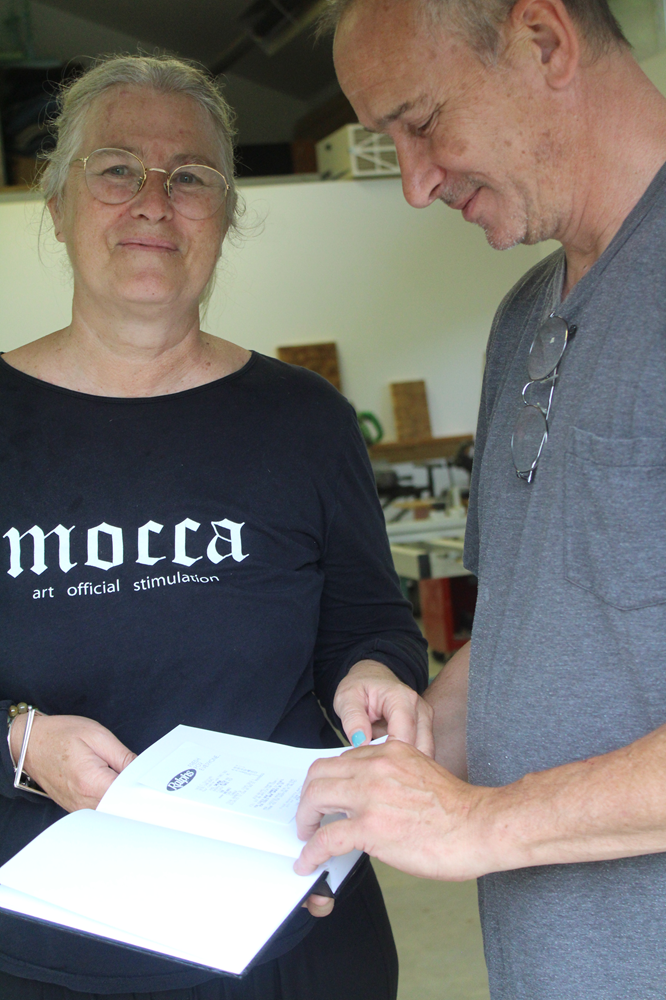
Looking outside of Chris Hanson and Hendrika Sonnenberg’s art studio, The Inconvenience Store, one would notice the large QR code smack dab at the front of the building, attached to the wall.
It leads to their website, Bucket of Blood. It’s a flashy name for an unassuming art studio, on a side road in Minden, which looks on the outside to be a warehouse.
The artists said their studio is in an “inconvenient location” and has an inconvenient time slot for visitors, hence the name. The art space houses what Hanson and Sonnenberg call their art projects. Hanson and Sonnenberg prefer to be known as the artist in this piece as they want their voices to act as one entity. “It’s all about the work,” said the artist, echoing their sentiment that they want to have the artwork front and centre. The artist has been working together for 30 years, hence their request to be one voice in the media.
June 29 saw the opening of Susan Homer’s paintings and drawings exhibit. Homer’s artwork runs the length of a wall. Paintings of a dead bird on the side of the road and of an owl, which is on the exhibit’s marketing, evoke a sense of bluntness. “She brings in other sorts of topics. There’s beauty. But also, this sort of underneath, this sort of poetic about the subject matter,” the artist said.
Homer was born in Boston and received a Bachelor of Fine Arts from the Rhode Island School of Design and a Master of Fine Art from the School of the Art Institute of Chicago. She has exhibited her paintings and drawings in New York City and in other places. She has drawn and painted birds and flowers for 35 years. Homer said she mostly hopes to create images that bridge subject and material, that express something beyond what can be described in words. She is inspired by the decorative arts, gardening and backyard birding, and by the woods in Maine, and Emily Dickinson, among several other things.
The artist prefers to think of their exhibits as collaborative projects, which allows them to work with creators they have a relationship with.
In terms of collaborating with Homer, the artist said, “we’ve known her for a long time. We studied our Master’s together. Then, we all decided there was a group of us who didn’t want to stay in Chicago, and we all moved to New York City. We always did the studio visits, shared our work together, always having conversations, getting together with wine and talking about art.”
The artist added, “her subject matter is not such a traditional approach to painting birds or flowers. It’s interesting because there’s some things that just make you question what you’re looking at.”
Sonnenberg shows a painting of a dead mouse that Homer’s late dad’s cat killed. “There’s a hidden intensity to her stories, what she paints.”
On being creative in a small town, the artist said it’s the same as being creative in a big town or city. The artist notes there’s more freedom to do what you want. The art studio is located at 3 Booth St. Minden and is open on Saturdays from 3 to 5 p.m. The Susan Homer exhibit will be running for two months.
Reviving dinner cruises from the 1950s

Imagine savouring gourmet, hand-made, cuisine while cruising along serene waters, surrounded by gorgeous views of the Highlands.
Heather Lodge and Ski-Mazing Watersports have launched a Cruise N Dine experience, offering guests a blend of culinary delights and scenic beauty.
Guests climb aboard a pontoon boat for a three-course meal prepared by chef James Jennings from the lodge. The menu features Canadian fare, with local products infused, such as from Abbey Gardens and Wintergreen Maple Syrup. The menu features steak, chicken, pork, shrimp appetizers and smoked chicken, mushroom white wine gorgonzola cream fricassee on a puff pastry.
Music can be played on the pontoon boat, which can seat up to nine people, and has been chartered by Ski-Mazing.
The boat leaves from the lodge’s dock and onto the waters of Twelve Mile Lake, and along the lake system connecting Twelve Mile, Little Boshkung and Boshkung lakes.
Maria Jennings, owner of Heather Lodge, was on board July 4 to share some stories of homes along the waterfront, and talk about the lakes and how they’re connected to the Trent Severn Waterway.
Spencer Bowker captained the boat and also offered commentary on the lakes and how they’re connected to other bodies of water around the County, such as the Gull River.
Craig Bowker, owner of Ski-Mazing, called the venture “a new concept for dining out at sea. We’re offering dinner cruises that are chartered through Heather Lodge, which is a well-known dining establishment, and people can choose from their menu.
“We thought it would be a nice, new, unique concept that hasn’t been done in Haliburton, probably since the 50s, so we’re reviving dinner cruises for the area, and we really hope that people will come out and enjoy it with us,” Bowker said.
The cruise lasts an hour-and-a-half. Jennings added, “it’s a fine-dining experience. Everything’s made to order by a professional chef.”
Tickets can be purchased at Heather Lodge and are $230 per couple. The cruise leaves from the lodge at 5 p.m. on Tuesdays, Thursdays and Saturdays. More dates of the week may be added as the event grows in popularity, Bowker said.
Angelica Ingram, the County’s tourism manager, was on the cruise and said, “it was a very enjoyable experience, from start to finish. I thought the collaboration between Ski-Mazing and Heather Lodge was incredible, and it was an experience unlike anything else in the County, and so it was fun to be a part of.”