
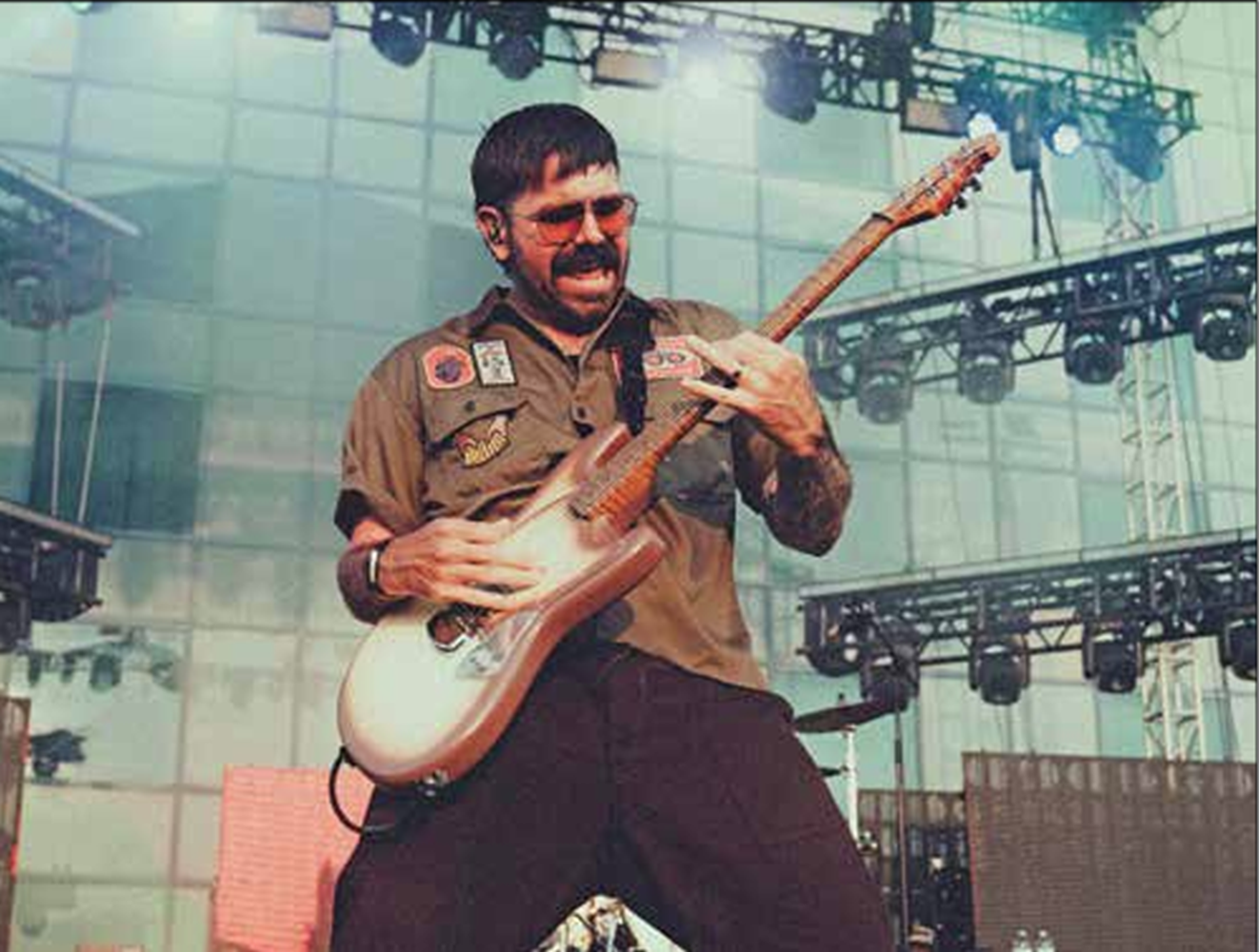
Earning a living for the past 26 years making major noise touring the world with Canadian post-hardcore band Silverstein, Josh Bradford said he’s able to balance his loud life on the road with the peace and tranquility of Haliburton County.
One of Silverstein’s founding members, playing rhythm guitar, Bradford said he still has a hard time wrapping his head around the fact he’s spent the bulk of his adult life living his dream.
Sitting down with The Highlander during a rare break from touring earlier this summer, Bradford tells how the band got its start in Burlington in 2000 and went on to form one of the most recognizable sounds of the ‘emo’ wave that took over music at the turn of the millennium.
“We were very underground for a while – we’d go to shows that were put on in the basement of a record store… not a whole lot of glitz, glamour and prestige, but we loved what we were doing and believed in the music,” Bradford said.
This wasn’t his first foray into music. When he was a young boy, before he could even formulate words, Bradford said his parents recorded him belting out renditions of popular songs from The Beatles and The Beach Boys. He started piano lessons at seven, leaning into the classical music his grandfather played as part of the Hamilton Philharmonic, but it didn’t stick.
By the time he was a teenager, the grunge scene that exploded in Seattle, Washington with bands like Nirvana, Pearl Jam, Soundgarden and Alice in Chains, started to take over the world – or at least that’s how Bradford remembers it feeling. It was a major departure from the heavy metal and rock that had dominated the music scene for well over a decade.
With new sounds becoming mainstream, Bradford started to experiment. His first band, Questionable Sushi, played a mix of ska, reggae and punk rock. They became a bit of a local sensation, one of the prominent up-and-coming voices of Burlington’s underground scene. It also introduced Bradford to his future Silverstein bandmates.
After hitting the proverbial glass ceiling with Questionable Sushi, Bradford said the formation of Silverstein allowed him to grow up and evolve musically.
“Silverstein was more purposeful – the musicians were handpicked because of their abilities. We started playing shows and it was real slow at first, but we started gaining a following in Burlington,” he said.
The band was writing original material and put out two self-released EPs, starting with Summer’s Stellar Gaze in August 2000 and following up with When the Shadows Beam that winter. Then came a successful two-week tour of the east coast, which convinced the musicians to go all-in.
Once home, they put together a press kit with information on the band and demos of their original music and sent them to every record label they could think of. In late 2002, they signed with Chicago-based Victory Records.
“They believed in us enough to finance a proper album,” Bradford said, noting he quit his job at a ski and snowboard store to focus completely on the band. That culminated in the release of When Broken is Easily Fixed in May 2003. It was filled with re-recorded songs from Silverstein’s two prior EPs and was a hit, propelling them onto the global stage.
Quarter-century
Celebrating their 25th anniversary last year, Bradford said Silverstein has now played in 45 countries. They performed on three continents during their quarter-century tour, with dates in North America, Europe and Australia. Later this year, they’re going to Africa for the first time.
Asked about markets the band sees the most success, Bradford said Silverstein is biggest in Canada, the U.S., Australia and Germany, though also has a strong following in the Philippines.
Since 2021, whenever he isn’t touring, Bradford has spent the bulk of his time in the Highlands. He credits the area with broadening his musical community, making several new connections, while also giving him the opportunity to heal after two decades on the road.
“The 26 years of late nights, non-stop travel and bad habits were catching up with me. Since moving here, I have taken my health more seriously. Finally getting sober, working out and eating well [has made a huge difference]. I got a skin cancer diagnosis and fought that living here,” Bradford said.
“I have made strides in every aspect of my life and really do think that something about this place has given me the space to explore and grow that I couldn’t find elsewhere. These hills, forests, lakes and rivers are my home, and they’ve given me a lot,” he added.
After thousands of performances over the years, Bradford said he still feels butterflies on stage when looking out at the crowd. With 13 albums under their belt, he feels the band’s sound has evolved – more mature, less angsty and mopey – and that they’re at the peak of their powers.
“We’ve already gone longer than I could have ever imagined. At this point, why stop? I think as long as people keep connecting with the music and coming to the shows, we’ll keep going,” Bradford said. “I don’t want to be the Rolling Stones of emo, but I’m still having fun.”