
A former director of the Haliburton County EMS told Eastern Ontario Regional Network (EORN) consultants Tuesday (June 23) they could find municipal government efficiencies by consolidating roads, and fire, departments in the Highlands.
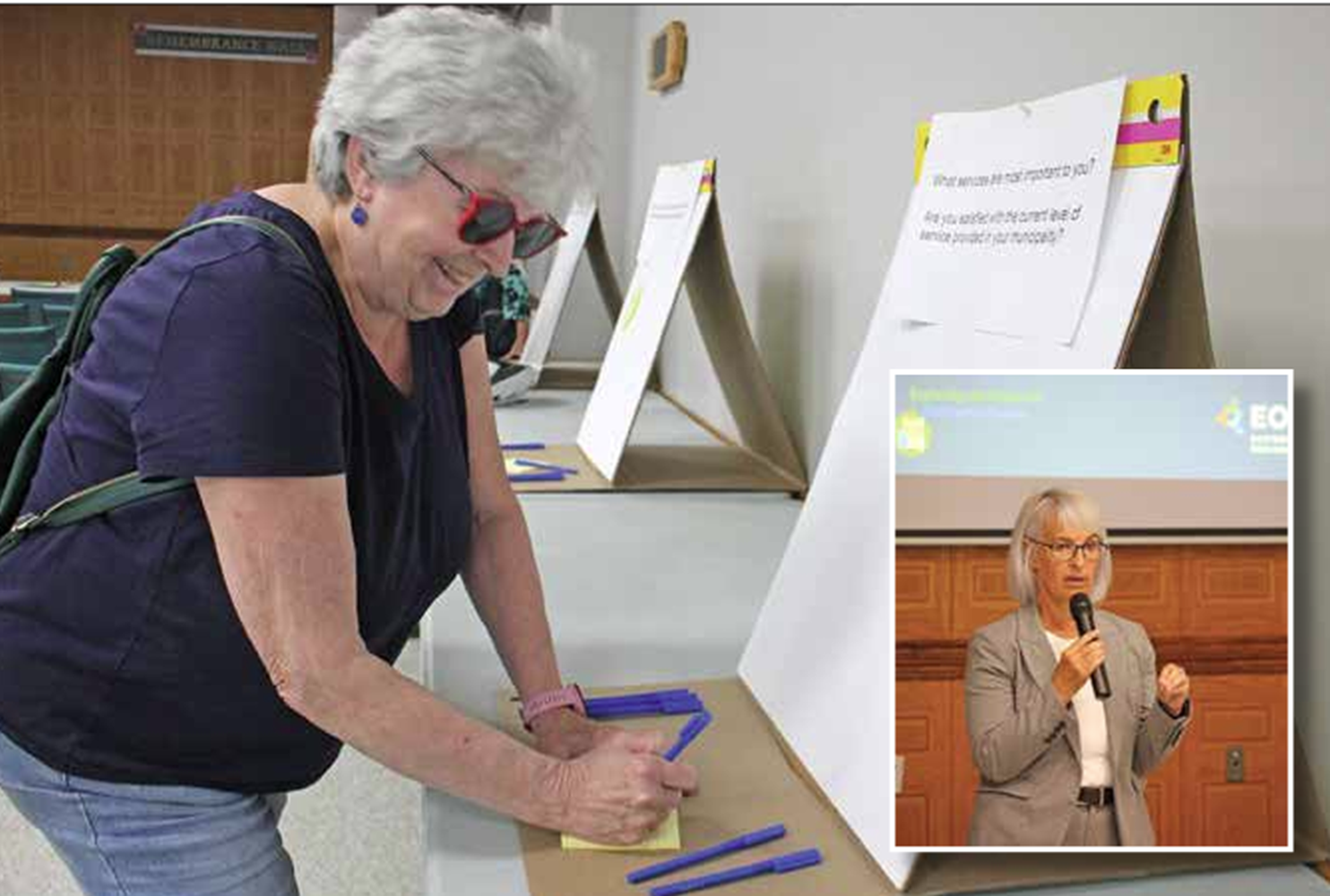
Bob English was one of about 20 people who attended an open house for an affordability and governance study that EORN is doing on behalf of the County of Haliburton.
His comments came after consultant, Maureen Adams, said one example of making local government more efficient could be centralizing planning services at the County level. Now, each municipality has at least one planner and some have junior planners.
English said it’s been done for paramedics and is not about losing personnel, but rather “wanting to provide seamless service,” with things such as standardized firefighting equipment, dispatch, and response times. He noted that now, some fire departments in the County can do water rescues, while some can only do shore rescues.
He said this could also be done with plow routes and parole yards.
Former County warden Chris Hodgson said because the County is small, the consultants must come up with a unique plan and then seek changed funding formulas from the province for things such as OPP billing.
Talk of consolidating services
Farmer Godfrey Tyler said one of the study’s challenges is that there are two distinct societies in Haliburton County: those who were born and grew up there; and newcomers in the form of retirees, migrants, and refugees from urban areas. “Their interests are different.”
Adams said they are also hearing from people that youth are looking to move elsewhere because there is nothing to keep them in the County.
Fellow resident Pamela Marsales wanted to know where the study was headed. Adams told her they are gathering feedback in June, then hoping to provide modeling options to the County at the end of July. It will be up to the County of Haliburton whether those models are taken back out to public meetings.
She noted nothing is predetermined; it could be status quo; amalgamation from two to single-tier or a modified approach, including talk of perhaps consolidating a couple of townships. She said they would come up with models, including costs, and service delivery levels.
EORN has been meeting with Highlands’ residents all week as part of the study. Last week, they held engagement sessions with the County, Algonquin Highlands, Dysart et al, Highlands East and Minden Hills.
Jim Pine, of Jim Pine Consulting, Adams and Lisa Severson of EORN have been making the rounds.
“We really want to make sure people can participate as fully as they possibly can because we do want that individual reflection from people and we want to take advantage of group discussions …” Pine told councillors.
He said the study is underway now because of growing fiscal pressures and challenging 2026 budgets.
EORN added the study will clarify each municipality’s financial state and future pressures; analyze governance models; look at good examples from other areas; and set things up better for the 2026-2030 councils.
Adams said one of the greatest challenges for this area is the tax base is 98 per cent residential, which limits how much money municipalities can bring in. She noted the Municipal Property Assessment Corporation (MPAC) has not done a property reassessment since 2016. Further, the average household income is 17 per cent below the provincial average.
Adams added Haliburton County relies heavily on a tourism-based economy with seasonal service demands. There are some high-cost services, such as OPP, that are beyond local control and federal and provincial infrastructure funding is unpredictable and insufficient.