

By Adam Frisk
Local Journalism Initiative Reporter
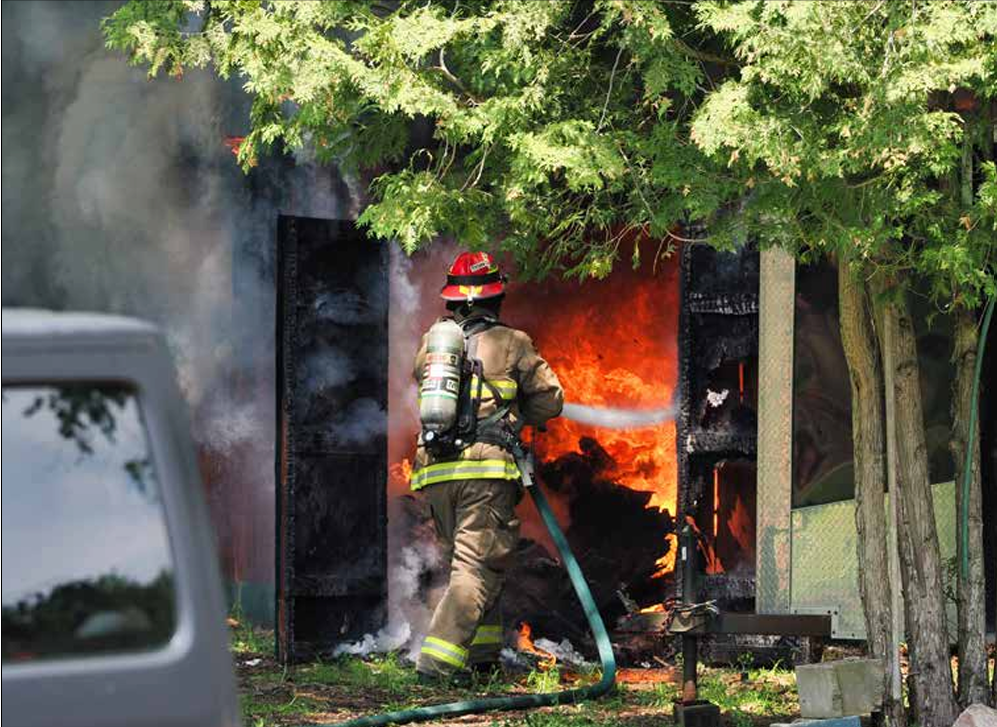
While a recent string of wet weather has been well-received, Haliburton County’s fire services are standing together with a single message: the wildland fire risk is high across the region.
The long stretch of dry weather has left the forest floor across all four townships vulnerable, leaving municipalities to raise the fire danger level to “high.” Both Highlands East and Algonquin Highlands issued a statement on social media and their websites, warning of the fire threat.
“Please note that the fire rating within the Township of Algonquin Highlands has been moved to high. Daytime burning is prohibited this time of year,” the municipality said in the statement. “If you are burning at nighttime, please take extra caution and ensure your fire is fully extinguished.”
The four townships use roadside signage to indicate municipal burn allowances throughout the year, but not the daily environmental fire hazard ratings that are posted on their websites.
Conditions dryer in southeast of County
“It’s the burn levels. It’s not the fire danger rating,” explained County fire co-ordinator Michael French, who speaks as a unified voice for all four local departments. “It’s your burn opportunities.”
The County is operating under a uniform “yellow” condition, which permits open air burning strictly between 7 p.m. and 7 a.m. No daytime burning is allowed anywhere in the County between April 1 and Oct. 31, and grass fires are entirely prohibited.
According to data from the Ministry of Natural Resources and Forestry (MNRF) and the Aviation, Forest Fire and Emergency Services (AFFES), the recent storms brought heavy rain to portions of the County while other areas saw less, leaving the forest floor to dry out at
different rates.
Provincial officials rely on the Canadian Forest Fire Weather Index, a system maintained by Natural Resources Canada, to map the risk. Currently, the County’s fine fuel moisture code, which measures the dryness of forest debris, remains in the low to moderate range.
However, the Build Up Index (BUI), which calculates the moisture buried in the forest floor, tells a different story.
“The BUI is primarily in the moderate range across the area, with higher values in the southeast portion of Sector E01, Haliburton’s primary area of fire responsibility,” Evan Lizotte, information officer with the AFFES, explained to The Highlander.
While township fire chiefs have the authority to declare municipal fire bans within their borders, a worsening dry spell could trigger a broader provincial response. AFFES said that should conditions get to a point where any open air fire poses a threat, or if active wildland
fires begin stretching provincial response systems thin, the MNR can step in with a blanket Restricted Fire Zone (RFZ).
“They are implemented by the MNR when conditions are so hazardous that an open-air fire of any kind, no matter how well tended, could represent a real threat to the surrounding area by escaping or spreading out of control,” Lizotte said.
“RFZs are also implemented when there are increased fires on the landscape that may impact our response capacity, and any new fire starts would put pressure on our response system managing existingwildland fires.
Fire bans are imposed by a local municipality within municipal boundaries. An RFZ and a fire ban can be in place at the same time.”
The good news is that for now, provincial officials said the current conditions are well within normal expectations for early
June.
“Periods of dry and wet weather are a normal part of our climate,” Lizotte said, noting that while weather systems can occasionally cause longer dry stretches, “the current conditions in early June are not out of the ordinary compared to the past few years.”
The County fire co-ordinator noted that residents and visitors have been following the rules and that fire calls have not been driven by carelessness.
“We have had a lot of significant bushfires over the last little while, but none are the cause of human error. They’re all natural fires,” French said.
“The majority of them are power lines, but there’s been no fires that have been caused by human error, or people burning outside
the rules, which is nice to see.”
He said that because residents and cottagers are following the rules, local fire chiefs chose to hold off on escalating the County into a “red” condition, a total fire ban, last week.
“We did have the opportunity to put a fire ban on last week,” French said. “We chose not to because we didn’t want to penalize the people when they were following the rules. We had no issues.