
Haliburton County residents and visitors can feel more confident if they have to go to the emergency department (ED) thanks to a new virtual simulation training program.
Haliburton Highlands Health Services (HHHS), in partnership with the Lakeridge Health Education and Research Network (LHEARN), have announced the launch of a groundbreaking emergency department virtual simulation education program.
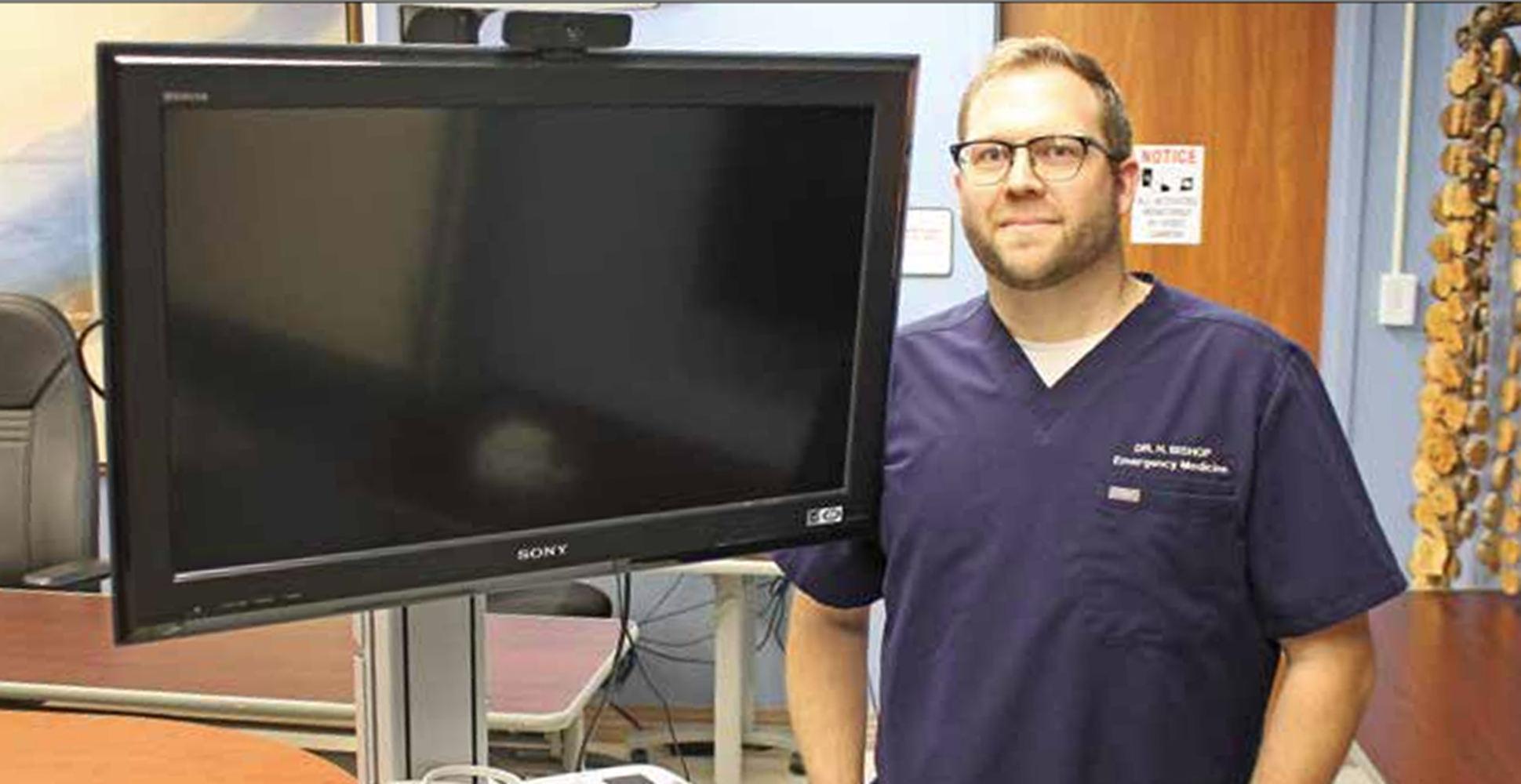
Full-time ED doctor, Harrison Bishop, inspired the concept. He told The Highlander it came about serendipitously.
Living in Cobourg at the time, his daughter was playing in the park with the daughter of neighbour, Dr. Adam Dubrowski, who mannequins. Sometimes there is outreach with mobile vehicles. is the professor and Canada research chair in healthcare simulation at Ontario Tech University.
Medical simulation isn’t new; however, it is centralized in larger cities in the province. There is an educator who works in a central booth, often behind glass, who guides health-care professionals in hubs around the core. They may be working on dummies or mannequins. Sometimes there is outreach with mobile vehicles.
Dr. Bishop asked Dr. Dubrowski at the park if he knew of a program where the technologist is centralized and they feed the signal to rural sites over the internet. The answer was no. They talked to Dr. Randy Wax at LHEARN.
Program enhancing care for our communities
“Essentially, that’s where the concept of it came from; it was simply out of a need or a void,” Dr. Bishop said.
Dr. Dubrowski is internationally recognized for advancing simulation-based health-care training. His research, leadership and collaborative work have been instrumental in bringing the virtual simulation model to life, HHHS said.
Dr. Bishop explained how it works. For example, the centralized operator could tell the doctor and nurse over an internet feed that they have a 65-year-old man who has fallen through the ice and is vital signs absent. The team works on a dummy, or mannequin, to try to resuscitate. Interventions are monitored. Then feedback is given after the fact.
“You essentially are practicing high-risk or high acuity scenarios without the risk of somebody dying,” Dr. Bishop said.
Again, he said the technology isn’t new. “The innovative part is about how to get the technology to rural sites.”
Local advantages
He said there are many advantages for Haliburton County-based ED physicians.
Doctors could access the training in the past but had to travel out-of-town for it. And, it was just for the doctor, not the medical team. Now, they can all learn on-site.
“So, it’s multidisciplinary. And, then, you also have input; being able to work with scenarios you see where you work, rather than just going down there and seeing whatever ones they give you.”
For example, winter emergencies such as people falling through the ice or snowmobile accidents. In summer, trouble cottagers might get into, water-based accidents and injuries, or mishaps in the bush.
Dr. Bishop said they did a wet run – to make sure the connection and feed worked – in December and staff are now signing up for spring training.
He said with only two full-time ED doctors, it helps others who don’t see emergency situations as often.
“Like any high-stress scenario, you need to have a little bit of muscle memory … what works? so that level of anxiety or stress is just a little bit lower.”
He added, “the really great resuscitation physicians and nurses and team could train on a rag doll and it will still be just as useful because it’s about decision-making and teamwork and communication, not about a single procedure.”
He said it’s still early days, but the feedback is good, especially with doctors and nurses suggesting scenarios. He noted they don’t get paid for the extra training, which is on top of their already busy schedules, but they want to give the community the best medicine they can.
“Haliburton’s got a really great team of professionals. They know it’s important to be as good as they can be for when people have emergencies.”
Dr. Bishop added there’s no reason the virtual simulation program cannot expand across Ontario, Canada, and internationally. “Anywhere that you can get an internet connection … Bancroft, Barry’s Bay, Mindemoya, the Northern Territories, Rwanda or Sudan. There’s no reason why any of these people should not have access to virtual simulation-based training when you can just do it with a webcam.”
HHHS said it “looks forward to evaluating its impact and exploring future expansion opportunities.”