

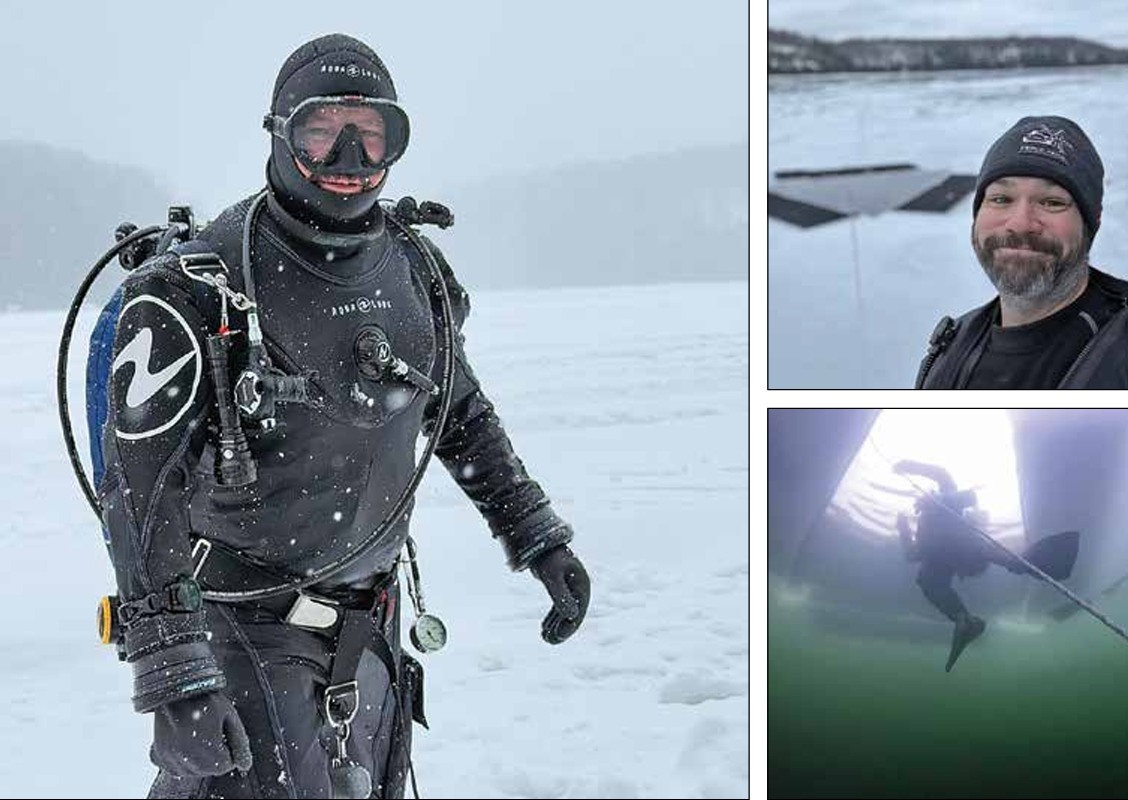
While Aaron Darling loves scuba diving from his cottage on Miskwabi Lake during the summer, he gets an even greater thrill
plunging into the icy waters at this time of the year.
The longtime diving enthusiast will be leading a group of six students into the frigid depths of his local lake Feb. 7-8 for the third annual Miskwabi Ice Diving Festival. He launched the event in 2024 to show people that, with some work, almost anyone could try one of the world’s most extreme sports.
It all starts with learning to dive in warmer waters – something Darling, a PADI Master Scuba Diver Trainer, has been doing in
Haliburton County for as long as he can remember.
“When I first learned, it was under the supervision of my grandfather and I was like 10 years old. He had a place on Paudash Lake and it just blew me away the kind of adventures we would go on,” Darling said. He became certified at 16, “and really got into it… I’ve been diving pretty much ever since, but it wasn’t until about four years ago that I got really interested in cutting a hole in the ice and going cold water diving.”
Ice diving carries much more danger than regular diving, Darling said. “Ice diving is an overhead (where direct vertical ascent to the surface isn’t always possible) environment, a bit like diving in a cave. The difference with a cave, though, is you’re diving down a narrow hallway.
When you’re diving into a lake during winter, you’re jumping into an auditorium with very little way to figure out where you’re going – except up,” Darling said. “But the problem with that is you’ve got to find the hole you came through.”
There are lots of safety mechanisms in place – everyone dives with a partner, who are attached by a line that goes back to the
surface. That ensures everyone can find their way back to the entry point, Darling said.
Once submerged, divers descend 70-80 feet. Darling said he’s taken the plunge dozens of times from his property on Miskwabi in recent years.
“It’s really awesome diving at this time of the year, because all the algae blooms and things that make the water [murky] in the summer have died off, so the water is very clear,” he said. “When I’ve gone down there, I’ve found balls of fish wintering together on the lakebed – just 200 fish all hanging out in a small area.
“Where we’ll be jumping in over the weekend is about 100 feet out from shore. It’s basically a straight drop off with beautiful rock formations… it’s also really cool going down there and looking up, you can see the lines from all the snowmobiles that have passed over the lake,” he added.
Darling is partnering with four Ontario dive shops for the festival, which is all about training people to ice dive safely. None of the participants are novices, he notes, with the six taking part this weekend all advanced certified scuba divers. Darling said, ideally, people will have experience diving in colder conditions.
There’s a classroom component before people get to go through the ice, covering how to properly prepare a hole, how to use rope, communication techniques and effective gear configurations. To become certified for ice diving, people need to complete three dives and spend a minimum 20 minutes underwater each time.
It takes significant manpower to run these events – Darling said there needs to be at least five people on watch above the surface
in case anything goes wrong.
He recommends participants wear dry-suits, not wetsuits, and always carry contingencies – spare air supplies and other equipment in
case it’s needed in a pinch.
Darling said, after this year, he’ll have taught about 20 people to ice dive in Miskwabi Lake. Anyone interested in learning can contact him at aarondarlingpadi@gmail.com.
“This is getting more and more popular every year… the whole idea is to help people understand what’s under the water and to respect it. It’s nice to be able to see everything up close and learn about what happens at different stages of the year, see the changes our lakes go through,” Darling said