

U-Links, which does water quality testing for Haliburton County, and the County itself, plan to put pressure on Lakelands Public Health to lift its game when it comes to timely reporting of blue green algae blooms on Highlands lakes.
The topic came up at a Jan. 14 County council meeting when Andrew Gordon, director of U-Links, and Jim Prince, co-chair of U-Links and chair of Woodland & Waterways Eco Watch, updated council on the work they have been doing on their behalf.
Prince said, “we’ve all heard about the threat of (harmful) blue green algae blooms in Haliburton County, but there really isn’t any data.”
He said that around 2020, they believe there were about 11 blooms on Highlands’ lakes. And while a number of lake associations chatted about it, no one was tracking the suspected, or confirmed, events.
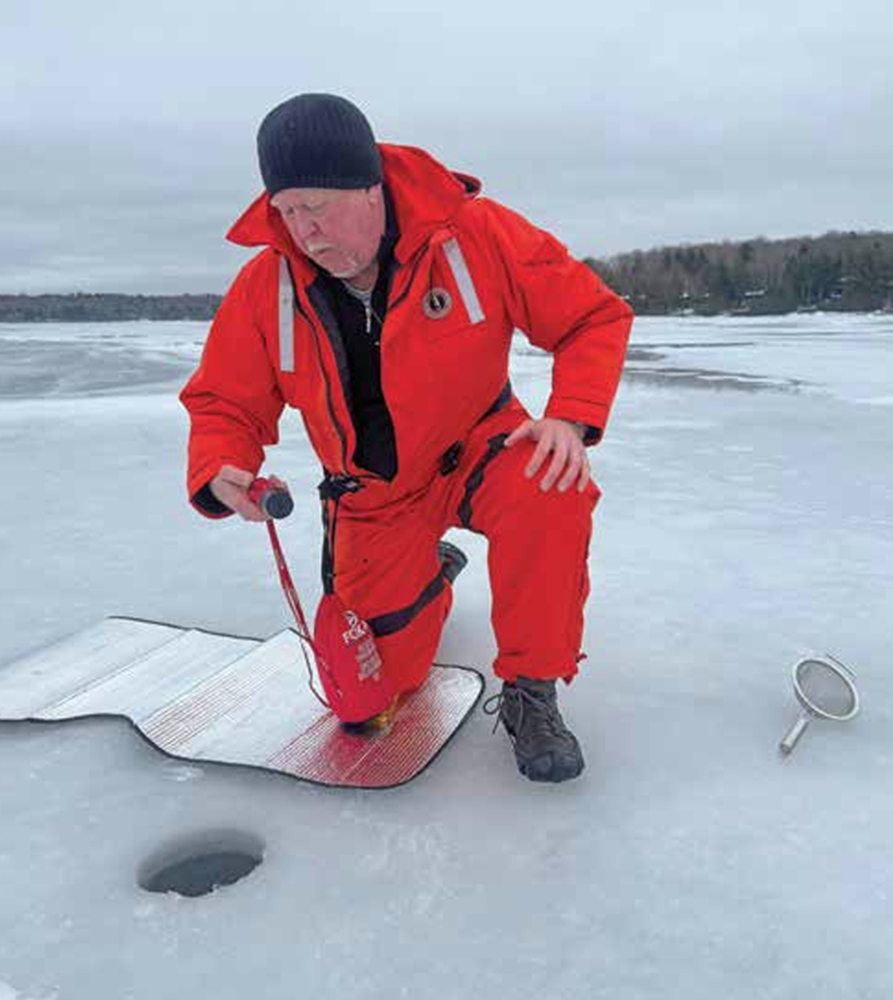
He said the Ministry of Environment, Conservation and Parks (MECP) Peterborough branch is involved. People can make a report to the spills centre, and if staff are available, they come to sample. However, he said they are not always available, especially on weekends and public holidays. Fishing for data Frank Figuli performs a lake depth measurement with a handheld sonar device. Submitted.
“Most of the time when they arrive, the algae bloom has dispersed and they aren’t able to get a good sample.”
Prince said they have sent data to Lakelands Public Health but they “don’t do any reporting or provide public notifications. It’s really different to other places in Ontario and Canada. Muskoka has a really robust reporting program. It alerts citizens about the hazards because your pets could die, you can’t drink the water if there’s an algae bloom near your cottage and you’re drinking water from the lake; and one-third of lakefront properties drink water from the lake.”
Lakelands Public Health said on Jan. 21 “sightings of possible blue green algae blooms are investigated and confirmed by the MECP. Lakelands Public Health’s role is to communicate potential health risks and provide public health guidance. We work with MECP and the County of Haliburton when blooms could impact drinking water, public beaches, recreational water, camps for children, or other at-risk settings, to ensure the health needs of residents are addressed. And we will continue collaborating with the County of Haliburton following recent council discussions on how to best meet resident needs regarding health risks and guidance relating to blue green algae blooms.
‘Fairly good and decent water quality’ for now
The Simcoe Muskoka District Health Unit (SMDHU) issues warnings with advice for the pubic. They also tell the public if they see a bloom that they should contact them and report to MECP. Current alerts for specific Muskoka lakes are posted on the SMDHU website and local municipal news pages.
Call to Lakelands Public Health
Prince said U-Links was willing to step up on the sampling side, which was important for making decisions and having historical data. U-Links is developing simple standard operating procedures for blooms to incorporate into their existing ‘testing the waters’ program. He said the plan is to put test kits in the hands of lake associations and citizen scientists. “It is not rocket science, it’s citizen science and it’s quite easy to do.” Prince said they are working with the MECP in Peterborough on the initiative.
He added they had put a call out to Lakelands Public Health to gauge “their appetite to get involved for reporting and public notifications.”
After the presentation, deputy warden Liz Danielsen commented, “my primary concern is the lack of willingness by Lakelands Public Health to provide information to residents advising them of the dangers associated with that. We’ve run into that a couple of times in Algonquin Highlands.
They basically threw it back at us, ‘it’s your responsibility’ but it is not.” She asked if there was “anything we can do to encourage, kind of push the health unit a little bit to assume their own responsibilities?”
Prince said they are reaching out to new medical officer of health, Dr. Thomas Piggott.
Coun. Cec Ryall is the vice chair of the health unit’s board of directors. He was planning to raise the issue with senior staff at this week’s public health meeting, calling it “a serious issue for our neck of the woods.”
Coun. Bob Carter said it wasn’t a new issue, and it had been raised with the Haliburton Kawartha Pine Ridge District Health Unit in the past. It’s been discussed at the Association of Municipalities of Ontario level.
“I don’t quite understand how we got to this point, so many other health units have taken this as a responsibility….”
Coun. Jennifer Dailloux said the County could step up in a formal way, to stress the need for health unit involvement in issues around lake health. The health unit does do beach testing in the summer. CAO Gary Dyke said he planned to reach out to Piggott as well.
Program expanding to 67 lakes
Meanwhile, Gordon said the benthic biomonitoring program that began in 2019 had left most County lakes in good biological shape. However, he said checking 12 water quality parameters remains important. ‘Testing the waters’ monitors three times a year, including ice-on sampling, including on drawdown lakes.
They started in 2022 with nine lake associations and 20 lakes. By 2025, they had grown to 25 lake associations and 39 lakes. They are hoping to expand the program again, to 30 lake associations and 67 lakes in 2026. U-Links is now talking to associations for Maple-Beech-Cameron; Redstone; Eagle and Moore; Percy; Twelve Mile – Little Boshkung; and Soyers lakes.
They are also looking for another control lake; to supplement the one they use on Stocking Lake in Haliburton Forest.
When it comes to trends, Gordon said lakes are becoming a little less clear and more turbid. He said initially people might be alarmed, “but this is actually a good thing because these lakes are recovering from the system level impact of acid rain that turned everything to vinegar back in the 1960s and 1970s, and so this is an absolutely normal biological response that we are seeing here. They are not going to turn into swamps or bogs; at some point that line is going to level out.”
Gordon added this is why long-term data is important. He said aquatic scientists say it takes about 18 years to identify a trend.
The program costs about $105,000 a year, with Haliburton County kicking in about 60 per cent, or $62,500. The 2025 results for the tested lakes will be available soon. Gordon said they have found “fairly good and decent water quality in Haliburton County lakes at the present time and if you keep up with (being cognizant of what to do to shorelines; septic inspections and water quality testing), 50 years down the road, we might actually be able to survive climate change and we’ll have some good water quality.”