
It’s been 81 years since the last major Nazi concentration camp, Stutthof, was liberated by Allied forces in May 1945. While there are few survivors remaining to share their chilling experiences, Haliburton’s Irv Handler is set to publicly share the horrors his family endured for the first time.
Handler is one of two featured presenters at a special Remembrance Day-themed ‘Speaker Series’ event, taking place at the Haliburton Legion Nov. 11. The bulk of his talk will focus on his parents, Shifra and Eliya, who were each detained by German forces at different locations during the Second World War.
“It’s a tradition on Holocaust Remembrance Day, in the Jewish community, for survivors to go into public and tell their story and give a personal testimony. Sadly, most survivors have passed away now, including my parents,” Handler said. “My generation is now stepping up to be the ones to keep these stories, dark as they may be, alive.”
Handler said his mother was 16 and living in Romania when she was captured and sent to a relocation camp in Transnistria, located in modern-day Ukraine.
His father was 28, married with two daughters and living in Poland when war broke out. He was sent to the GrossRosen death camp in Rogoznica, Poland and never saw his first family again.
His father was 28, married with two daughters and living in Poland when war broke out. He was sent to the GrossRosen death camp in Rogoznica, Poland and never saw his first family again.
The historian of the family, Handler said it has been difficult coming to terms with what he’s learned. His research found approximately 400,000 people were taken to Transnistria, with 380,000 dying – mainly through disease and starvation.
About 40,000 of the 125,000 prisoners who passed through the front gates of Gross-Rosen made it out.
“It was a miracle they survived, that anybody survived.”
Handler said his mother was young when first relocated to Transnistria, accompanied by her mother and sister. They all contracted typhus, which killed Handler’s grandmother. His mother and aunt survived the rest of their imprisonment.
Because Transnistria was labelled a relocation, rather than concentration, camp, Handler said his mother wasn’t entitled to reparation payments once the war ended. In the 1990s, she and other survivors formed a class action suit against the German government, which they won.
“She managed to get a pension, but it was a small amount compared to other survivors – and there was no backpay,” Handler said. “She was thrilled, though. She told me, ‘they said I didn’t suffer enough, that I wasn’t in a concentration camp, but this money proves that I was, that I did suffer.’ So, it was very meaningful for her to get.”
At Gross-Rosen, Handler believes his father survived due to his grisly job as a member of the Sonderkommando – slave labourers, mostly Jewish, who were coerced into assisting Nazi soldiers at the camps. Handler said his dad was forced to dispose of bodies at the Gross-Rosen crematorium.
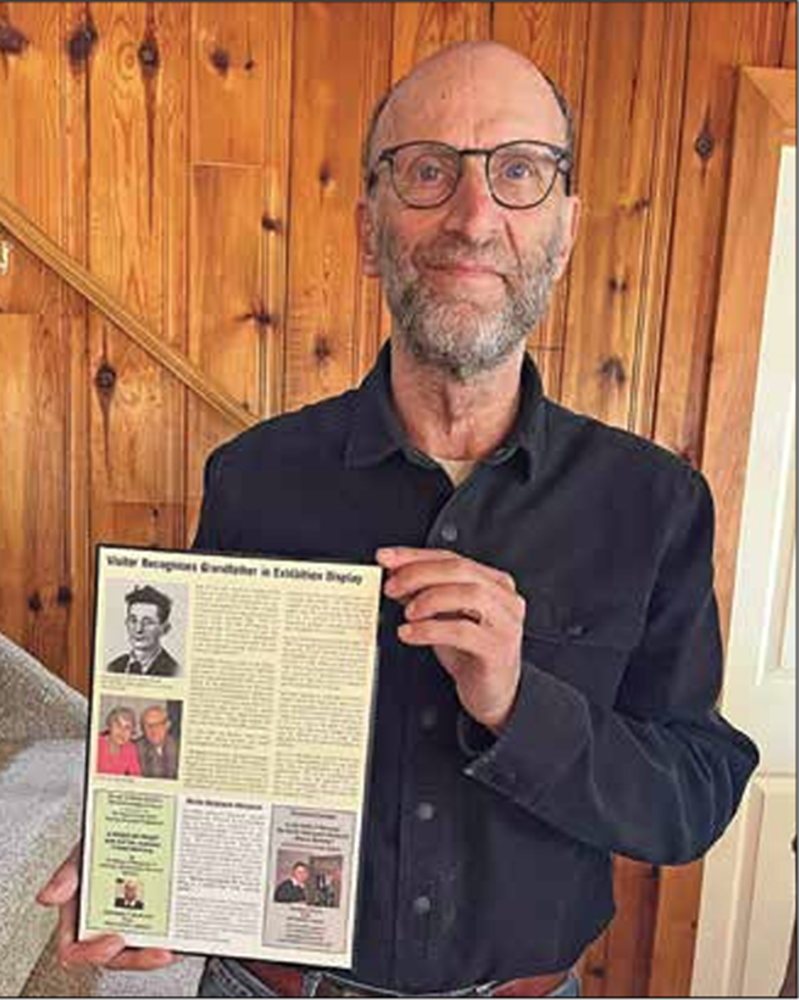
Handler said his parents got together after the war ended, before moving to Canada. He’ll be bringing lots of original documentation to speaking engagement to support his findings, sourced by his brother on a genealogical trip to Europe several years ago.
Learning all that he has over the years has taken a toll on Handler, who is suffering from intergenerational trauma.
“It was a very difficult upbringing. I had a lot of symptoms while living in Toronto, but since moving to Haliburton I feel a lot better. It’s a very welcoming community. I feel, finally, for the first time in my life that I belong somewhere,” he said.
On his presentation, Handler added, “this is a dark and disturbing story, but it’s also a powerful testament to human endurance, while also serving as a warning that to accept hate in our community is to open a Pandora’s Box of crime and evil. So, we have to continue to fight hatred.”
Home children
Speaker Series organizer, Barrie Martin, said this is the first time he’s put together a Remembrance Day-themed event, noting it happened completely by chance. Speaker Series events are held on the second Wednesday of each month from October to May.
Asked what Remembrance Day means to him, Martin said, “we all have memories – my family were farmers, so they didn’t fight in the war but made a sizeable contribution to the wellbeing of Canadians.”
He said he connected with the second speaker, Joan Knighton, via a mutual friend. Knighton is a member of Home Children Canada and will be sharing details around the migration of 100,000 children from England to other Commonwealth nations, including Canada, South Africa, Australia and New Zealand, from 1869 to 1948.
“For the most part, those kids were put to work on farms once they arrived to Canada,” Knighton told The Highlander. “I’m a descendent of one of those home children. My father worked on farms and suffered some abuse because of it.”
She said the effort was led by the Catholic church and 40-50 other organizations that ran orphanages throughout England that became overrun during the Industrial Revolution and First and Second World Wars. She said about 12 per cent of the children sent to Canada were considered true orphans, meaning most still had some family back home.
“A lot of very sad outcomes, unfortunately,” Knighton said, guessing a quarter of the kids ended up in kind, loving homes while the rest were largely left to fend for themselves.
She estimated 10 per cent of Canada’s population today is made up of descendants of the home children.
“I’ll be getting into as much of the history as I can – what happened, why, how, and the results of it all. It’s a big part of British and Canadian history that is unknown to most people,” she said.
Tickets to the event are $15, available at the door or online at tellingourstories.company.site/products. It starts at 7 p.m.