
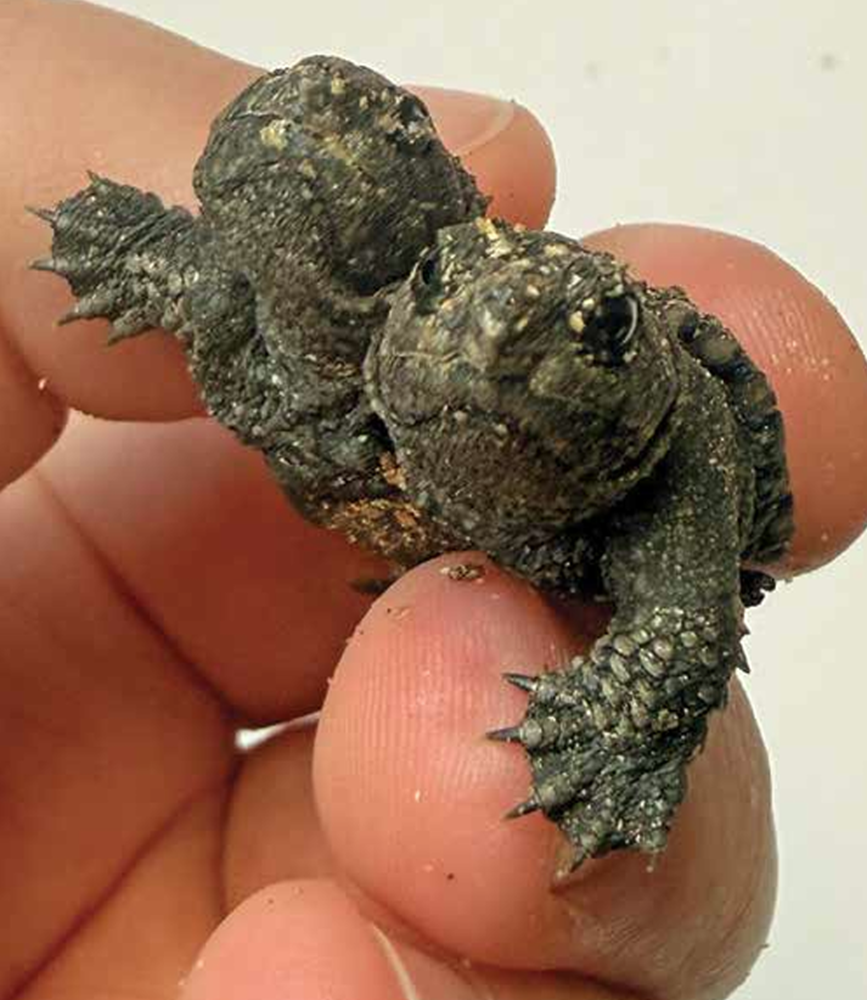
Turtle Guardians founder Leora Berman had a surprising first-time experience in late August, coming face-to-face-to-face with an ultrarare conjoined twin snapping turtle hatchlings in Haliburton.
The Siamese siblings came from eggs recovered from the Eagle Lake area earlier this summer, and hatched Aug. 21 at the non-profit’s incubation centre in Haliburton village. The mini snappers were born with two heads but only one shell and body, a condition known as bicephaly.
Berman said she’d never encountered the phenomenon in-person before. A 2025 study by the Southwest Virginia Wildlife Center in the U.S. estimated twin births occur in about one per cent of recorded hatchlings. Conjoined twins are much less common, though, with one in every 100,000 cases.
“We’ve had twins before… but it was quite shocking to find a conjoined pair,” Berman said, noting staff have named the young reptiles Bert and Ernie, after the famous characters from Seasame Street.
Despite male names, Berman said the turtles’ sex won’t be determined until adulthood as a turtle’s reproductive organs remain internal while they’re juveniles.
Berman had two theories for the rare birth. Bert and Ernie shared the same yolk sac, which usually means two distinct embryos developed from a single egg, but didn’t completely separate during early development.
It’s also possible the mother utilized sperm from multiple mates during the fertilization process. Berman said females can store viable sperm inside specialized oviduct tubules for several months.
Bert and Ernie may live
Dr. Kristen Janke from the Ontario Turtle Conservation Centre (OTCC) in Peterborough told The Highlander she hasn’t encountered conjoined twins in her 10 years with the institution.
“So, it’s certainly rare. In this case, it looks like a twinning that did not fully separate.”
More testing needed
Turtle Guardians operates one of Canada’s largest incubation and conservation programs, with staff and volunteers working to protect nests, nurture eggs, and release healthy hatchlings back into the wild.
So far this year, the group has collected and cared for 13,688 eggs from 482 nest sites across the Highlands – including nine sets of twins, all new records.
Under Ministry of Natural Resources rules, incubators may only keep turtles on-site for a maximum of 10 days once hatched. Berman has sought an extension for Bert and Ernie and is continuing to care for them. She wants to send the twins to Newmarket for more testing.
“They’re sharing a lot and I think they can survive together,” Berman said. “We would want to do a CT scan to see if they have two hearts and figure out what else is going on under that shell.”
The turtles aren’t mobile, with extra limbs preventing them from walking. Berman said the non-functionable legs could potentially be removed, with her Newmarket-based vet having experience with surgical separations.
Despite their many shortcomings, Berman believes they could survive in the wild and wants to give them a chance.
“This is kind of the purpose of our entire program,” she said.
Berman said Turtle Guardians has the longest-running road ecology study in the country. Her analysis shows a decline of up to 40 per cent in turtle populations in some areas of the County over the past 10 years. Since 2022, she’s seen a significant increase in the number of turtle eggs imploding or collapsing before hatching. Berman’s been actively working with academics at the universities of Manitoba and Alberta to find out why and hopes to have some answers by 2028.