
By Adam Frisk Local Journalism Initiative Reporter
The return of the annual Toronto Outboard Racing Club (TORC) powerboat regatta to Head Lake over the weekend (Aug. 15-16) reignited a long-standing debate on how Haliburton balances economic activity with environmental health at its local fixture.
While an inquiry into shoreline residue triggered a provincial pollution report on Monday (Aug. 17), municipal field tests, event organizers, and regulators have confirmed surface sheens at Rotary Beach were the result of natural organic decay rather than petroleum runoff from a weekend of heavy boating activity.
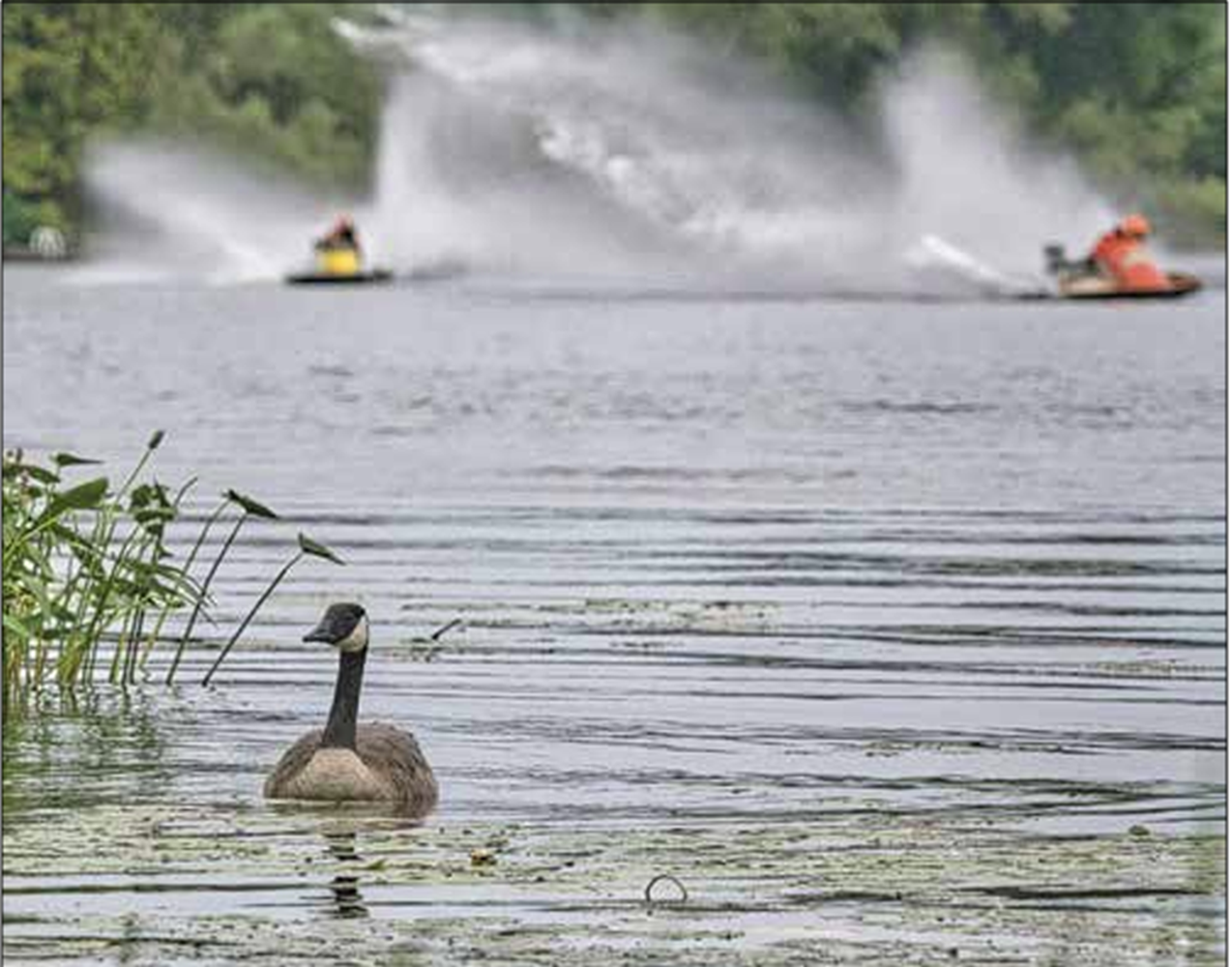
The 11th annual, two-day, event brought high-speed hydroplanes back to Head Lake over the weekend, and was dedicated to late Dysart et al mayor, Murray Fearrey.
Acting mayor Walt McKechnie paid tribute to Fearrey’s pivotal role in establishing the event while highlighting its ongoing support for local health care.
“Eleven years ago, Murray Fearrey stood on the beach of Haliburton Lake watching a sample of this sport,” McKechnie wrote in a statement published in the event handbook. The acting mayor noted Fearrey worked alongside event organizer, Barb Hammond, to present the proposal to council.
“Murray would be proud and happy to welcome the Toronto Outboard Racing Club back. Every dollar raised is one more dollar our hospital did not have yesterday.” Organizers said $6,000, including a $1,000 donation from TORC, was raised for Haliburton Highlands Health Services (HHHS).
Concerns about lake health came up Monday morning after sheens were documented along the beach and on surface water near the visitor centre. It prompted an inquiry to the Ministry of the Environment, Conservation and Parks (MECP) Spills Action Centre (SAC), which logged an incident report and referred to the municipality for investigation.
Municipal staff conducted an on-site assessment of the beach Tuesday morning. The Highlander witnessed the physical testing of the water, which consisted of disturbing the surface film with a stick, which showed the sheen breaking into rigid sections.
What that means in water science is that an oily-looking layer that breaks into sharp pieces when poked is usually a natural, organic slime cluster from rotting plants or bacteria. Should the greasy layer be petroleum or oil, the substance stretches like rubber and swirls into shiny rainbow ribbons.
Provincial officials have said that these organic sheens are often mistaken for petroleum-based spills, resulting in members of the public reporting what are often called bog sheens to environmental authorities.
Ashley Dembinski, Dysart’s environment manager, confirmed to The Highlander supplemental laboratory water sampling and spill containment measures were deemed unnecessary following consultation with the province.
“As we did not observe a gas smell yesterday or this morning and the matter on the water broke up both times rather than sticking together, [MECP] deemed our review to be the presence of organic matter decay,” Dembinski said, adding photos forwarded to the ministry raised no concerns with officials.
In a statement, TORC said the club follows “strict environmental standards” across all racing sites and suggested other watercraft on the lake over the weekend could have contributed to general lake activity. The club said Head Lake is a relatively shallow body of water and natural organic processes frequently produce film-like surfaces.
“Marsh waters often show a colourful, oil film that looks like a gasoline spill. This was created by a harmless anaerobic bacteria in the mud,” the club said. “When disturbed, this natural bacteria push a shimmering metallic or rainbow-like colour to the surface.”
Economics versus environment
While physical testing ruled out fuel contamination from weekend activity on the lake, the presence of high-speed motorized events on Head Lake continues to generate broader discussion about the economic and environmental impact they have on the village.
According to the Haliburton Business Improvement Area (BIA), the event brings mixed results for downtown businesses, with several reporting a general slowdown while others see benefits through sponsorship of the event.
BIA chair Brandon Nimigon said membership polled over the years had generally shown the event to be a “downturn” for shops due to parking limitations, noise, and the tendency for racers and attendees to remain near the lake.
“From the downtown business point of view, it’s not generating more revenue; if anything, it’s taking it away,” he said, speaking on behalf of the broader BIA membership. He added nearby establishments like Hook Line & Sinker frequently report slower weekend traffic.
But business response varies depending on direct involvement with the regatta. Maple Avenue Tap & Grill reported a solid weekend after taking on a formal sponsorship role, Nimigon said of his follow-up with downtown businesses.
Despite individual success among sponsors, the loss of public parking and noise concerns continue to prompt questions among BIA members regarding the event’s location.
“What’s the benefit to the town if we’re losing parking for a weekend… is it worth having it, or is it maybe worth looking at a different lake potentially?” Nimigon asked.
Environmentalists have expressed concern about the impact.
Leora Berman, chief operating officer of The Land Between and founder of Turtle Guardians, said high-speed boating disrupts environments by forcing warm surface water into deeper zones, which accelerates the loss of critical fish habitats. The noise and waves disturb wildlife during breeding seasons, she said, pointing to distress calls heard among resident birds.
“The boat races coincide with loon fledgling… the babies are only about a month old,” Berman said. “I’ve never seen any kind of consideration or mitigation for the impacts to loons, but certainly there’s a lot of distress.”
Berman also questioned the location.
“Head Lake is just too small a lake to accommodate the waves [and] the mixing of the water,” she said. “You need a very large lake to accommodate that.”