
By Adam Frisk Local Journalism Initiative Reporter
A single Canada goose can drop up to two pounds of poop a day, a stomachchurning fact that members of the Halls & Hawk Lakes Property Owners Association (HHLPOA) were using this past weekend (Aug. 8) to drive home a serious message about local drinking water protection.
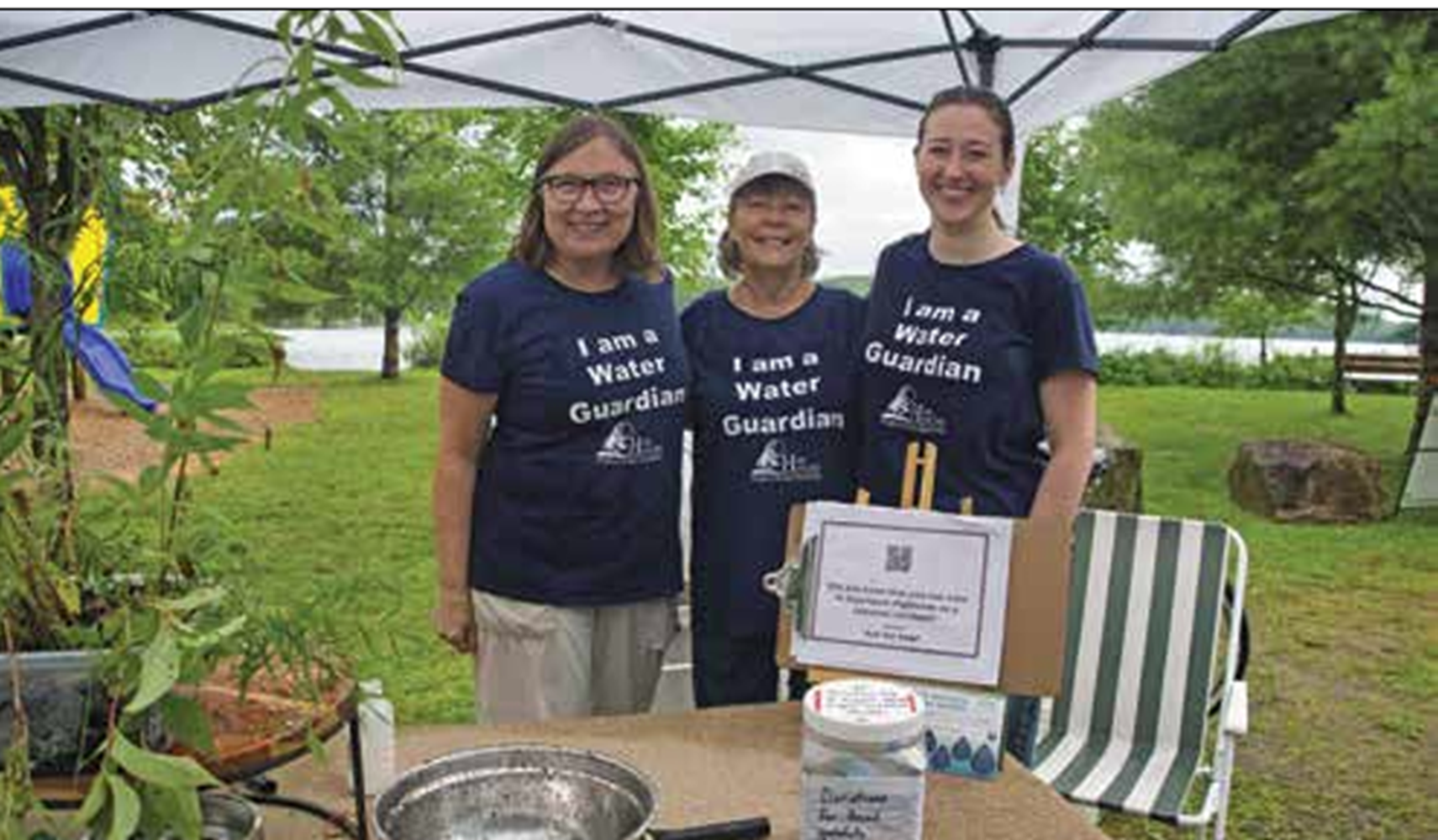
The HHLPOA launched its new Water Guardian campaign on Saturday at Elvin Johnson Park, urging property owners to take direct action to protect vulnerable, untreated drinking water supplies.
“Because we’re not within a town or city, we’re relying on well water, groundwater, or surface water from lakes and rivers, and that’s it,” Shelley Fellows, HHLPOA president, told The Highlander. “For a lot of us, you turn the tap on and assume it’s safe to drink… But here, we are responsible for it. It’s about bringing that home, understanding that every one of us is a guardian of the water.”
The initiative serves as the public outreach component of the HHLPOA’s Protect Every Drop: Drinking Water Source Protection Plan. The 60-page document was created as part of a pilot project funded by the Federation of Ontario Cottagers’ Associations following a provincial auditor general report that highlighted gaps in nonmunicipal water safety.
The Water Guardian pledge encourages property owners to adopt specific practices, like maintaining their septic systems, eliminating fertilizer and pesticide use, regularly testing their drinking water, and renaturalizing their shorelines. The renaturalization helps filter surface runoff and deters Canada geese, whose poop contributes to localized coliform bacterial contamination.
The campaign comes during a time when data indicates declining water quality across the watershed. According to Olivia Tomlinson, a Big Hawk Lake cottager who led a recent revamp of the association’s broader lake plan, long-term monitoring shows water clarity and dissolved oxygen levels dropping, while algal blooms are on the rise.
“It’s a very sensitive ecosystem,” Tomlinson explained, noting that while changes aren’t drastic just yet, there is a statistical downward trend. “The goal would be to see a stabilization… it’s really about trying to correct it before it gets any worse. And I think it’s totally doable. Everyone is so involved.”
Tomlinson explained that waterfront properties face risks from blue-green algae blooms, which were documented on nearby Kennisis Lake last summer, as well as invasive species. She said that she had taken some water samples that indicated the potential presence of spiny water flea in local waters, though official lab verification is required.
The association is also working to address widespread gaps in water testing. An HHLPOA survey conducted last year found that 55 per cent of waterfront residents never test their drinking water, despite health unit recommendations to do so at least twice a year.
“I was one of those people who did not test my water for coliform; it just wasn’t something that occurred to me,” Beth Carey, HHLPOA member, admitted. The association had free water sample bottles from Lakelands Public Health on hand at Saturday’s event.
The HHLPOA has several research projects underway to gather baseline scientific data, including an aquatic plant inventory and a Halls Lake causeway study that will look at how the historical fillingin of the man-made causeway near Elvin Johnson Park has impacted water flow, siltation, and plant growth in the bay.
The association aims to eventually sign up all 650 property owners to the Water Guardian program. To help track participation, HHLPOA plans to use selfassessment check-ins, waterfront display medallions, shoreline restoration contests, and social media tracking.
“Most people, if you’ve grown up on the lakes, know a lot of this almost instinctively, but it’s a really good reminder,” Tomlinson said. “Everyone has been so curious… they want to know how they can help.”