
Taking his fishing boat out on Drag Lake recently, Haliburton resident Jim Miners said he had anything but a relaxing time on the water.
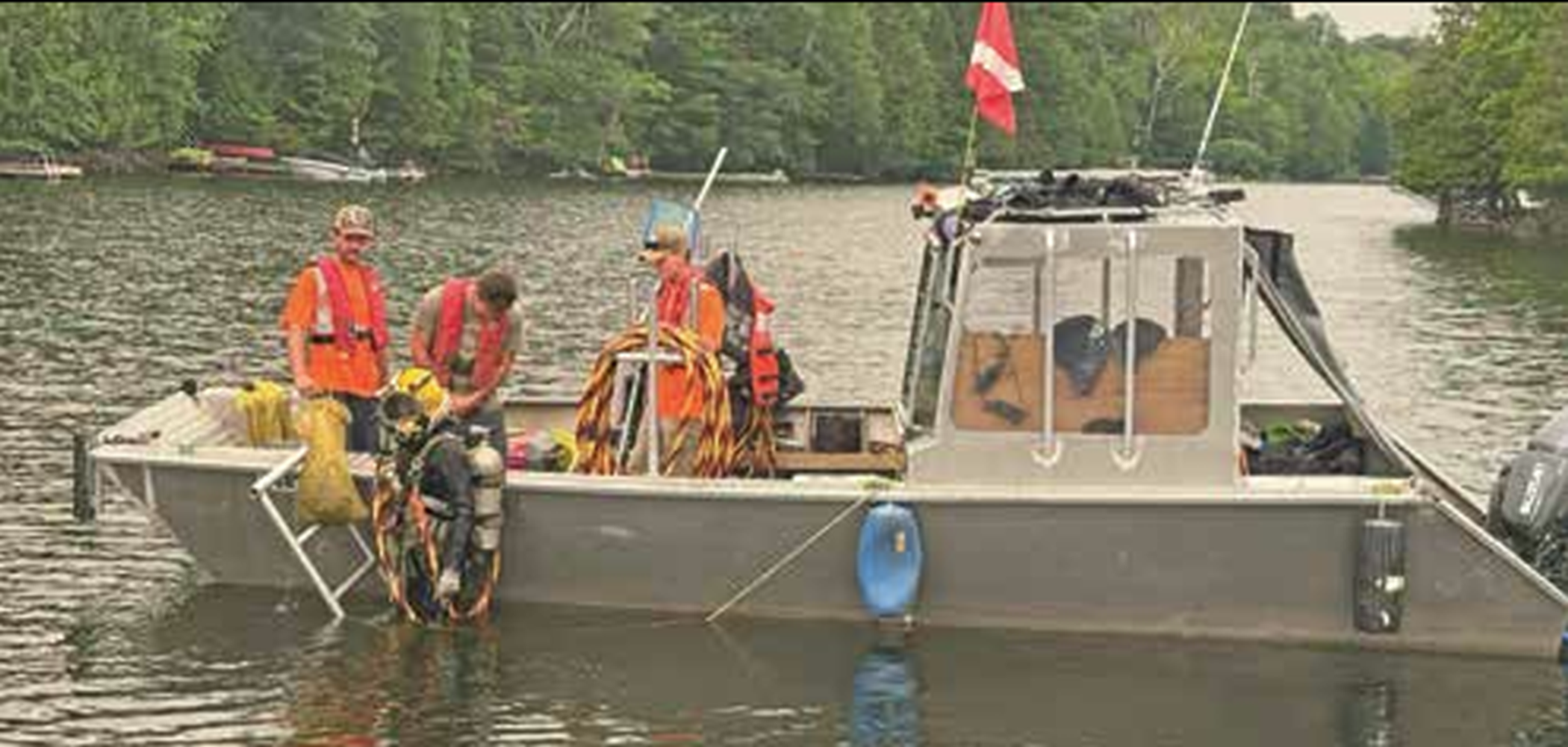
He was one of approximately 30 volunteers from the Drag and Spruce Lake Property Owners’ Association (DSLPOA) to work with four professional divers July 13-15 as mitigation efforts to limit the spread of Eurasian watermilfoil continued.
Residents on Drag Lake first noticed the invasive species in 2017. By 2020, volunteers had mobilized into an official corporation so they could get permission from the Ministry of Natural Resources and Forestry (MNRF) to target problematic outbreaks on the lake.
Initial analysis identified four locations with Eurasian watermilfoil (EWM), with three more popping up in 2021. This year, the group assessed 20 known sites, Miners said.
“It’s a plant that can spread very quickly… once it’s established, it self-seeds. When it flowers, it fragments, breaking off from the stem and floating to the surface,”
Miners said, noting pieces of the plant can spread, leading to other outbreaks. Miners said there haven’t been any new outbreaks since 2023. He’s crediting the program developed by former lake steward Bert Bicknell and Trent University professor Dr. Eric Sager six years ago for that.
A dive team was brought in twice in 2020 and once every year since to apply underwater decomposable matting to the EWM, blocking out sunlight. They were approved to lay mats at seven locations this year.
While scientists have debated EWM’s impact on aquatic life and lake health, Miners believes it poses a risk to humans.
“It can be very dense and imposing in the water, growing to be 10-15 feet or even longer. If someone happens to fall into a patch and doesn’t immediately get themselves out, they can become entangled… there are documented incidents where people have drowned,” Miners said.
While decomposing, EWM can reduce oxygen levels in lakes. It can also impact property values, Miners said. While its presence is concerning, he doubts it will ever become an epidemic on Drag Lake, with the plant covering only four per cent of the lakebed.
“I don’t think it’s ever going to get out of control… because Drag Lake is as big as it is and the shoreline is as rocky as it is, it tends to not be that attractive to EWM,” Miners said, noting only three of the outbreaks – near Bonham’s Bay, at Outlet Bay and one in the centre of the lake are considered serious.
Expensive work
Another volunteer, Bob Heyes, has had a property on Drag Lake for several years. Asked how bad he thought the problem would be if the lake association hadn’t starting tackling EWM, Heyes felt the situation would be much worse.
“I know 10 years ago there are people who say the sites where EWM is now the thickest didn’t have anything there – it was always a nice, clear, rocky bottom where people went to fish. It’s not such a pretty spot anymore,” Heyes said. “If we’d left this alone… we would have 20 really bad sites today, maybe more, instead of just three.”
While the team had planned to lay 21 mats, they only ended up placing 17 due to how dense some of the patches were. Miners said it was a difficult job for the dive team, who had to figure out how to pin down taller growths up to 10-15 feet tall.
With each day costing approximately $8,000-10,000, it’s not cheap work. Miners estimates next year’s efforts may need to be expanded from three days to four or five, just to keep pace with the growth at known EWM sites.
That will require an increase in funding. Miners said the group has invested between $170,000 and $180,000 over the past six years, with $20,000 already raised to support efforts in 2027.
The working group is focusing on controlling the EWM population rather than completely eradicating it, something Miners felt was an unrealistic goal.
“You might get rid of it in one place, but you’re never going to get rid of it forever in all locations on a lake once it’s taken hold,” he said.