
By Adam Frisk Local Journalism Initiative Reporter
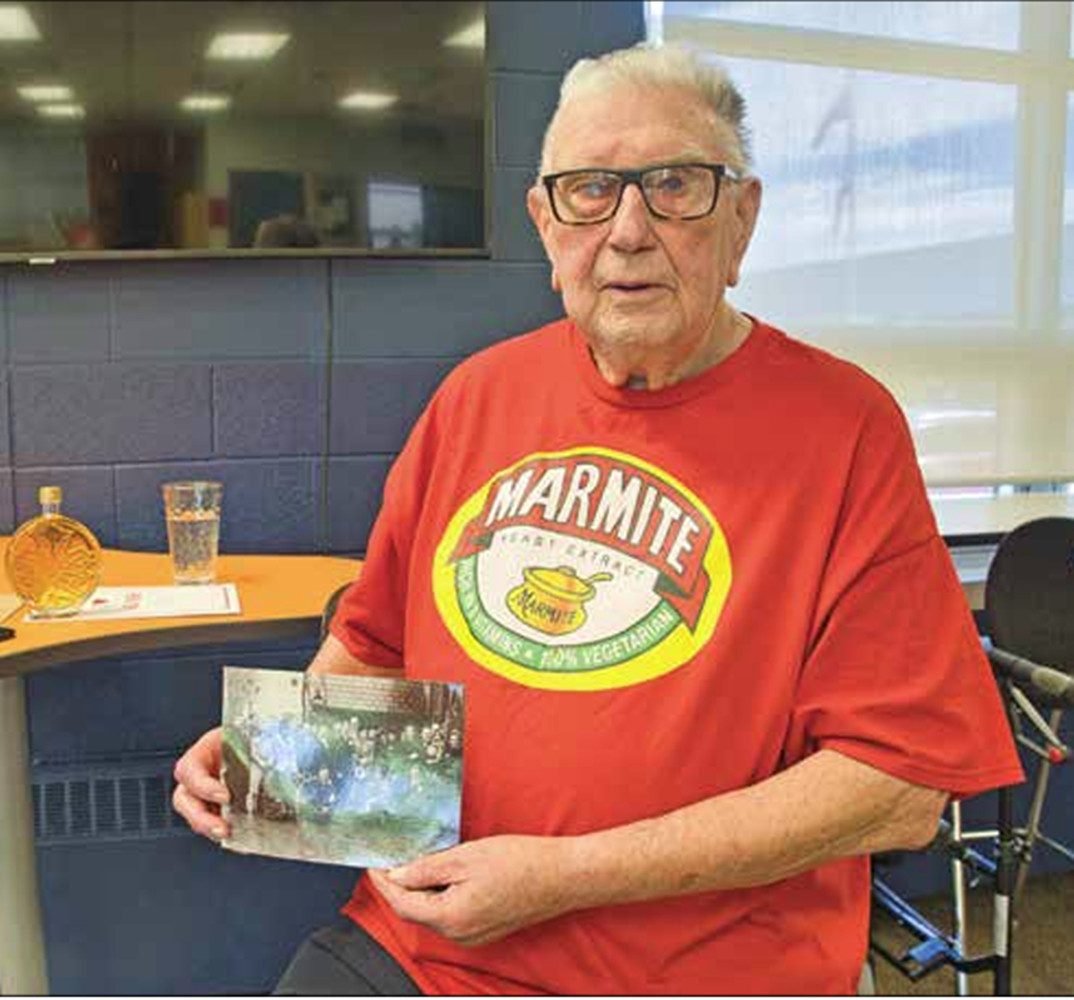
The library at Hal High became a living history museum when Second World War survivor Jim Neville spoke to students about living through the 1940 London Blitz.
The 87-year-old provided students a rare glimpse of what life was like for a child living during Nazi Germany’s bombing campaign, explaining that the reality of war was often found in “the little stuff” that wasn’t really detailed in history textbooks.
While the British government successfully evacuated about one million children from London in 1940, Neville’s family chose to stay behind. According to the Guelph, Ont., resident, many of the displaced children struggled to adapt, with the majority returning to the capital within a year due to friction with host families or a hatred for country life.
Neville explained that rural displacement was a major disruption for families living in the cities, recounting how his own grandparents openly detested being relocated to the edge of the countryside in Roehampton from where they lived for so long, opposite the Fulham Gas Works.
“They hated it there because, A, there was no pubs close by, and B, they didn’t have any gas smell,” Neville said.
To pass the evenings between air raids, Neville said his family relied on storytelling to keep spirits high. But the destructive reality of the Blitz was nearly impossible to escape, to the point where the sensory memories remain sharp to this day.
“The street behind us was completely destroyed,” Neville recalled. “Looking out the back door, I can still see those flames going into the sky and bits of debris that were being lifted by the hot air.”
Asked what the city smelled like, his answer was simple: “Smoke and fire.”
Neville explained that surviving the war meant finding routine amid chaos. He and his classmates continued to play during daylight hours.
“The kids I went to school with, we used to play in the street together, typical kids’ games,” he said.
A shift occurred late in the war with the arrival of American GIs, Neville said, explaining his neighbours befriended the soldiers, leading to a massive post-war care package from the United States.
“A couple of them sent us a great big parcel of marbles, chewing gum, candy,” he said. “Because you couldn’t get any of that stuff. Well, candy and sugar were rationed right up until 1953.”
Neville has been speaking with students for a few years now, after a casual dinner conversation with his grandson, Jake, sparked the idea to share his memories.
As firsthand accounts of the war become increasingly rare, Neville said he hopes that his stories inspire students to look beyond textbook facts.
“I just hope it makes them a little interested in learning more about the history of the war, and our country, and Britain,” he said. “And just to be a little bit more aware of what’s going on in the world as well… to form their own sort of opinions about it.” June 6 is D-Day, the anniversary of the Normandy landings.