
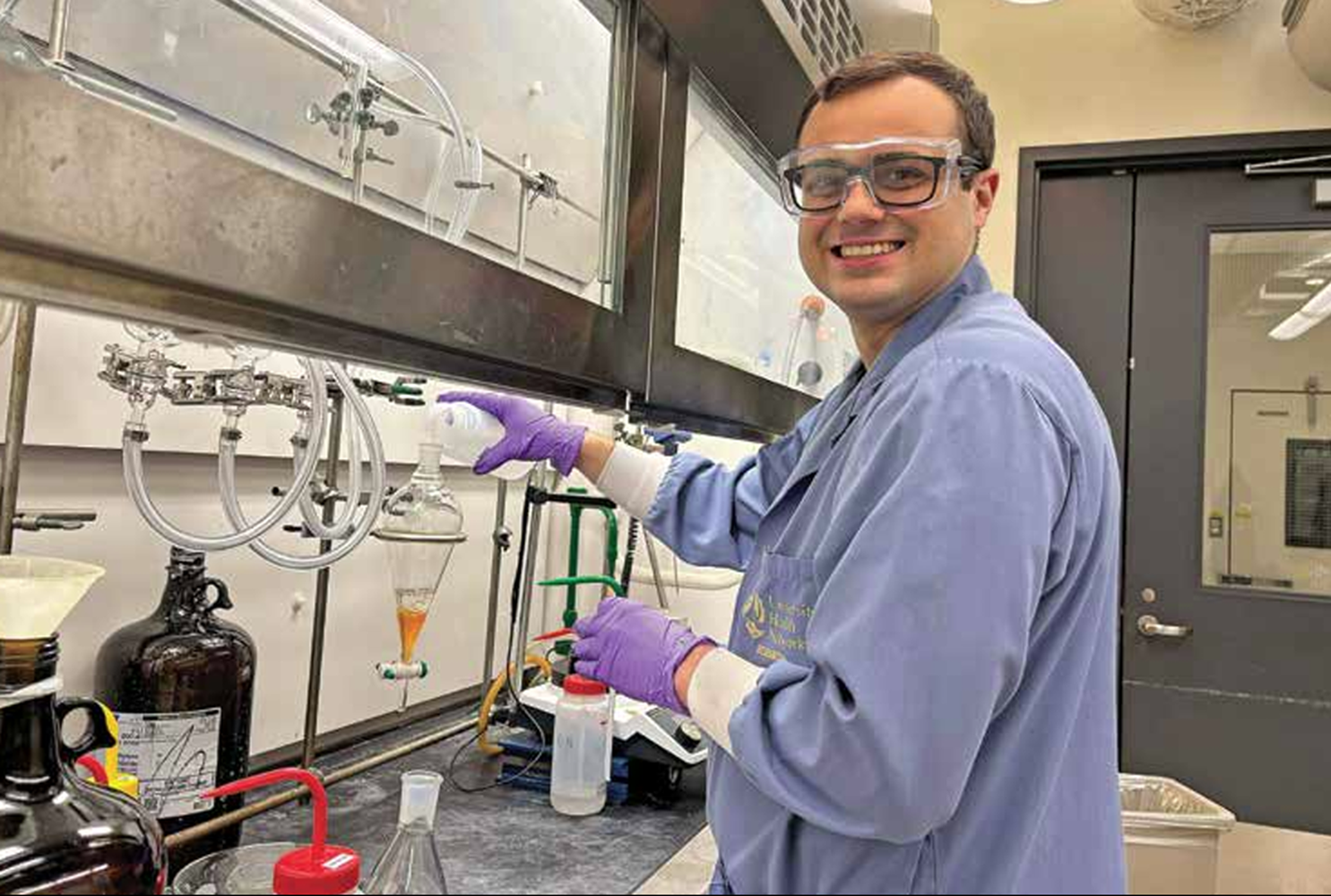
Angus Sullivan is asked what he is doing on the day of an interview with The Highlander, and he responds, “just another day of chemistry for me.”
But, it’s a little more than that.
Sullivan is currently involved in leading-edge medical research at University Health Network (UHN) in Toronto. He is in the midst of a two-year scholarship given to 100 of the world’s leading early career scientists. It’s known as the Canada Leads 100 Challenge; with funding generated by the UHN Foundation and The Princess Margaret Cancer Foundation.
UHN is a major teaching and research hospital network based in Toronto, affiliated with the University of Toronto. It’s known as Canada’s top research hospital, encompassing sites such as Toronto General, Toronto Western, and Princess Margaret Cancer Centre.
Sullivan goes on to explain he is doing research and development chemistry.
“So, my work focuses on gold nanoclusters, and I’m trying to design them to fight diseases like cancer, and use them for other biomedical applications.”
At the moment, he is making nanoclusters; metal nanoparticles smaller than one nanometer in size. “They’re really good at absorbing certain types of radiation. I’m trying to design them to specifically go into cancer cells in order to make radiation therapy more effective.”
The specific nanoclusters that he’s making first emerged in 2019. “So, I’ve been kind of at the front of developing the chemistry for these ones … these nanoclusters are a lot more stable than previous nanoclusters that have been made. Our idea is that since they’re more stable, that makes them a lot better for biomedical application; where you don’t want them breaking down in the body, losing effectiveness, or creating toxicity.”
Sullivan graduated from Haliburton Highlands Secondary School in 2015, before moving onto Trent University for his undergraduate degree, then Queen’s University for his PhD, graduating in January 2025. He did post-doctorate work at the Queen’s lab for a couple of months before joining the UHN lab on June 30, 2025.
He describes his first six months as “really great.” He said he is a chemist by training, but is now in a medicine-biochemistry environment. “I’m kind of like a fish out of water … so it has been a lot of learning for me, and they have been very generous in their time and expertise in helping me get that knowledge.” He added it is a welcoming place and everyone is passionate about fighting diseases, and trying to contribute to medicine.
More to do
Asked what his days look like, he said, “having a lot of short-term goals, that when put together, will get me to where I want to go. There’s just so much in research that you can’t control. My overall goal is eventually getting one of these nanoclusters to be a drug, to be used in humans but that’s further away right now. So, my initial focus is smaller; targeting where I want to get it to go into the cells I want it to go, and find reliable methods to get these targeting molecules on the clusters.”
They are injecting mice with cancer cells to induce tumours and then using the nanoclusters to try to treat the tumours. “We have successfully treated these mice with cancer cells with nanoclusters. We are able to remove their tumours successfully, but there is a lot more to do.”
Mr. Zondervan taught him chemistry at Hal High, but Sullivan said he had always been “inherently driven. I was always so focused on getting results and having success, even from a really young age.”
That being said, he was not always interested in chemistry per se, but science, and research and learning. It was in his undergrad years, he discovered a passion for chemistry.
“It was just something that was consistently challenging for me, which I really liked. There are a lot of layers of learning in it. Once you’ve learned the basics, it’s kind of like you’re in a playground…if you are in a lab, you can create whatever you want and make new things and that kind of really appealed to me.”
Asked if he thinks about what his life work might mean one day, Sullivan said “I’m not getting too caught up in the future. I don’t want to miss what’s going on right now. I focus on every day, do the right things every day, and that will lead to success.”