


Why are local councils, non profits and businesses still posting their information on social media platforms filled with slop and misinformation? Bram and Lisa talk to communications expert Lauren Hunter about how we can post and get information without being manipulated by secret algorithms. As social media becomes increasingly unreliable and confusing, where should citizens get their information and how should organizations get it to them?
Realtor floats idea of starting Minden BIA

After investing in Minden’s main shopping hub this summer, purchasing a three-unit building on Bobcaygeon Road, realtor Brandon Nimigon is leading the charge for a downtown business improvement area (BIA) – though some longtime merchants aren’t convinced.
Nimigon purchased 105-107 Bobcaygeon Rd. in July, wanting to move Century 21’s Minden operation closer to the community’s beating heart along the Gull River. He’s in the process of renovating the 130-year-old building and has had talks about renting out two units – one for retail and the other a sit-down restaurant. Nimigon feels Minden’s main street is a sleeping giant and wants to help transform the downtown into a shopping destination, akin to Haliburton village.
“I want to help reinvigorate this downtown core… there’s so much potential here. We have the Gull running through the downtown, there’s a beautiful river walk, all the tools are there,” Nimigon said. “We just need more people to invest – that can then bring more businesses, which brings more shoppers and tourists and just improves the
whole feel and mood of the downtown.
“Haliburton has got a really cute cottage town vibe, where people want to go shopping. Minden is getting there, but
I think it needs more of a focus, more attention put on developing the downtown,” he added.
Nimigon says ‘no-brainer’ to start Minden BIA
As president of the Haliburton BIA and serving on the board of the Bancroft BIA, Nimigon said he’s seen firsthand the benefits an overarching organization can have on local merchants, believing it’s a “no-brainer” to start one in Minden. He said a BIA can help beautify the downtown, organize public events, and provide a direct line of communication between council and the local business community.
Nimigon said he’s been a member of the Haliburton BIA since 2016, serving as president since February 2024. The BIA has been in place since 1988.
“I grew up in Haliburton and know what it was like before the BIA – there were so many empty storefronts. The mindset was ‘I need to get out of this town because there’s nothing to do here,’ but now every storefront is packed with successful businesses. Minden, I think, is in a similar spot to where Haliburton was,” Nimigon said.
No interest in BIA
Minden Hills mayor Bob Carter said he’s not sure there’s enough appetite among existing business owners to launch a BIA, saying it’s been almost a decade since the idea was last floated.
“There was the start of a BIA conversation when we had an economic development staff person [around 2016], but it fell off once economic development got turned over to the County,” Carter said. “There are a couple of interesting things about a BIA – it’s a formally-governed process where a municipality is involved with businesses, which some people don’t like, and it involves the businesses paying extra taxes to run the BIA, which a lot of people don’t like.
“At the time, there wasn’t enough interest among business owners to be a part of this,” Carter added.
He said the money is typically spent improving the downtown through marketing, event planning and physical
improvements.
While he isn’t interested in forcing a BIA on a business community that might not want it, Carter said he and councillors Ivan Ingram and Shirley Johannessen have recently launched a new working group to help improve the downtown. They have invited business owners to participate and have held one meeting so far, with another scheduled this winter.
‘We need something’
Shawn Chamberlin, owner of the Dominion Hotel, said it’s been about 50 years since Minden merchants had an overarching business group, which he said was strong through the 1970s – though it was never run under the banner of a BIA.
“A BIA and business association are two desperately different things that people talk about as if they’re the same – they’re not,” Chamberlin said. “A BIA comes under the control of council, whereas a business association is run by the owners.”
Through a BIA, Chamberlin said the municipality communicates with commercial property owners, and not the
tenanted businesses, which he believes would lead to a disconnect.
“Business owners don’t get a vote in a BIA – the landlord does… meanwhile, the costs all get passed down,” Chamberlin said. “So many of our businesses are just hanging on, I’m not sure this is something every business would or could take on.” As well as the financial challenges, Chamberlin said he doesn’t think many downtown merchants have the capacity to give another five or six hours a week to a business association.
“It’s a lot of work, a lot of meeting and planning and figuring things out. Most of our businesses here are owner-operated, they’re working all day, all week long. They just don’t have anything else to give once their day is done,” Chamberlin said. Shawn Smandych, owner of Ommmh Beauty Boutique, has been a part of the downtown core for 14 years.
“I want to see this town succeed and for it to succeed things need to actually start happening,” Smandych said. “Do we need something, maybe a business association? Absolutely. Do I think a BIA is the best option? I don’t know.”
He feels there’s very little driving people downtown, especially in the mornings, and thinks a new restaurant could go a long way to increasing traffic.
Smandych is also concerned about the growing trend of vacant buildings along the main strip.
“It’s not a good look seeing places sit empty – we have three or four vacant units at one of the most important points in town. That concerns me, because it gives the downtown a bit of an icky feeling. We need to fill the spaces we do have to give people a reason to visit, that’s got to be a priority,” Smandych said.
Wanakita invests in leaders of tomorrow
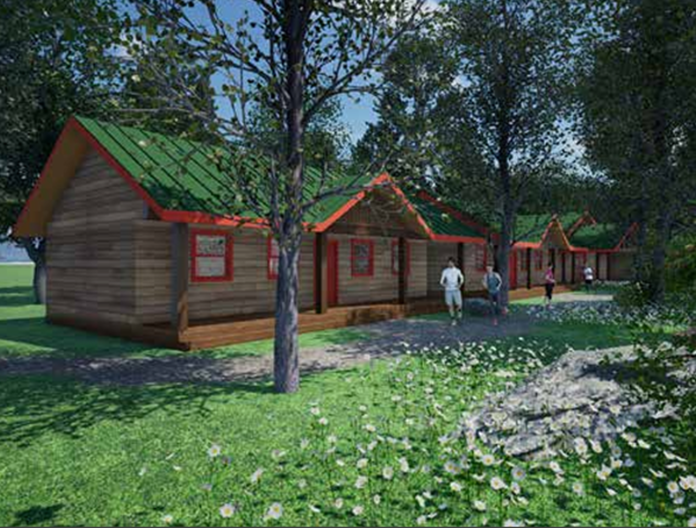
YMCA Wanakita is paying homage to a key figure from its history, recently announcing a $2.6 million investment in a
new leadership centre that camp figureheads say will open next summer.
The building has been branded the Wayne Perkins Leadership Centre, in honour of the man who spearheaded Wanakita’s popular student counsellor program half a century ago. The two-year initiative teaches campers essential life and leadership skills via outdoor education, teamwork and mentorship – helping to create the next generation of leaders, says Andy Gruppe, vice president of overnight camp and outdoor education at Wanakita.
Gruppe said Perkins was Wanakita’s camp director in the mid-to-late 1970s and would go on to serve as CEO of YMCA Canada from 2008-2010. Perkins passed away in January. “He was pretty instrumental in making this place everything it is today,” Gruppe said.
“He was a special person, he helped turn Wanakita into a four-season facility, was a leader in the camp and the community and obviously left a significant mark in terms of establishing a more formalized leadership program for campers before they become staff.”
The 4,080 sq. ft. space will replace nine already-demolished buildings that housed Wanakita’s leadership operations. There will be a main meeting space, dorms for summer camp goers, and an Indigenous learning library. In the winter, the space will be used for snowshoeing lessons. It will be able to accommodate up to 58 people.
Gruppe said the leadership program has become one of Wanakita’s most popular. The first year is open to youth as soon as they turn 15 and is focused on improving multiple outdoors skillsets, particularly water-based such as lifeguarding and paddling. The second year is about building communication and leadership skills that youth can utilize in later life.
Most of Wanakita’s summer staff are graduates of the program, Gruppe said. County-based Rodco Enterprises is handling the build, with footings for the foundation now installed. Gruppe said the facility has to be finished by June, in time for Wanakita’s busy summer season.
Gruppe said Wanakita sees approximately 10,000 visitors per year. In the shoulder seasons, the camp operates as an outdoors centre, opening its grounds for school groups and private bookings.
Gruppe said Wanakita’s administration is committed to the camp’s long-term success, investing close to $10 million in camp upgrades since 2013. This latest addition is the largest spend since the COVID-19 pandemic, Gruppe confirmed.
“We’re a big place – we have 143 buildings and two separate camps on the property. It takes a lot of ongoing investment and upgrades to keep the place going,” he said.
Wanakita is seeking donors to assist with future investments. For more information, visit ymcaahbb.ca/wayne-perkins leadership-centre.
Mental health and addiction support come full circle

The lead of a new peer support drop-in service covering Haliburton County says personalized programming is intended to meet people where they’re at, offering hope to those in the Highlands dealing with mental health and substance use challenges.
The Coming Full Circle program has been running out of the Halco Plaza at 83 Maple Ave. Unit 7A since early September. A grand opening event was held Nov. 4.
David Barkley, program supervisor, said the two-year pilot is a partnership between Point in Time, the Canadian Mental Health Association Haliburton, Kawartha, Pine Ridge (CMHA-HKPR) and the Haliburton County Connections Committee. It was announced last spring, as part of an $800,000 investment from Canada’s Substance Use and Addictions Program.
Barkley, who has 22 years of experience working in peer support, said uptake has been slow. He said two-to-three people are utilizing the space when it’s open, on Wednesdays and Thursdays from 10 a.m. to 3 p.m. Services are also offered at the Minden Community Food Centre at 24 Newcastle St., Fridays from 9 a.m. to 1 p.m.
Tuesdays will soon be added to the schedule in Haliburton, likely in late November, Barkley said. There are also plans to expand to Wilberforce and offer programs in the evening.
“The goal is to be doing something somewhere at least once per week,” Barkley said. “Drop-ins are meant to be low barrier. There are no expectations. This is a person-centred space. We want to get to know people, what their goals are, what they’re passionate about, and how we can help them on their path.
“If all people are looking for right now is a warm place to go for a cup of coffee, we can be that place. If you’re not quite ready to talk, but want to be around other people, this is somewhere you can do that… we want to be a spot people can feel welcome, even if they feel like they have nowhere to go,” he added.
The service boasts six staff members, trained in things like crisis intervention and conflict management. All of them draw from their education when helping to get people back on track, with some also boasting lived experience – a key component to truly connecting with people suffering, Barkley said.
Alongside counselling-type peer supports, the drop-in can also be a fun space. There are games, arts and crafts and musical instruments available most days.
Coming Full Circle doesn’t have any quotas, Barkley said, saying they will measure success on the differences they are able to make.
“Helping one person is success to me… though, we do have broader goals. We’re funded for two years, so we want to showcase what a successful peer support model can look like. I want the community to see the benefits of peer support, so that if time is eventually up for us in terms of being here, there is a lasting legacy,” Barkley said.
“At the end of the day, it’s just community activism. People helping others through difficult circumstances and experiences.”
For more information about the program, email dbarkley@cmhahkpr.ca.
Tail gunners tell of luck and courage

Haliburton’s Barry Hart told a theatre full of high school students on Remembrance Day that he still shudders when considering how fortunate his father, William Hart, was to survive a plane crash that killed the rest of his crew during the final months of the Second World War.
A tail gunner with the Royal Air Force’s (RAF) 582 Squadron, Hart and the rest of his seven-man crew took a Lancaster bomber on an 18-hour round trip from London, England to Chemnitz, Germany on March 5, 1945. Their mission was to be a pathfinder, marking enemy targets with magnesium markers. They had just returned to British airspace when disaster struck on March 6.
“They’re coming down to land, and the plane just blows up,” Hart said, noting that some of the leftover magnesium markers hadn’t been set properly and, upon the plane descending to 3,000 feet, inadvertently went off.
One of the soldiers called out the fire right away, with the pilot saying he would try to hold the plane steady and directed the rest of the crew to bail. Hart said his grandfather was in the tail gunner turret while this was
happening and, with the plane jolting, fell out. He managed to recover and quickly pull his parachute, Hart said.
“Miraculously, he survived the parachute drop. The plane nosedived and the other guys, unfortunately, didn’t make it out. They were all incinerated in the crash,” Hart said.
He told how his father only became a tail gunner after losing a coin toss with his comrades – the position was widely
considered to be the most dangerous on the Lancaster, as it’s the first target for enemies.
In September, he visited the crash site near Oxford, saying there’s a memorial stone and plaque there to honour the crew. His dad wasn’t named though, being a survivor, so Hart had another plaque made and installed. William died in 1992.
While not quite as death-defying, Pat Casey said his grandfather, Earl Casey had many horror stories from his time fighting in the war. He was also a tail gunner, serving with the Royal Canadian Air Force’s 428 Ghost Squadron, which flew nighttime bombing missions.
“Flying at 20,000 feet, the glass cover that protected tail gunners from the elements would get frosted over on lengthy flights.
The soldiers couldn’t see, so nine-times-out of-ten they would kick the panel out and fly in the breeze at the back of the aircraft,” Casey said.
His grandfather was 17 when he enlisted, one year younger than the minimum requirement. Casey said he must have lied on his application. Earl was the youngest in his flight crew, with the oldest being 23.
After a successful bombing mission over mainland Europe, Casey’s Lancaster was struck by shrapnel over the English Channel on the return flight home. The crew ditched the plane in the water and spent 14 days with limited supplies on a rubber dinghy.
“They ran out of food and water pretty quickly. They got to the point where, to survive, they had to drink their own urine,” Casey said. “They didn’t think they could go on much longer – then they got picked up by a German patrol boat and became prisoners of war (PoW).”
Earl sustained a broken shoulder and leg in the crash, which didn’t heal properly given the poor living conditions PoWs were exposed to. He wasn’t sure how long his grandpa spent in captivity, but knows exactly when his time as a prisoner came to an end.
“He told me the Germans lined him and his crew up in front of a firing squad. The Germans loaded their guns, my grandpa and the other boys all said a teary goodbye to one another – they were pretty worn out and beat down by this point,” Casey said. “But as they waited for the trigger, a German captain stopped everything. The war was
over.”
The soldiers were all transported back to England and returned home to Canada within weeks.
“If you want to talk about luck – that’s how close my grandfather came. His luck was in at the most critical time,” Casey said.
Bringing the heat

This year’s Heat Bank dinner and auction entered a new chapter – with a new venue, The Bonnie View Inn, and chefs joining forces from the County’s top restaurants: Rhubarb, Juna, The Post House, and Dimensions Retreats.
Moving from Rhubarb, the event nearly doubled in size, hosting more than 100 dinner guests.
Tina Jackson, of Central Food Network and Heat Bank’s executive director, said they raised more than $43,000.
She said, “Sunday night was grand. It was a beautiful showcase of the collaborative
spirit of the Haliburton Highlands community … with chefs, musicians, staff volunteering,
businesses and community members all coming together in generosity and spirit to
support Heat Bank and ensure that no neighbour is left cold.
Our hearts are so filled with gratitude.”
Three Red Hawks crack 100 at OFSAA

Red Hawk runners raced at the OFSAA cross country championships at Heart Lake Conservation Park in Brampton Nov. 1.
The race includes the two best teams, and top five individual runners, from the 18 associations from across Ontario.
Coach Karen Gervais said, “HHSS runners demonstrated grit and resilience facing challenges like the stampede; starts with 275 runners exploding off the line at once; jostling and elbowing for position; getting boxed in on narrow trails and a good helping of slippery mud after Friday’s rains.”
The top finisher for the Hawks was Junior Girl Annika Gervais in 64th. Gervais shaved a minute and a half off her time on the course earlier in the season, reeling in several runners over the last two kilometres.
Novice Girl Quinn Hamilton used her speed to get ahead of the mob in the mass start, hanging on to finish a strong
76th. Hamilton also improved her time on the 4 km course by a minute and a half despite the cold and muddy conditions.
Novice Boy Alex Lee cracked the top 100 in his debut OFSAA race, finishing 99th. Lee ran consistently throughout
the season, but Gervais said he found the OFSAA race challenging with the many runners on narrow trails making it difficult to pass.
Senior Girls and longtime teammates Violet Humphries and Erika Hoare crossed the finish line together in 174th and 176th in the very competitive field of senior runners. The senior category includes athletes in Grade 11, 12 and sometimes fifth-year runners, like Hoare. The senior 6 km course featured not just extra distance,
but a very hilly loop near the beginning of the race, Gervais said.
She added, “the team will miss the leadership of Humphries, Hoare and senior girls Grace Allder, Ella Gervais and Olivia Gruppe, who will all graduate this year and have been pillars of the distance running program at HHSS.”
Character building weekfor new-look Huskies

It’s been quite a week for the Haliburton County Huskies – back-to-back double overtime games Nov. 5 and 8, followed by a huge come-from-behind win on the road Nov. 9.
The team was also sporting three new players after amajor trade with the Cobourg Cougars.
This past Sunday, the Markham Royals stunned the Huskies with three first-period goals: at 12:35, 15 seconds
later at 12:50, then at 15:32 to take a 3-0 advantage.
Alternate captain Isaac Larmard said, “we went into the dressing room after the first period and just regrouped. We
all agreed we had to be better and went out for the second and that’s when we came back and it was 5-4.”
The Royals had made it a 4-0 scoresheet at 7:16 of the second, but it was all Huskies after that.
Declan Bowmaster got the first one back at 8:56 on the powerplay, assisted by newcomer, Jack Cook, and Kieran
Raynor. Chase Del Colombo notched the second Husky goal at 10:37 from newbies, Liam Oravsky and Carson Durnin. Ronen Macfarlane bulged the twine at 12:10 on the man advantage, from Del Colombo and Durnin. Then,
at 13:26, Oravsky tied the game, from Easton Poe. Durnin potted the game-winner at 18:16, assisted by Oravsky and Del Colombo.
The third was scoreless in the improbable 5-4 Huskies win.
Larmand said, “coming back from 4-0 is pretty hard to do.”
Huskies 1 Dukes
The night before, Nov. 8 at home, the Huskies played the Wellington Dukes to a 1-1 tie when no one could score
after double overtime.
Wellington got on the board first, at 11:04 of the second period. But Oravsky tied things up at 9:39 of the third, with
an assist to Daniel Vasic.
That was it for the scoring as the teams recorded a rare tie. Larmand said, “we had lots of chances to win that game; hit some posts, it was very back-and-forth. Taking the tie and not letting Wellington get the extra point helps us in the standings.”
Buffalo 3 Huskies 2
In this one, Julius Da silva got the blue and white on the board first, at just 54 seconds, from Vasic and Mike
Mardula. Then, at 10:10, Carter Petrie gave the Huskies a 2-0 lead on the PP, with assists to Larmand and Macfarlane.
However, the team squandered two late goals, at 16:24 and 18:09 to let the Junior Sabres back into the contest.
There was no scoring again until the Sabres broke the Huskies’ backs at 1:05 of the second OT to take a 3-2 win.
Larmand said, “that game was a very winnable game for us. We took the positives away from it,” including the good
start. However, he said they should not have given up two late first period goals. “Obviously, it didn’t finish the way
we wanted it to.”
Larmand said the three games were “pretty nuts. We just stuck to our system, stayed together as a team.” He felt they were character building games, especially coming back from a 4-0 deficit.
Trade
The Huskies traded Curtis Allen, Connor Hollebek, and Alex Rossi to Cobourg, picking up 20-year-olds Durnan
and Cook, and 19-year-old Oravsky.
“Just bringing in a couple of older guys to add some age to our team and add some experience and hopefully help us
get some wins,” Larmand said.
Next up: Pickering on the road Nov. 14 and St. Michael’s at home Nov. 15. Puck drop 4 p.m.
Heart, teamwork andgrowth in 3-3 tie

The U13 LL Casey’s Water Well & Geothermal Inc. team put forward a huge effort in their game against a top
opponent, Durham Blue, showing grit, skill, and teamwork from start to finish. The Nov. 8 game finished in a 3-3 tie.
Olivia Emmerson ran the power play with poise, quarterbacking the unit and creating scoring chances every shift. Beau Gilmour was relentless on the penalty kill, reading plays perfectly and keeping the other team off balance. Brody Alton nearly lit the lamp with a blast from the point, only to be robbed by an incredible save. Bobby Walker held the blue line with authority, keeping opponents out of his goalie’s crease and maintaining control in the defensive zone. Blair Fisher had a couple of quality chances from the point but couldn’t quite get the bounces to go his way. Parker Fessey once again proved to be the team’s Swiss Army knife, seamlessly moving between forward, defence, power play, and penalty kill roles.
Grayson Pelley’s calm breakout control and elite playmaking made him a key factor in the flow of the game. Jase Jones’ hard work paid off with two goals, both products of his determination and skill. Miller Brown battled all game and was unlucky not to score multiple times, denied by a standout performance from the opposing goalie. Raelyn Adlam used her speed to pressure defences down the wing and stayed active in front of the opposing net. Aliyah Cox continued to shine as one of the team’s best playmakers, turning broken plays into chances and setting up her teammates with accurate passing. Nolan Frybort buried one in the net with his trademark powerful wrist shot. The three rookies Charlie Mainprize, Mason Mihlik, and Jack Guyatt are developing quickly, making strong
contributions on both sides of the puck.
In net, Gavin Suke delivered one of the most memorable sequences of the season with a diving save spree in the
first period stopping three straight shots across the crease, stretching out the trapper to deny the final rebound. Facing a barrage from an undefeated team, he stood tall and only allowed three goals.
The team missed Kylie Simms’ strong playmaking and Nathan Hill’s steady defensive presence, but everyone
stepped up to fill the gaps. All in all, it was a game full of heart, teamwork, and signs of real growth across the lineup.
Abbey Gardens’ holiday market returns

After a brief hiatus, Abbey Gardens has announced the return of its holiday night market.
This year’s event will be on Saturday, Nov. 15, from 4-8 p.m.
Executive director Angela Kruger said the festive community offering transforms the Abbey Gardens property into a winter wonderland, where visitors can shop, sip, and celebrate the magic of the season.
“Following record-breaking attendance in past years, the market is back and better than ever. Guests are invited to stroll along illuminated pathways, explore a cozy, heated vendor tent filled with local artisan creations, and enjoy festive food and drink from the Abbey Gardens Food Hub and local partners,” Kruger said.
She added there will be holiday-themed cocktails and warm beverages, from cider to hot chocolate, and other seasonal sips on offer. So, too, will be wood-fired pizza, sweet treats, and café favourites.
Some 20 local artisan vendors are offering handmade gifts, jewellery, décor, and seasonal treasures.
Kruger added there would be “exclusive Food Hub finds and festive surprises. Ambient lights, fire pits, and cheerful music filling the air with warmth and joy.
“The holiday night market truly captures the spirit of Abbey Gardens. It’s where our community comes together
to celebrate creativity, connection, and local craftsmanship — all against the backdrop of our twinkle-lit gardens.
The response this event has received in previous years reminds us how much people value gathering in nature and supporting something that gives back.”
Admission is by donation, with priority entry for online ticket reservations (walk ins welcome as space allows). All proceeds support Abbey Gardens’ environmental education and restoration projects that help connect people with nature and sustainability year-round.
For more information, visit abbeygardens. ca/event-details/abbey-gardens-holiday
night-market.
Abbey Gardens is a charitable organization in the Haliburton Highlands created with a mission to transform a spent gravel pit into a green space dedicated to developing economic, ecological, educational, and recreational growth within the community.
Kruger said they are proud to be FEASTON certified for carrying Ontario products in their Food Hub. It is a social
enterprise that produces, promotes, and sells sustainable, local food to engage the community and support Abbey Gardens.
Other big events:
• Santa Claus parade in Minden Nov. 15, starting at 11 a.m. followed by Christmas in the Village at the cultural centre until 3 p.m.
• Diwali in Haliburton, Nov. 15, 6:30 p.m. at the Haliburton Legion. The event is suitable for adults, youth and children. Tickets are $40 for adults, $20 for students and children under 18 are free. Tickets are available
online at www.dancehappenshere.com or at Redmans Records. For more information see www.dancehappenshere.com