Home Blog Page 169

Simon’s garden a different way to live in the world

0

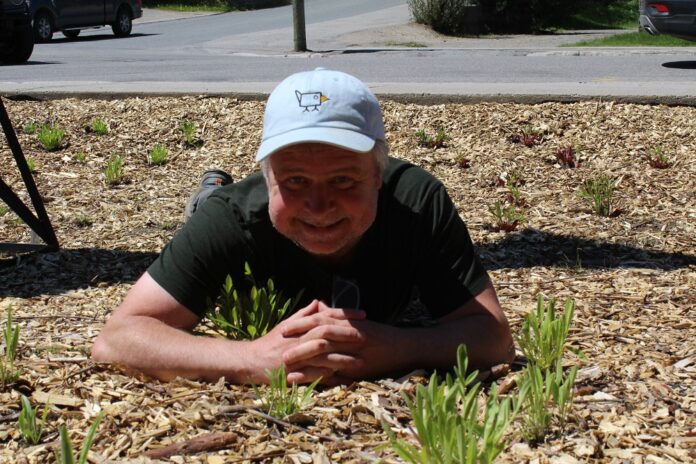
Simon Payn is getting his hands dirty as he creates a garden at the corner of Maple Avenue and Mountain Street in downtown Haliburton.

Passers-by might have seen work progressing at the historic Lucas House, which houses the Corner Gallery, Lebo Law and The Highlander.

Payn said he is creating a garden that not only appeals to him but also serves the interests of nature as a whole.

“I’ve carefully selected plants that will create an ecosystem, benefiting everything from invertebrates to birds,” he said. “I hope it will be beautiful to nature as well as to us.”

Payn said this approach to gardening will reduce maintenance. He has removed the lawn and replaced it with native plants from Haliburton County and the wider area, including little bluestem, pale purple coneflower, and swamp milkweed. These plants are suited to living here, meaning they don’t need much care.

He ordered 1,200 small plants from a nursery and expects in a year or two they will cover the ground and eliminate the need for weeding.

“As the plants are getting established, they need to be watered in hot and dry weather,” he said. “But as time goes on, all it will require is a little tweaking as the plants mature.”

Instead of gardening to please humans, Payn said his landscape considers the environment too.

“It’s a different approach to how we live in the world,” he said. “You do things for the benefit of the wider world – wider biodiversity, wider ecosystems. When they benefit, it benefits us too.”

Payn said his garden shows how people can adopt sustainable practices that go beyond our own needs. He hopes his garden serves as an inspiration to those who are trying to make a positive impact on the world around them.

Payn is co-owner and former publisher of The Highlander.

Gardeners reveal innovative tour of Riverwalk

0

The Haliburton County Master Gardeners launched a self-guided tour of the Minden Riverwalk May 26. Called ‘stepping into nature’, it can be accessed through a smartphone app called PocketSights.

The Master Gardeners have been working on the project for around six months. Master Gardener Shelly Fellows said they have planted approximately 45 native plants along the riverwalk. Some of these native plants are joe pye weed, sedges, and spruce.

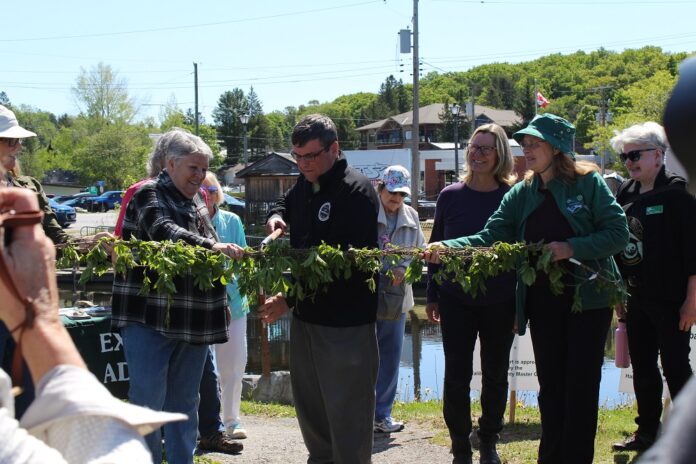
Minden Mayor Bob Carter, County Warden Liz Danielson, U-Links executive director Andrew Gordon, HCDC program and operations coordinator Heather Reid, along with the Master Gardeners, were in attendance to officially kick off the event by cutting ‘the rope’.

Fellows said, “the multi-media walking tour includes photos, detailed descriptions of plants, insect information and gardening tips, along with audio stories.”

When walking beside the Gull River listening to the self-guided media tour, it gives an in-depth description of what people are experiencing. It vividly describes things such as the rainbow bench in honour of Sinclair Russell, who created Minden Pride and passed away in 2020.

There has been a massive population of geese surrounding the Gull River, which can have many health risks to humans, other natural species and water. The Master Gardeners and the township of Minden Hills have worked hard to reduce the population.

They started with letting the grass grow naturally at the edge of the river and not cutting it. This stops the geese from eating the other native plants on the riverwalk. It may take two to three years for this to be effective because geese tend to return to the same nesting locations.

The Master Gardeners gave out a free native plant to everyone, along with free tours. You can access the guided walk anytime by downloading the PocketSights app and scanning one of the QR codes on the multiple signs located along the riverwalk.

Haliburton man passionate about MG brand

0

When Ian Macnab bought his first car, a beat-up Austin-Healey Sprite, in the late 1960s he had no idea he was planting the first seed for what would become a lifelong passion.

The Haliburton resident looks back fondly on his years as an early adult, where he spent whatever free time he had away from his studies at McMaster University learning how to restore and care for the classic car. Better known in Europe as the MG Midget, the vehicle was among the most popular affordable sportscars on the market right around the time of the moon landing.

“I didn’t really know or appreciate what I had back then, but I was deeply enamoured with the MG brand. It’s fair to say that’s where my passion began,” Macnab recently told The Highlander.

While he would sell his Sprite after graduating, Macnab remained faithful to the Morris Garages brand. Today, he has one of the most impressive MG collections on the continent. The crown jewel is an emeraldcoloured 1970 Midget that Macnab says he’s owned and meticulously maintained for almost 25 years.

He purchased the vehicle from its previous owner in North Carolina in 1999. Back then, it wasn’t much to look at.

“It came up here in boxes. The parts were all painted in grey primer, it was a total rebuild job. But it was exactly what I had been looking for,” Macnab said, noting he paid $500 for it. “I spent the better part of three years working until it was finally ready to hit the road. I haven’t looked back since.”

The car regularly turns heads at shows across North America. It won first place in its class at an MG conference in Niagara Falls in 2015, with other awards earned at events in Louisville, Kentucky, Peterborough, Port Perry and Kingston. The Midget has become a regular feature at the annual Brits in the Park car show that takes place in Lindsay each summer.

The early years

“The older I’ve gotten, the more interested I’ve become in the origins of the MG brand. It’s really quite the success story,” Macnab said.

Founded by Cecil Kimber in the 1920s, MG established its home base in Oxford, England and became known as the manufacturer that made the marque famous. Renowned for its open two-seater sports cars, MG also produced saloons and coupes. The company is celebrating its centennial this year.

Since its conception, MG has led the way in sports car development, Macnab claims.

“There are sports cars that are far better cars than MG, faster than MG. But MG was the one that started it all. They were the pioneer.”

The collection

Macnab has dozens of items from those formative years on display in his garage in Haliburton, part of a 300-plus piece collection that he estimates is worth in the region of $25,000. Whether it’s newspaper clippings of old stories or advertisements, framed posters of some of the earliest MG models, branded teapots, or actual pieces of the original factory and assembly line that was decommissioned in 1972, the collector has a little bit of everything.

“I’ve got several pewter models, die cast models. I have a plate that formed part of the engine in an MG T-type – that car is long gone, production stopped in 1950, but I was able to find this online from a seller in the UK,” Macnab said. “I was able to take the information from the plate to find out exactly what car it was from, and when and where it was made.”

The walls inside the garage are filled with various other keepsakes. There’s an enthusiast medal handed out by the British Car Council of Canada in 2017 in honour of Macnab’s collection; the original steering wheel from his 1970 Midget; a one-of-a-kind commemorative plaque MG assigned to Macnab in honour of the company’s centennial – they only made and distributed 100, Macnab has number 59; and a watercolour painting of the emerald green Midget that an admirer in Lindsay put together around 10 years ago

“I don’t know that it’s the most valuable collection in the world, but it’s definitely unique. And it’s been a lot of fun pulling all this stuff together,” Macnab said.

Looking ahead

Macnab said he has some wonderful memories with the car, most notably from his wedding to his second wife, Jane, in 2008. The couple were married in Gravenhurst on an old Muskoka steamship but made sure to bring the Midget along so they could ride off into the sunset.

“Jane insisted – we decorated the car with a ‘just married’ sign, we had it waiting on the pier once we got off the boat. That’s something that will stay with me forever,” he said.

It’s recollections like that which will make it hard for Macnab to let go. He said he’s considering parting with his collection, including the 1970 Midget, but only for the right owner.

“I’d like to think this all can live on in some way,” he said.

Not that he’ll be getting out of the MG business completely – Macnab said he’s long toyed with the idea of purchasing a rare MGB GT hard top if he can find the right deal.

“That’s on the bucket list. Again, it’s not the fastest or most shiny car, but it appeals to me. The whole point of this is to have a little fun, bring some enjoyment into your life and put a smile on your face,” Macnab said. “I’ve had enough smiles and good times out of this thing to last me two [lifetimes].”


Minden garden a community effort

0

Minden resident Bruce Down said having the chance to grow his own produce right in town is a blessing he isn’t taking for granted.

The retired senior was among the first to register for a plot at the new Minden Community Garden, which opened May 18. Located at the Minden fairgrounds, the space boasts 20, four-feet by 12-feet raised beds that locals can use to plant fruits, vegetables, herbs, and flowers.

“We live on a lot on South Lake Road and it’s all bedrock, solid stone. I couldn’t plant there even if I wanted to,” Down told The Highlander. “I was born and raised on a farm and know what gardens can do for you. They’re a gift.”

Development of the garden was a joint venture between the Minden Community Food Centre and Minden Rotary Club. Gary Stoner, a volunteer with the food bank, said he’s been working on the concept since August.

The project is designed to provide fresh produce to food bank clients and the general public, many of whom – like Down – do not have the physical space to create a garden on their own property, or who live in rented accommodation.

Work began at the site in early May. Stoner said the wood for the plots was donated by Minden Home Hardware and Canadian Tire, while Carnarvon’s Francis Thomas Contracting supplied the topsoil.

“It’s been a real community effort,” he said, estimating the cost to be around $15,000.

As of press time, there were still seven lots available for rent. Stoner said the cost is $20 per season.

The space was a hive of activity on Victoria Day, with several residents stopping by to tend to their lot. Down was the first, planting onions, radishes, lettuce, tomatoes, carrots, and some flowers.

“There’s nothing quite like growing your own stuff,” he said.

Stoner said fencing designed to keep deer and other wildlife away from the plots will be installed in June, while there are plans to run water to the site and install hose beds next summer. Looking long-term, he said the site could be expanded to include more lots if demand spikes.

Anyone interested in tending to a plot can call 705-286-6838, or email mindencommunityfoodcentre@gmail. com. Stoner said he’s looking for people who would be willing to grow fruits and vegetables to donate to the food bank.

“We have certainly seen an uptick in the need for fresh produce in Minden. None of the lots are specifically designated for the food bank, the challenge we have is finding volunteers to look after that, but we would be really thankful if anyone from the community was interested [in taking that on],” Stoner said

Forest studies helpshape future plans

0

Haliburton Forest and Wild Life Reserve held its first Research Day in more than four years May 13, inviting students and specialists from across Canada to share information and analysis on a range of forestry-related issues.

On the agenda this year were presentations on the impacts of beech bark disease, silviculture efforts at Haliburton Forest, the benefits of biochar technology, and a look at how declining moth populations is threatening birds and other wildlife in Ontario.

Organizer Adam Gorgolewski said there was a lot of good information, with around 40 people attending.

“Each year we try and cover a bit of everything that’s going on in Haliburton Forest. There are usually 20-plus research projects happening at any one time. Because we haven’t held an event for four years, I was able to narrow in on a few important topics that, literally, could change and help shape the way we operate in the future,” he said.

The morning presentations focused on forest management and silviculture. Gorgolewski spoke about how Haliburton Forest is changing the way it identifies trees for harvesting. For years, the business has followed the standard practice of individually studying and marking trees, making sure they were healthy enough to be harvested, which Gorgolewski said is “one of the most labourintensive parts of the way we manage our forest.”

During the pandemic, Forest staff piloted a new system that uses canopies to determine the underlying health of a tree.

“Rather than walking around every tree and scanning for every single defect and then doing the math to figure out when it’s likely to die, you can just look at the canopy and if it has 20 per cent or more die-back (decline), it’s quite likely to die over the next 20 years, or at least decline in quality,” he said.

Haliburton Forest produces approximately 110,000 fbm (board foot) of lumber each day across its four sawmill operations.

A species on the decline

Gorgolewski said beech bark disease is the “biggest, most significant problem” Haliburton Forest is currently facing. First identified on-site in 2010, the disease is spread through fungus that lives inside insects that feed off a beech tree’s sap. Once a tree is infected, it’s a death sentence, Gorgolewski noted, saying he expects the species will be wiped out completely by 2033.

“Beech trees represent around 15 per cent of all trees in Haliburton Forest… so that’s a massive decrease in the number of trees we will have,” he said.

There is a silver lining, though – he said staff will plant a variety of tree species in place of the fallen beeches, which will create a more resilient forest eco-system. That’s important, he said, at a time that invasive species are running roughshod on various tree populations.

“Probably a more present and imminent problem than climate change… invasive species are one thing that could make or break our forestry operations,” he said. “We weren’t prepared for [beech bark disease] when it appeared – if we had something similar come in and hit all of our maple trees, which makes up around 50 per cent of our tree population, then you’re looking at the majority of our trees being wiped out.”

An immediate concern is the increased presence of hemlock woolly adelgid – an aphid-like insect that attacks and kills hemlock trees – in the GTA.

“Our whole eco log business is based off lumber that comes from hemlock trees, so if that gets here, it’s going to have huge implications on how we operate,” Gorgolewski said.

The future

Biochar is a big part of Haliburton Forest’s future operations, Gorgolewski said. The company invested $10 million expanding its work in the field in 2022.

“There are hundreds of different uses of biochar. Most of the research we’ve done has focused on soil amendment and rejuvenation, but the possibilities are endless,” he said.

In her presentation, Lutchmee Sujeeun, a PhD student from the University of Toronto, indicated biochar has proven to positively affect the growth of certain tree species, particularly sugar maple and hemlock.

Biochar is a carbon-rich, charcoal-like substance produced by burning forest material in a zero-oxygen environment to create oil and gas by-products that can be used as fuel.

In a release last year touting the expansion, Haliburton Forest managing director Malcolm Cockwell said biochar produced on-site can be used to displace various fossil fuel products, resulting in a net reduction of 4,200 tonnes of CO2 equivalent emissions per year.

“We’re just getting started with biochar, and we hope to have another exciting announcement later this year,” Gorgolewski said.

Researchers put Minden under the microscope

0

If you live in Minden, chances are you’ve seen Dionne Pohler and Leticia Chapman around town.

Pohler, a University of Saskatchewan faculty member, and Chapman, a PhD student from the University of Alberta, have been chatting up locals for a research project on rural Canadians.

Pohler explained they’ve been inspired by the work of Katherine J. Cramer, the author of The Politics of Resentment: Rural Consciousness in Wisconisn and the Rise of Scott Walker. She delved into why Democratic Wisconsin turned Republican in 2016, and the mood of rural and smalltown America.

Cramer’s work focuses on the way people in the U.S. make sense of politics and their place in it. But. instead of relying on polls and surveys, she dropped in on informal gatherings, such as coffee shops, and gas stations, to listen in on what people were saying.

Pohler said as a result, Cramer, “had probably the most compelling explanation for what had happened, and what people were upset about because she was actually coming and talking to people in rural communities.”

She added when it comes to social science research, academics tend to live in cities, which means, “we’re doing research that doesn’t get a sense of what happens outside of the large urban areas. Canada’s urbanizing and a lot of the research is survey-based or opinion research, polling, and that kind of thing. You don’t really get a feel for how people make sense of issues, what they care about, why they care about it, and how they make sense of issues together in groups.”

Pohler got a grant from the Social Sciences and Humanities Research Council to study rural Canadians, and Chapman is her research assistant. Pohler’s collaborator is Clark Banack, the director of the Alberts Centre for Sustainable Communities.

“We’re starting to spend two weeks in every rural community we visit and try and get a sense of the place and the people. What do they care about? How do they make sense of issues? Why do they care about the issues they care about?”

She said they come without an agenda, and just see what presents in a community. In this instance, it’s the closure of the Minden ER.

They’ve picked up on the seasonal nature of the County, too, as well as a movement towards self-sufficiency and homesteading.

“I think people in urban centres, or in general, think rural communities are not diverse, thriving places, and you show up in them and you’re like, ‘wow, they are’,” Pohler said.

Other observations they’ve made is that people might have different opinions but generally get along.

When they are done their research, Pohler said it may turn into a book. They will definitely publish academic papers, but would like their findings to be more accessible to the general public, including the communities they are visiting.

Pohler said it’s been eye-opening since most of her research is statistics and datadriven. “I have to say there’s something interesting about just letting people tell you why they think and believe the things they do in their own words.”

Chapman added, “when we’re debriefing after we’ve talked to somebody, is people in small communities don’t necessarily expect other people to be totally coherent. You can have this opinion, and you can have that opinion, and it doesn’t matter what’s kind of related to that. Sort of a bit of pragmatic tolerance.

“When I decided to go back to university and start a PhD, I wanted to write about rural communities because I wanted to research them and find a way to talk about this in a different way because what I was seeing was really complex and interesting. Basically, people finding ways to get along with each other. I’ve always seen rural life in small communities being much more socially complex.”

Pohler added, “maybe we don’t have as many competing values as we think when it comes down to it. It’s about relationships. You care about interacting with somebody and you don’t walk away because it’s a difficult conversation.”

Dionne Pohler and Leticia Chapman conducted research in Minden.

Gold medalist appearing at Home Show

0

Canadian curler Mark Ideson is the living embodiment of grit, hard work, and determination.

A little more than 16 years removed from a major helicopter crash that almost killed him, Ideson reflects on his second chance at life in a recent interview with The Highlander. While he is confined to a wheelchair, diagnosed with quadriplegia after breaking 29 bones in the February 2007 accident – including shattering his legs and pelvis and breaking his neck in two places – Ideson has spent every day since chasing his dreams and living his best life as one of the country’s top Paralympic athletes.

He’ll be at the Haliburton Curling Club Saturday as the featured guest at the 44th annual Haliburton Home and Cottage show.

After cracking Team Canada in 2013, Ideson won mixed team gold at the 2014 Sochi Paralympic Games, following up with bronze medals in Pyeongchang in 2018 and Beijing in 2022.

“I was just lost after the accident, looking for something I could sink my teeth into. I spent months in rehab, but it wasn’t until watching the documentary Murderball about full-contact wheelchair rugby that I started to come out the other side,” Ideson said.

While that endeavour didn’t last, largely because he was competing against amputees and paraplegics with full use of their upper body, it gave Ideson the drive he needed to find success elsewhere.

He remembers watching the 2010 Paralympic Games in Vancouver, specifically following the journey of Jon Montgomery, who won gold in the men’s skeleton event.

“I remember thinking he was a superhero. It was so inspiring and really pushed me to find something I could excel at to get to the world stage,” Ideson said.

He started curling later that year. There was a learning curve, but given he’d played as an able-bodied adult he picked things up quickly. After a year of continuous improvement, he attended a Team Canada curling camp in Grimsby, ON in 2011. That put him on the national program’s radar and, after sticking with it, he was named to the mixed squad ahead of the 2013 World Championships in Sochi, where he won a gold medal.

The trick was repeated 12 months later, when Ideson appeared in three games en-route to claiming Paralympic gold.

“It was very emotional, because not a lot of great things had happened to me after my accident. There was a lot of heartache and tears, so to have that moment was just incredible. It was the single greatest honour of my life, being up there on the podium and hearing the national anthem blaring. But there was also a sense of unfinished business,” Ideson said. “I didn’t get to play in the gold medal game, so I left hungry for more. I made it my mission to make the starting lineup ahead of the next games.”

He did just that, serving as skip in Pyeongchang, South Korea. He led his team to nine wins out of 11 in round robin play, setting up a semi-final showdown with China. Canada lost a close 4-3 game to the eventual gold medal winners, securing a podium finish with a 5-3 victory over the host nation in the bronze medal game.

Ideson was back for another crack at Beijing in 2022. Canada snuck into the semifinals as the fourth seed after going 7-3 in round robin. They came face-to-face once again with the Chinese, who prevailed with a 9-5 win. Canada would go on to claim a second straight Paralympic bronze after Ideson and his team bested Slovakia 8-3 for the bronze.

“I consider myself very fortunate to have come as far as I have. My biggest takeaway of the last 15 or so years, and what I tell people who are recovering from different things – when one door closes, another one opens,” Ideson said. “I loved my job. I loved flying helicopters. But when that door closed suddenly, I was able to find a new opportunity to pursue.”

He competed in the 2023 World Championships in Richmond, British Columbia in March, where his team came away with silver after being bested by, you guessed it, China in the final.

“We definitely have a bit of a rivalry going on. They’re an incredible team,” Ideson said. “I’m busy now trying to keep myself in shape and focusing on the 2026 Paralympics in Italy. Appearing in four straight games would be something really special to me.”

Ideson is looking forward to coming to Haliburton, sharing his story, and giving people a chance to see his collection of medals. His appearance was arranged by his brother, Joel, who lives in the area.

“It’s not every day you get to see a Paralympic gold medal up close and in-person. I’m excited to do this. Hearing that it’s a fundraiser for the local curling club, this is a great opportunity to give back to the sport that has given me so much,” he said.

Ideson noted he’ll also be bringing a signed Team Canada jersey that he’ll be raffling off.

He’ll be at the Haliburton Curling Club booth from 11 a.m. to 2 p.m.

Award-winning musician returns to Haliburton

0

At the Royal Canadian Legion Branch 129 in Haliburton June 3, there’s an opportunity to glean some insight into song writing from award-winning singer-songwriter Rob Lutes from 1-2:30 p.m.

Then, at 7:30 p.m., the artist takes to the stage for a concert with long-time friend, and collaborator, Ron MacDonald.

“I have only played solo in Haliburton, but this time I’m bringing my guitar player with me. I have played with him for more than 25 years. He is a phenomenal player, and it is interesting what we do together, so I am bringing something slightly new this time,” Lutes said.

When asked about playing smaller places, such as Haliburton, Lutes added, “when I am invited back to a place like Haliburton it’s a no-brainer. It’s a beautiful town, I know people there, and it is always very receptive and fun.”

Getting into the music business was anything but planned, according to Lutes. He said he heard a lot of acoustic music growing up and, “it was more organic then planned.” The next logical step was to start writing songs, which he did well. “They were popular, people liked them around the province (Quebec) and I had the kind of boost of ‘ok you can do this,’ and then I just kept doing it.”

The term “roots” is how he describes his music because, “…we are drawing from the same well, blues, country, singer-songwriter, folk, Americana. You are picking little bits of different styles, and they are so similar. You have a lot of choices.”

Lutes has eight albums, numerous nominations and two awards from the CFMA (Canadian Folk Music Awards) for contemporary singer of the year in 2018 and 2022. He is noted for his style of guitar picking, and his unique songwriting ability. La Presse, a French-language digital newspaper in Montreal, said, “Rob Lutes confirms his place among the most important songwriters of his generation.”

The most recent album, Come Around, was recorded during COVID and came together using the internet and other digital technology. Lutes explained how he laid down his tracks and hired people across the country: a singer from Toronto, a bassist in Edmonton, a couple of people in Montreal, who all recorded in their own studio.

“I played my guitar and sang, then sent the song to one person, they put what they did down on it, then back to us, we mixed it and sent it to the next person. It was like getting out the crayons and colouring in the picture with everyone’s different work.”

The future of contemporary folk/blues music is good, according to Lutes. “There are new people doing it, and they are doing it well. As part of this multi-segmented music, folk has endured and continues to produce really good things. There is pop-infused folk, it is kind of pop, but it’s got a folk influence and brings more people to the genre. There is an interest in the authenticity of folk, and blues. The blues is durable, there is something about that music, it is culturally relevant, always.”

For more information and tickets for the workshop and concert go to haliburtonfolk.com.

Fearrey ‘sympathetic’ over ER

0

Dysart et al mayor Murray Fearrey has broken his silence on Haliburton Highlands Health Services (HHHS) decision to shutter the Minden emergency department effective June 1, calling it a “major loss” to the County.

The mayor told The Highlander he isn’t happy about the looming closure.

“I think they provided a good service [in Minden]. They may have made a decision based on what they think the facts are, but they haven’t communicated that very well,” Fearrey said. “I don’t think they had a longrange plan in place, they didn’t seem to know how they were going to transition so quickly.”

HHHS president and CEO Carolyn Plummer, and board chair David O’Brien, announced the decision April 20, saying that all emergency and in-patient services would be consolidated at the Haliburton hospital ahead of the busy summer tourism season.

Plummer said the move was related to the organization’s staffing crisis, with a shortage of nurses and physicians leading to more than 20 ‘close calls’ over the past year where one or both emergency departments faced temporary closures.

A more detailed plan was rolled out to the public May 16, highlighting enhancements that have been made, or are coming, to the Haliburton hospital. The number of treatment spaces in the emergency department is increasing from nine to 14 or 15, a new trauma bed is being added, while seating and space in the waiting area has been nearly doubled. An additional 15 parking spaces have been added outside.

While Plummer said there will be more staff working to cover the anticipated increased volume of patients, Fearrey has his reservations.

“If staffing was a concern before, I have to think that’s going to be a concern again… they’ve said they’re going to have extra nurses available and two doctors instead of one at the busy times – maybe it’ll all be OK, but I have some concerns,” Fearrey said.

“For a lot of people in our County, this is going to mean an increased travel time for emergency services. Nobody can think that’s a good thing.

“I’m very sympathetic to people in Minden and the surrounding area. If they don’t do something to take the pressure off, like opening a walk-in clinic, I think there’s going to be problems,” he added.

NDP leader calls on province to act

0

Ontario NDP Leader Marit Stiles labelled the closing of the Minden ER “outrageous” May 25, while calling on premier Doug Ford and health minister Sylvia Jones to reverse the decision to close it June 1.

Speaking in downtown Minden, Stiles dismissed Ford, Jones and MPP Laurie Scott’s claims the decision is a local one – made by the Haliburton Highlands Health Services board and management.

“The buck stops with the provincial government when it comes to health care. They have the power to do something. And if this ED is closing, you can be darn sure that the minister of health had to sign off on that. I think we need to hold them to account and hold them responsible and we need to shame them.

“It is their responsibility to ensure this stays open. Ford and Jones have the tools and the resources to do the right thing and cancel this decision immediately. They can listen to the voices of the community, advocates, health care professionals, and so many others who have been unequivocal that this is worth saving, that the right thing to do is worth doing,” she added.

Speaking in the town’s Village Green, Stiles said it is not normal for a local ED to close and leave rural communities without timely access to health care; for the minister of health to abdicate responsibility; and for a premier to ignore community voices.

She also panned HHHS and its board.

“This is really extraordinary, to, out of nowhere, with no consultation with the community, no consultation with emergency services, such as paramedics, and police and firefighters and ORNG ambulance, to just go ahead and announce, a-month-and-a-half out, that they were going to close the emergency department. It’s outrageous and the only thing probably more outrageous than that is the fact that the local MPP, Laurie Scott, Ford, and Jones have refused to show any responsibility or to take action and stand with these folks.”

She said the NDP were listening and standing with the Minden community. A petition to stop the closure has garnered 24,000 signatures.

“We are working together to save this emergency room and save rural emergency rooms across the province,” the official opposition leader added.

Residents descended on the green with signs and told Stiles their stories. Business owners are worried about people not coming to, or leaving, the community. Others said they would not have moved to the area with aging relatives had they known this was coming.

She noted the June 1 closure comes “when cottage-goers are arriving, when parents will be dropping off their children to nearby summer camps, and when local residents will be out and about enjoying the summer weather. They’re going to be needing reassurance that timely, nearby, emergency room services will be there for them – if emergencies strike.”

“I am incredibly inspired by the people of Minden, but they shouldn’t have to fight for basic medical services in their community like this. They shouldn’t have to be raising money to mount a legal challenge when their premier could just listen.”

Stiles added she’s concerned about the direction Ontario is heading in terms of health care.

“Some people will say we’ve spent too much money on health care. I can’t see it.

“We have a health care crisis across this province because we have a government that actually fails to spend the money they were allocated on health care.

“The health crisis we are seeing today was created. It is chaos and the government is using this as an excuse to bring in privatization, private clinics. That’s going to be their answer,” she said.

“The vultures are circling over the community of Minden. We cannot afford to sit back and stand by and let this happen. What happens in Minden is what’s going to happen across this province if we’re not careful.”

As for the closure coming in a staunch Conservative riding, long held by Scott, Stiles said, “the government really takes communities like Minden for granted – they’ve done that for too long.”