
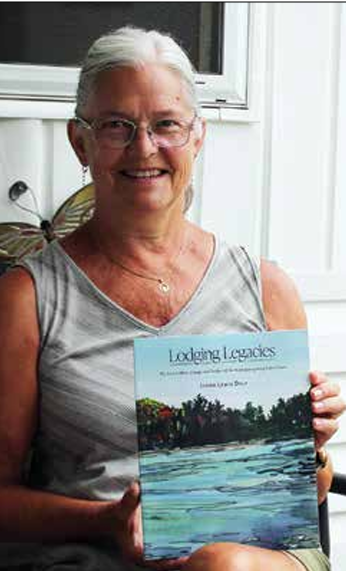
Linda Lewis-Daly has been coming to Northern Eagle Trailer Park since the 1960s. The park, off Caribou Road between Minden and Haliburton, sits on Lake Kashagawigamog.
She said it was her intention to write a book about Northern Eagle for association members, but that project morphed into the history of the lost cabins, camps and lodges of the five-lake chain. It’s titled Lodging Legacies.
“I always say that this is book two, and I haven’t finished writing book one yet,” Lewis-Daly said while seated at the kitchen table of her trailer recently.
She ended up researching and writing about 44 places, and the Golden Slipper dance hall. She knows there’s others, including B&Bs, but information was scant.
“A lot of the original owners have died, like the lodges themselves have died.”
Lewis-Daly said her strong connection to Northern Eagle, and the nostalgia it evokes, represent a “visceral connection” for her. She knew those who had stayed at all of those former cabins, camps and lodges would have the same reaction to seeing those establishments featured in a book.
“I just love the lake. This is our little piece of heaven. Driving up the 404, the minute we get off onto Ravenshoe Road, the world changes; your breathing changes. We just love being here.”
She began the work by visiting Master’s Book Store in Haliburton to see what had already been written. Owner Kathy Stouffer was a great source of information. She read about the pioneering days and settling of the County. She joined the Haliburton County Genealogy Group, to tap into their resources. She added, “it’s amazing what information you can find in obituaries.”
She then sought out former owners and other people associated with the cabins, camps and lodges to conduct a series of interviews. A self-described introvert, it took her out of her comfort zone. During those chats, she was told some interesting tales, even some ghost stories, including this one from the Wigamog Inn.
Ghost stories
“One of the owners’ wives had passed away. She was killed in a car accident. She had been very precise in how she taught the dining staff to set the tables. When breakfast was set the night before, and if it wasn’t set exactly the way she had taught staff, when they came back in the morning, everything had been changed.”
There was another tale at another establishment about blood appearing on barn walls, then disappearing again.
Lewis-Daly was able to get the words, but also needed images. She sourced some online, others from interviewees. She got permission to use images of Group of Seven paintings, three of which depict Haliburton County.
Lewis-Daly said she felt it was an important piece of history to capture now.
“The importance of the project for me was the story. Some of the storytellers are starting to leave us. Some of the lodge owners that are still with us are in their 90s.”
She thinks Highlanders are good at telling stories orally, but not writing them down.
It’s been a true labour of love, with the author starting casual research before the pandemic. She recalled hosting guests from Lost Haliburton Boat Tours aboard the Lady of the Lake at Northern Eagle, which has an historic farmhouse from the late 1860s. One of the guests was looking for a red brick inscribed by family members and they found it. “Just watching her excitement sparked me to delve into that.”
Asked about the lost cabins, camps and lodges, Lewis-Daly said, “this was the heyday of tourism, and tourism is what has made the character of Haliburton County. And tourism, just like everything, has evolved and is changing. It is less the lodges and more the individually-owned cottages and income properties.”
She said the transient nature of short-term rentals is changing that history, “as opposed to guests becoming family members of the owners, and the forming of lifelong friendships.”
Lewis-Daly said she is excited the book is out there. “My goal now is for people to read it and to have the book invoke their own memories. Or to help people understand the history of tourism and how it’s changed. The reception has been really great.”
The book is available at Master’s Book Store in Haliburton.