
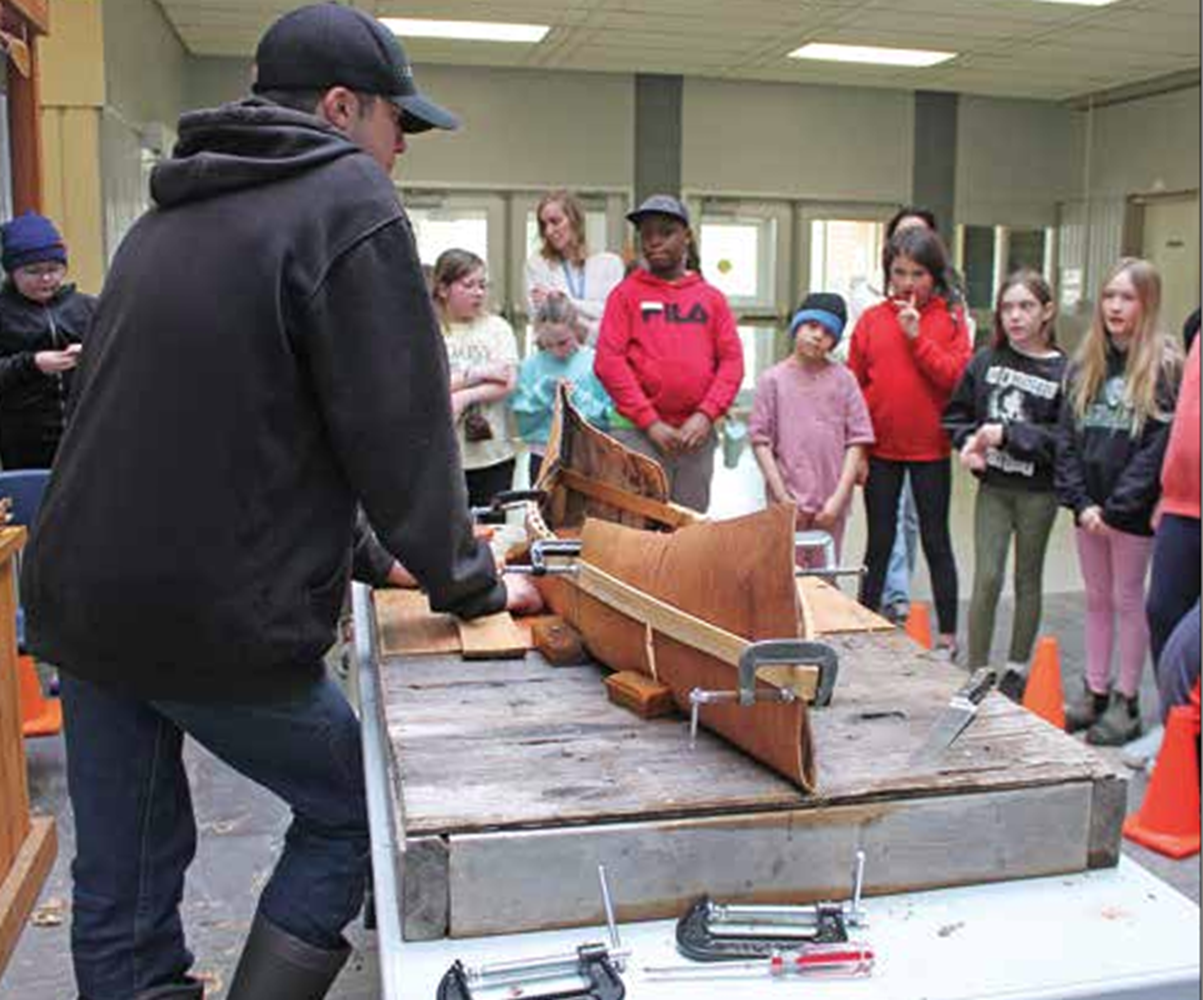
Alex Labelle built a four-foot birch bark canoe last week while fielding questions from students at J. Douglas Hodgson Elementary School.
Some of the queries included how much bear fat he uses in waterproofing his crafts; if he has ever sunk a canoe; and how old he is.
Trillium Lakelands District School Board’s Indigenous student success team and Indigenous guides at JDH and Stuart Baker elementary school brought the 20-year-old in last week.
Labelle built the canoe in the JDH foyer using traditional practices.
He is a Métis canoe builder of Algonquin ancestry from Mattawa. He learned the craft from his grandfather, Marcel Labelle, and shares his knowledge with others through presentations and in-house construction of canoes.
While working on the canoe last week, Labelle told The Highlander he mixes the bear fat with spruce gum as a sealant. He added, “the bear in our culture is also a strong, protective spirit, so we’re protected on the water.”
Labelle said his grandparents taught him not just about canoes, but about the outdoors and living off the land, including trapping, hunting and fishing. “You learn from the older generation.”
Labelle said his grandparents were his daycare, after school, and on weekends, so he has been trailing them since he was a toddler.
“That’s why I enjoy the process of building canoes. It’s a sense of peace; just slows everything down, and requires patience. You’re working with natural materials. They are not going to be perfect. Just taking your time is a big lesson.”
He has been going into schools since he was 14. He thinks kids relate to him because of his age.
“The big thing is connection. I hope – if people are separated by beliefs, or anything that causes them not to be friends – that seeing that connection is important. Because connection is what brings this canoe together.
“I hope they take away that you need to slow down in life. Bad things happen when you speed through. Sometime it’s okay to take a step back and realize how far you’ve come.”
JDH Grade 5 teacher Erin McKnight-Sisco said Alex’s visit was part of a joint learning series. Every month or so, they have hosted an Indigenous guest with a different background or ancestry.
She said the theme is “what does it mean to be a good ancestor?” She hoped Labelle’s visit would connect students with nature. She said there were also learnings in science, technology, engineering, math and social studies.
Sherry Telford of the Indigenous program added, “canoeing is a passion for many in Haliburton County, so there’s a natural interest in how canoes have been traditionally built in this area. If we look carefully in the forests, every material in the canoe can be found near us.
“As we observed and asked Alex questions, we learned about Indigenous culture and understandings, in this case Algonquin and Métis, and about the gifts that each material in the canoe provides in order for the canoe to function. We learned about respectful harvesting, so there is always enough for others and for future generations. We witnessed perseverance, problem-solving and patience. To me, that’s amazing learning.”