
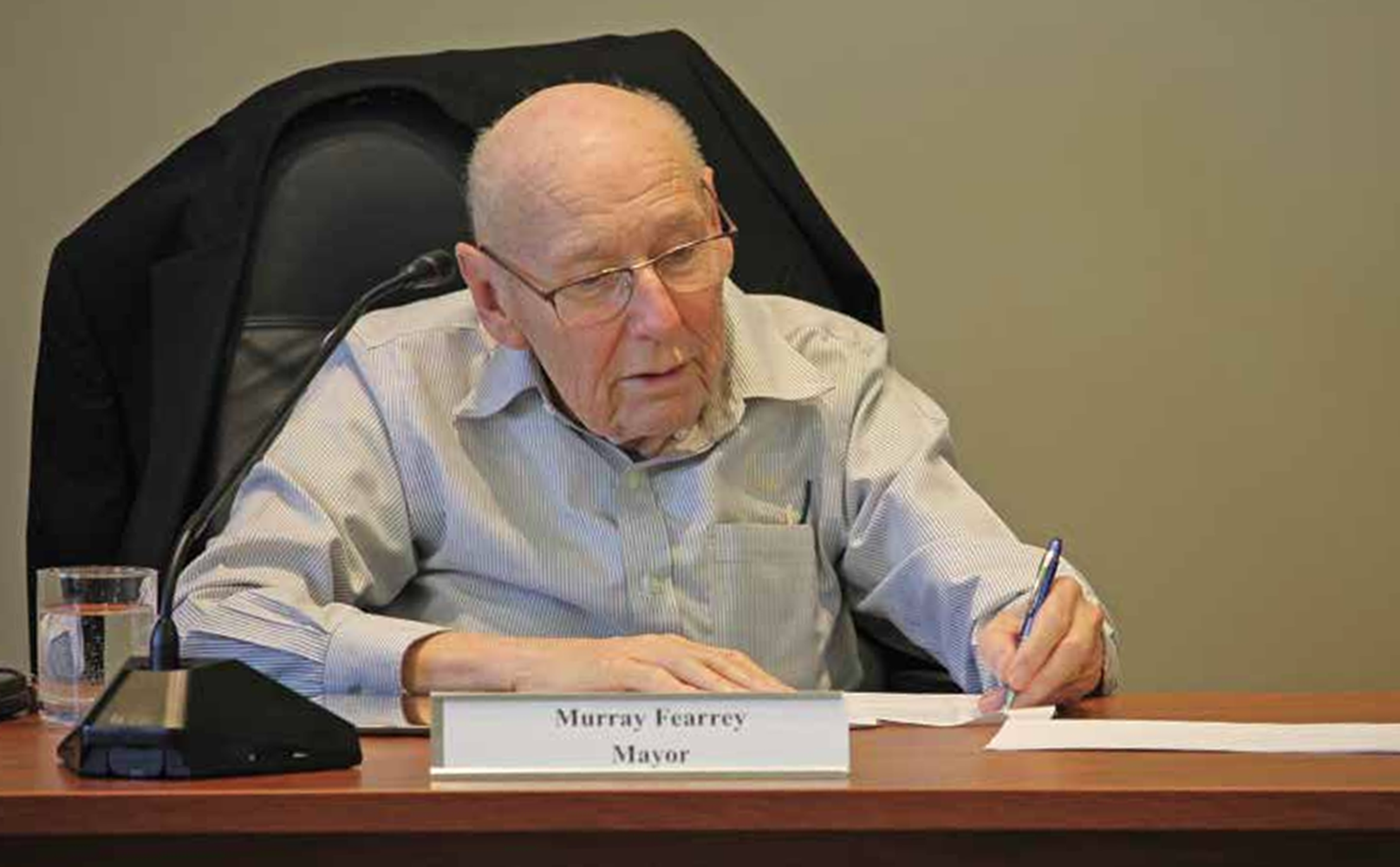
Dysart et al mayor Murray Fearrey told the rest of council “I’ve done a lot of these things, this is the worst I’ve seen in terms of flexibility,” after presenting the township’s first-ever mayoral budget Dec. 12, carrying a 5.83 per cent tax increase for local ratepayers.
This is the first set of financials tabled since Ontario Premier Doug Ford extended Strong Mayor Powers to Fearrey last May. He, and Minden Hills mayor Bob Carter, were two of 216 heads of council to be awarded greater control over municipal budgets last year.
At last month’s meeting, Fearrey said he had spent weeks working alongside Dysart’s new treasurer, Brayden Robinson, and department heads to find efficiencies in the budget, with an initial draft coming in at 7.2 per cent in October.
“But that didn’t have any projects in it – no new roads, nothing. If we had stuck to that and then put everything else in that we need, it would have been an increase of 15 per cent or more. That’s just not acceptable,” Fearrey said.
The 5.83 per cent hike equates to an increase of $20.51 per $100,000 of a residential property’s assessed value, or $46.98 on a median single-family home. For seasonal properties, that climbs to an annual increase of $83.08.
As a result, Robinson said the typical homeowner in Dysart will now pay $372.69 per $100,000 of assessment. He noted 78 per cent of the municipality’s taxbase is residential.
On the commercial side, businessowners can expect an increase of $30.42 per $100,000 of assessment, with industrial property owners seeing a hike of $35.25 per $100,000.
“We made a lot of cuts to get here… but we’re still at 5.83 per cent and that’s not great in these times, with the way people are struggling, but it’s about as good as we can do without drastic cuts to services,” Fearrey said.
With Dysart’s wastewater costs for the year reflecting a 5.1 per cent increase for ratepayers, to go with the 4.38 per cent hike already approved by the County, Fearrey said it’s going to be a taxing year for property owners. He laid the blame at the feet of the provincial government.
“It’s a slippery slope we’re on. There’s no end to municipal debt, the way the province is funding things right now. Unless they find another source to give us, everything is on the property tax. That’s not fair,” Fearrey said. “There’s all kinds of things they could share with us a little bit to take us out of this hole, but they haven’t done that.”
This is only the first draft of the budget, with council having an opportunity to provide further feedback Jan. 9, so none of these figures are set in stone.
The numbers
The township’s operating expenses are increasing by more than $1 million from 2025, up to $17.76 million. The biggest driver, Robinson said, is an 11 per cent increase to policing costs, with the OPP billing an extra $462,061 for services.
Dysart’s wage-related costs are up 5.4 per cent, or $389,204, with an additional $186,794 going towards maintaining the municipal fleet. The remaining $119,188 is earmarked for landfill costs, with increases to garbage tonnage and hauling costs.
The most significant spend on the operating side is in the transportation department, accounting for 25.5 per cent of costs ($4.5 million), with protection services just behind at 24.21 per cent ($4.3 million). The environmental budget, for landfill costs, accounts for 13.6 per cent ($2.4 million); parks and recreation at 13.4 per cent ($2.4 million); and administration at 13.3 per cent ($2.35 million).
Robinson told council there’s $8.96 million of capital project expenditures included in the budget, with $2 million funded through taxation, $4.5 million through new long-term debt, $1.86 million through reserves and $495,611 via federal and provincial grants.
Robinson said Dysart will be at 16 per cent of its annual debt repayment limit under this budget – the province stipulates municipalities cannot exceed 25 per cent though Robinson said he’d be more comfortable capping it at 15 per cent. The township will pay $503,000 servicing its debt in 2026.
A good chunk of the capital budget, at $3.8 million, is going towards the replacement of the Redstone Brook, Barry’s Bay and Head Lake Park bridges; $1.28 million is earmarked for the rehabilitation of sidewalks on Highland Street; $866,100 set aside for vehicle replacements, including a new tandem plow, one-tonne pickup and fire truck; $720,643 needed for retaining wall repairs, waste bin retrofits, transfer station design at the Haliburton and Harcourt landfills, and capping at the Kennisis Lake and West Guilford landfills.
Just over $1.5 million is being spent resurfacing a dozen roads in the community, including the entirety of the Halbiem Crescent subdivision and portions of Fred Jones Road, Wenona Lake Road, Meadowview Road, Industrial Park Road, Eastern Avenue, Pine Avenue, Humber Avenue, Dome Street, Harmony Road and Mink Road.