
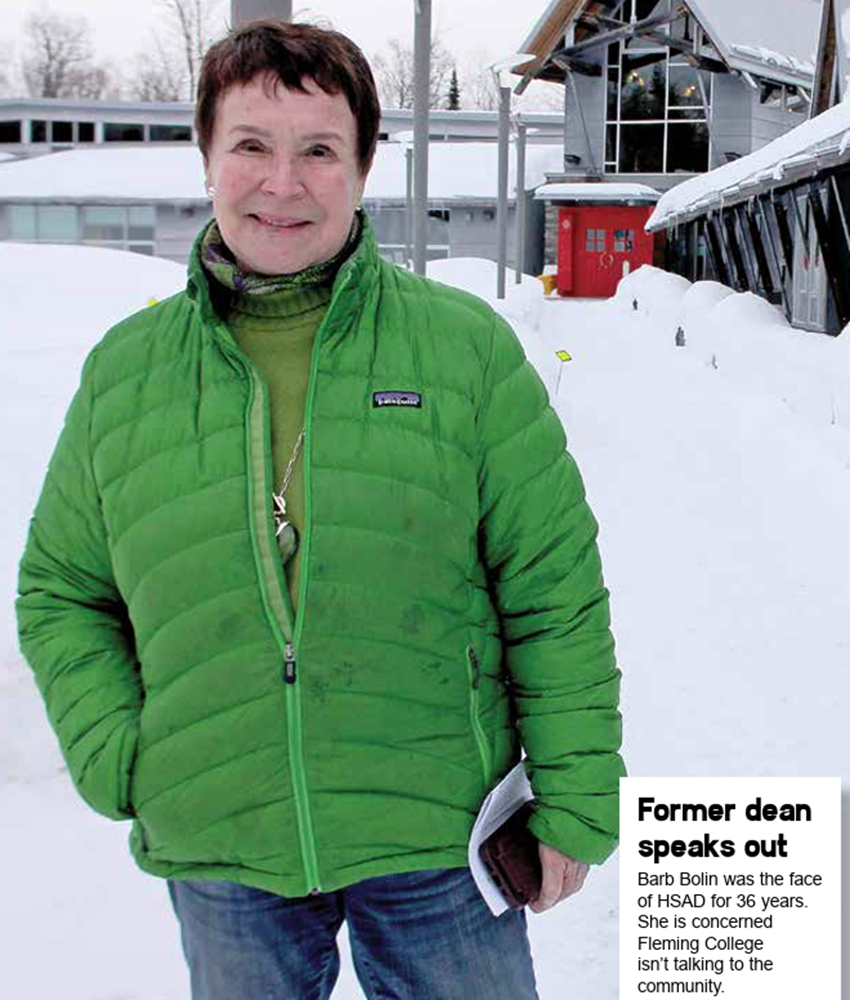
Former dean of Haliburton School of Art + Design (HSAD), Barb Bolin, and Dysart et al mayor, Murray Fearrey, say they are both concerned about the future of the college after the termination of dean Xavier Masse.
Peterborough-based Fleming College, of which HSAD, Peterborough and Lindsay campuses are a part, confirmed last week that Masse was no longer with the college.
Masse declined to comment and the college said “out of respect for employee privacy, the college will not be sharing additional personal details.”
The Highlander this week requested an interview with interim college president, Dr. Theresa Knott, and board of governors’ chair, Don Gillespie. However, the college told us, “unfortunately, Dr. Knott and Mr. Gillespie are not available for interviews at the moment.”
They issued a statement instead that said: “Fleming College remains committed to the long-term sustainability of its campuses, including the Haliburton School of Art + Design, and the delivery of quality education. The college has made the difficult decision to eliminate the senior executive lead at the campus and invest in programming that is student-focused and community-centred. The operations of the campus will not be disrupted, and HSAD is planning for exciting spring and summer sessions.
“HSAD will continue to offer unique and flexible programs taught by creative professionals in a one-of-a-kind studio environment, and the Haliburton campus remains an important part of Fleming College’s academic and community presence.”
Highlander questions, such as how Fleming plans to ensure the long-term stability of HSAD; or how operations would not be disrupted with a key position eliminated, remain unanswered.
According to the Sunshine list, Masse was paid $164,163 in 2024.
Public has yet to see inside new residence
Surprise announcement
It appears the decision to eliminate the dean position came as a surprise to the college and community.
Bolin said it’s well-known Ontario colleges have been struggling financially since the federal government capped the number of foreign students starting January 2024.
The Haliburton campus was the only Fleming-operated site to escape widespread program cuts after the limits were imposed. Twenty-nine programs in Peterborough and Lindsay were scrapped, with then Fleming president Maureen Adamson estimating the cap would mean a $40 million annual revenue loss for the college. At its peak, the institution reported 4,000 of a total 7,200 students were international. Last March, a college spokesperson said the impact in Haliburton has been negligible but warned changes could be on the horizon.
Bolin understands that but wishes the Peterborough head office would have talked to the community. She said the Haliburton campus exists because of support from community organizations, politicians, and individuals.
“So, I’m surprised and disappointed that the leadership at the college has not reached out to any of them to talk about ways of making the campus here more viable. The community here is interested in what’s going on with the campus leadership, and programming, but there has, to my knowledge, been no effort by the college leadership to reach out to us.”
Fearrey said he’s had little success meeting with college leadership to discuss its longterm future, other than advising Masse “you’ve got to diversify here. You can’t just do art. If you do other things … get some revenue in.” He said Bolin were successful at doing that during her tenure.
The mayor said it’s discouraging “because I want to know what the future is. What are we doing here? They’re closing colleges around us.”
No one on board
Bolin said there is no board of governors representative in Haliburton that she knows of. She said she recommended a local for a board position years ago; the person applied but received no response.
“I’m very concerned that there’s not a board of governor rep up here. But we have had lots of past board members who are very active in the County and could give feedback to the board, and leadership of the college, about concerns.”
As for no longer having a dean, Bolin added, “long-term leadership is so important so that the person can deal with campus issues, and community issues. That’s part of the whole thing with community colleges.”
Commenting on the college’s stance that operations will not be disrupted, Bolin said “I don’t know how existing staff would have time to do all of that (work).
“I’m very concerned about what the direction of the campus is, and how the campus is going to be promoted, and specifically how the campus is going to be led in any direction.”
Further speaking to a disconnect between the college and community, she said Fleming had not even offered tours of its new student residence in Haliburton. There was never a grand opening either. Dysart et al donated land for the build.
“It does feel disrespectful to me…to the community…to not be in touch with the community to tell us the direction, ask for input, talk to us about where they see the campus going,” Bolin reiterated.
Provincial funding
On Feb. 12, the province announced changes for post-secondary education in the fall, including $6.4 billion in new funding for the sector over four years, touted as a 30 per cent increase, including to help meet the needs of rural institutes.
There is an updated tuition framework. Ontario will allow publicly-assisted colleges and universities to raise tuition by up to two per cent per year for three years, then up to two per cent or the three-year average rate of inflation, whichever is less, after that.
There will also be alterations to the Ontario Student Assistance Program (OSAP) system. Ontario students will be eligible to receive a maximum of 25 per cent of their OSAP funding as grants and a minimum of 75 per cent of their funding as loans. OSAP will no longer offer grants to students at private career colleges, in alignment with changes made by the federal government to its own student support funding.
It is not known what impact any of this will have on HSAD.
Bolin said “once you divide it among all the colleges and all the universities, I don’t know that it’s a huge impact, and does it have strings attached to it? I don’t know.” There are 56 post-secondary schools in Ontario.
The college said Feb. 12 it welcomed the news. “This generational investment is exciting news for Fleming College and the students and communities we serve. The college is grateful for the province’s commitment and looks forward to reviewing its allocation details.”